How to Implement AI Marketing Automation for Your Business
Customer data is scattered across websites, social media, sales systems, and Excel files. Meanwhile, campaigns still run on fixed schedules, and teams have to manually segment audiences, send messages, and track responses. AI Marketing Automation helps businesses connect data with marketing workflows to segment audiences, personalize interactions, and trigger engagement based on behavior. But AI does not replace strategy or guarantee results: performance still depends on data, objectives, and how the system is operated. This article explains what AI Marketing Automation is, how it differs from traditional Marketing Automation, how businesses can use it, and what a practical implementation roadmap looks like.
1. Overview of AI Marketing Automation
1.1 What is AI Marketing Automation?
Before getting started, it helps to understand two concepts: (1) Marketing Automation uses software to carry out marketing activities based on predefined rules and conditions—for example, sending content after someone signs up or moving a lead to the next stage of nurturing. (2) AI Marketing applies artificial intelligence to support data analysis, identify behavioral signals, create content, or recommend actions. These concepts are related, but they are not interchangeable: Automation executes workflows; AI supports analysis and decision-making.
AI Marketing Automation combines artificial intelligence (AI) with Marketing Automation to help businesses analyze data, identify customer behavior, personalize interactions, and automatically carry out marketing activities according to suitable scenarios or conditions. AI supports analysis and recommendations, while the Automation system executes actions that have been configured or approved. The level of automation depends on the platform’s capabilities, data quality, and business processes.
1.2 How does AI Marketing Automation work?
The process can be understood as three connected layers:
- Data layer: Collects, unifies, and standardizes customer data from sources the business is permitted to use.
- AI layer: Analyzes signals, identifies behavioral groups, supports content creation, or recommends actions. The level of analysis depends on the AI’s capabilities and the data available.
- Automation layer: Triggers workflows, sends messages, applies tags, follows up, or routes leads according to configured conditions.
For example, interaction data may help identify a customer who asked about a product but has not responded. AI can help identify the customer’s status or suggest a next step; a workflow sends a follow-up or routes the lead only if that condition and process have been configured or approved. Incomplete, duplicated, or outdated data reduces the usefulness of analysis and automation.
2. How is AI Marketing Automation different from traditional Marketing Automation?
Traditional Marketing Automation typically operates according to “if–then” rules. AI Marketing Automation can add behavioral analysis and decision recommendations, but it does not guarantee that every recommendation will be accurate.
| Criteria | Traditional Marketing Automation | AI Marketing Automation |
|---|---|---|
| Mechanism | Executes predefined rules and scenarios | Combines rules with data analysis, pattern recognition, and AI recommendations |
| Segmentation | Based on manual conditions such as signup source or order status | Can support segmentation based on attributes and behavioral signals |
| Personalization | Content based on configured groups or data fields | Can support content adjustments based on context and interaction history |
| Scenario setup | Marketers build each branch and condition | AI can help suggest branches, content, or conditions; human review is still needed |
| Behavioral analysis | Tracks events configured in advance | Can analyze more signals if data is connected and sufficiently high-quality |
| Interaction timing | Based on a schedule or fixed condition | Can help recommend suitable timing based on available signals |
| Performance | Depends on scenario design and manual updates | Can support testing and optimization; performance must be measured in practice |
| Decision support | Reports configured metrics | Can add analysis, identify trends, and recommend actions |
AI-powered analysis, prediction, and optimization capabilities vary between platforms. Businesses should check the actual features, input data, and level of automation before choosing a solution.
The two approaches can be combined. Stable, predictable processes remain well suited to automation rules. AI can help process complex data, suggest content, or identify signals for marketers to review. Marketers remain responsible for strategy, messaging, budgets, and final decisions.
3. How can businesses use AI Marketing Automation?
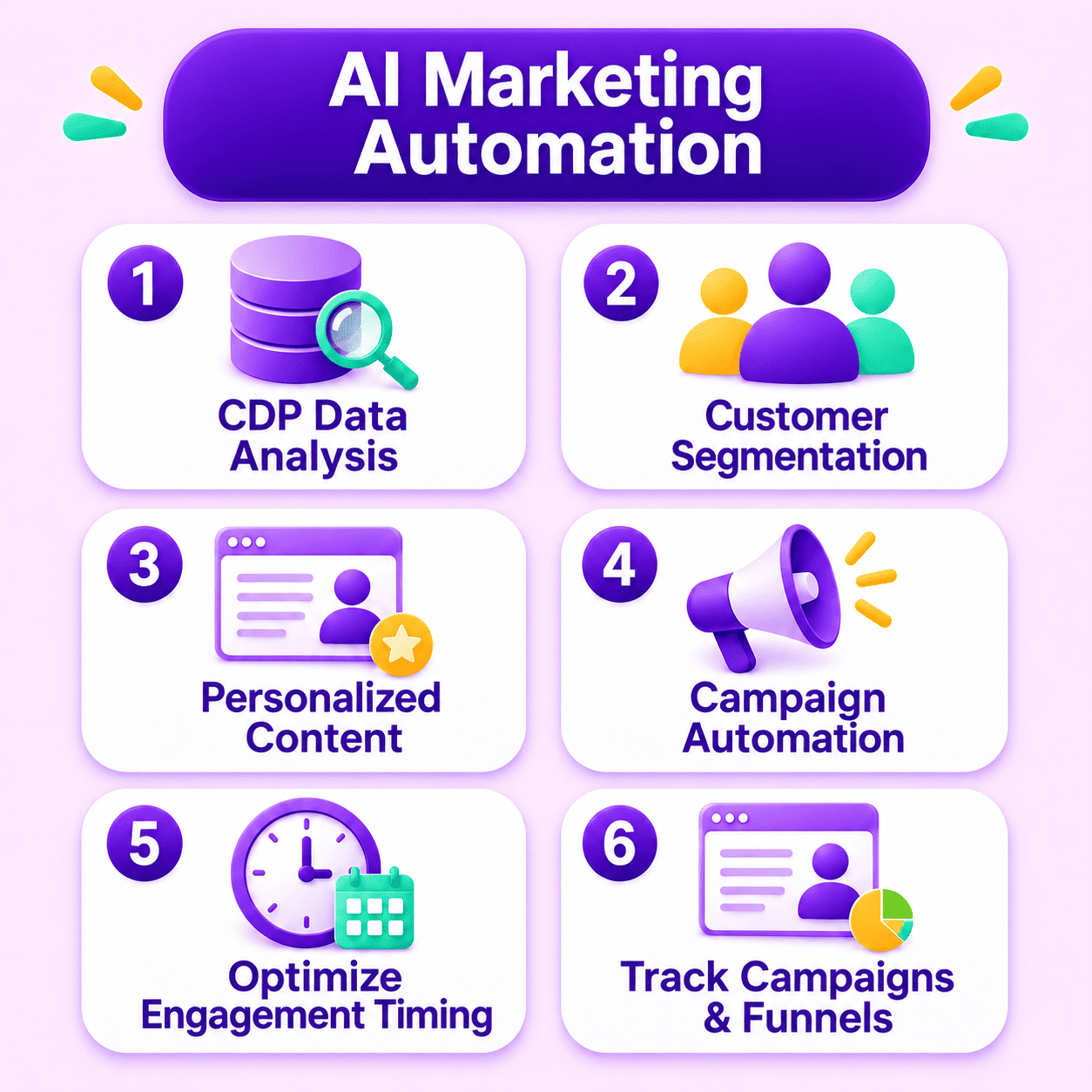
Effective use of AI in marketing usually starts with a specific process, rather than implementing a tool and then looking for a use for it. Below are six common application areas.
3.1 Analyze customer data with a CDP
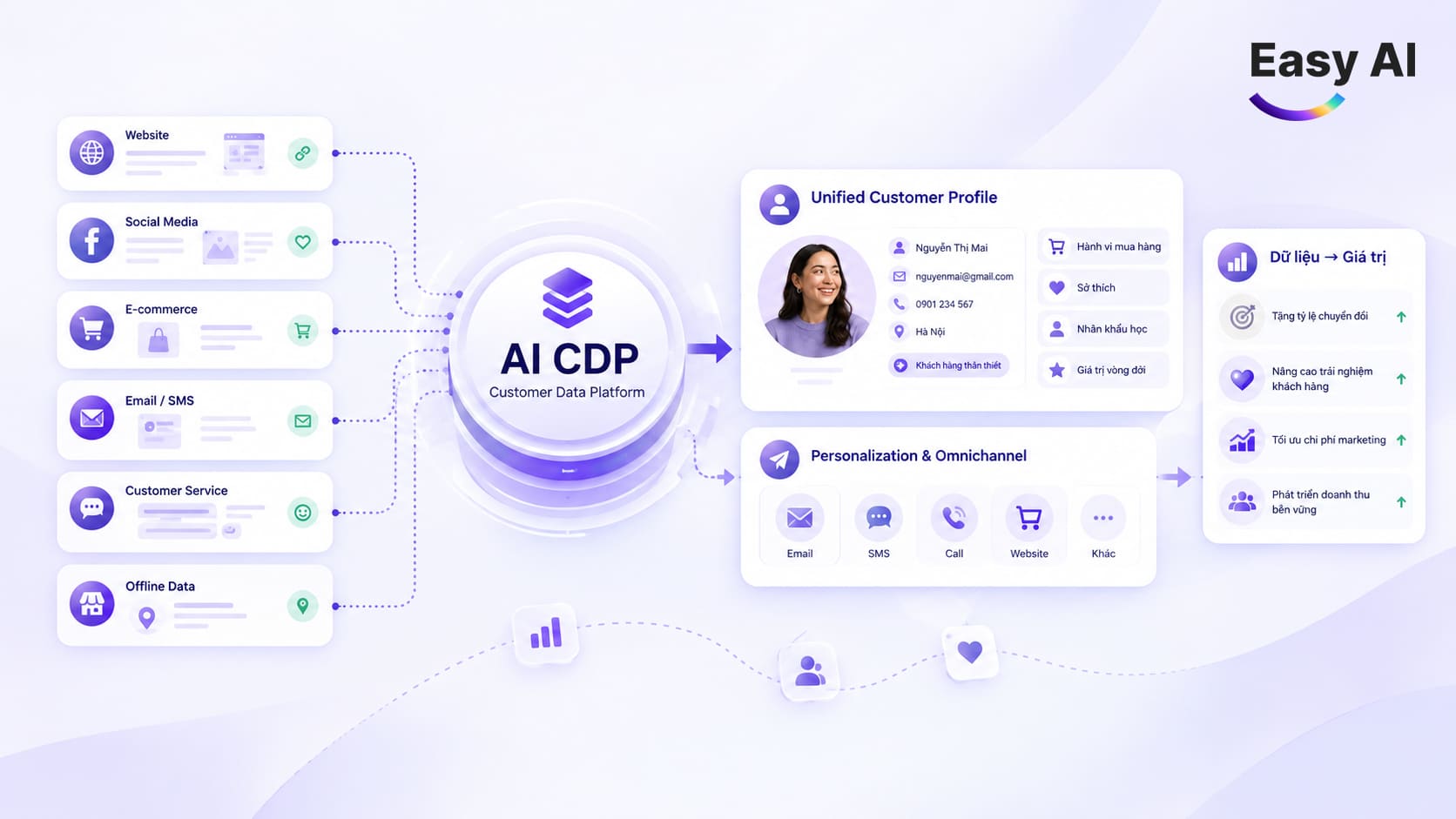
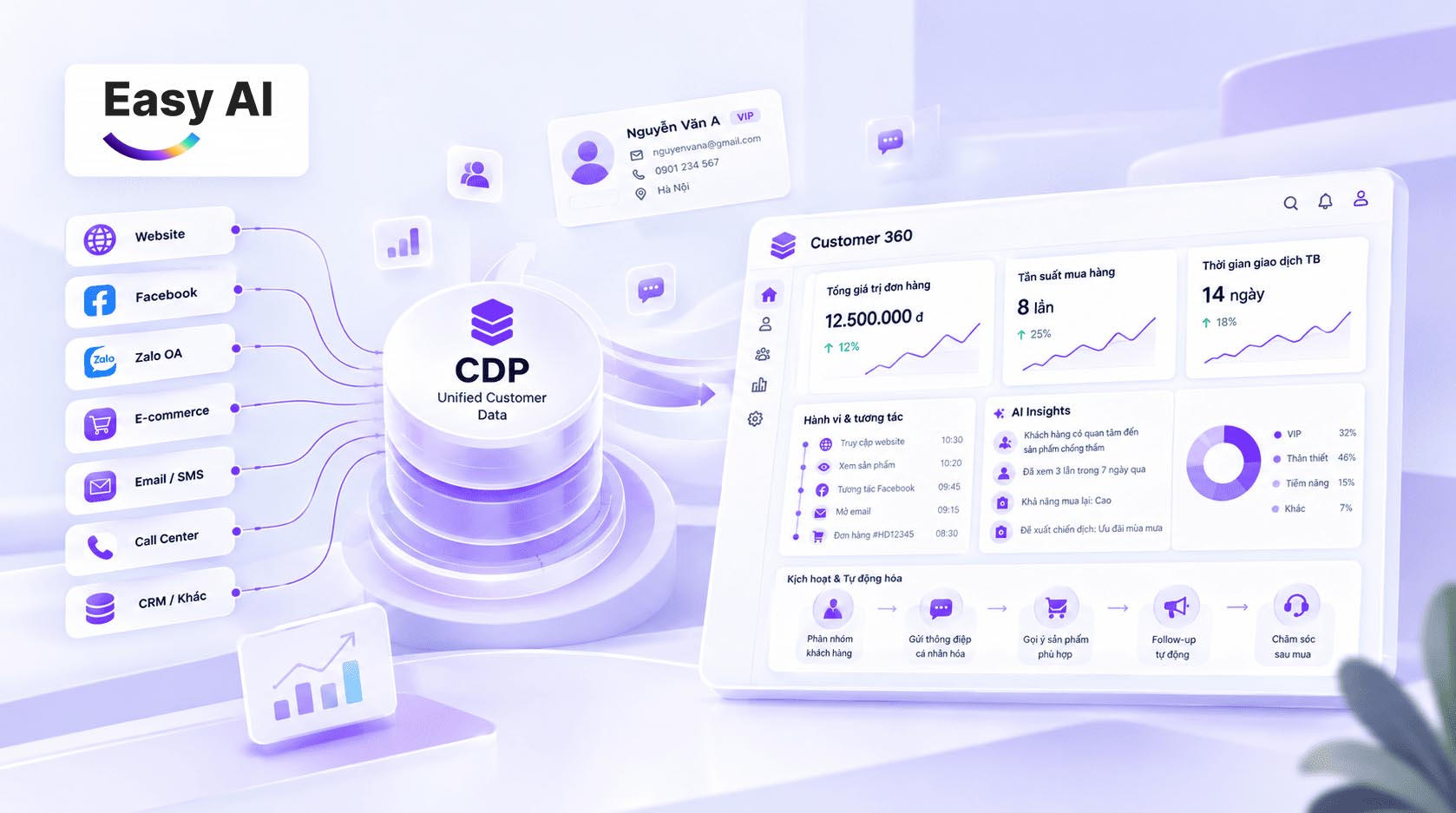
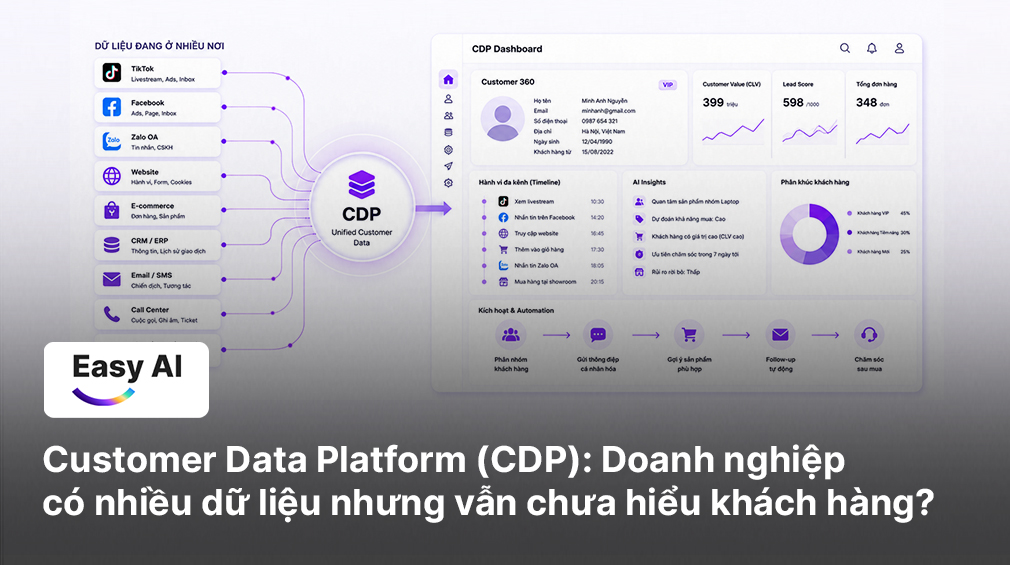
A Customer Data Platform (CDP) helps unify customer data from sources such as websites, points of sale, conversations, and sales systems using appropriate identifiers. Unified profiles support the creation of a Customer 360 view and journey analysis.
A CDP is not the same as a CRM. A CRM primarily supports relationship management, sales opportunities, and team activities; a CDP focuses on unifying customer data from multiple sources for analysis, segmentation, and engagement. A CDP does not automatically include AI; advanced analysis, prediction, or automatic segmentation depend on the features of each platform and how the business implements them. “AI CDP” is often used to refer to a CDP integrated with certain AI capabilities.
3.2 Segment customers by attributes and behavior
Customer Segmentation can be based on information such as location, products purchased, page views, conversation history, or time since the last interaction. AI can help identify groups with similar behavior, but businesses need to check whether those groups align with their business objectives.
3.3 Personalize content and recommendations
Personalized Marketing uses data about customer needs and behavior to tailor messages, suggested products, or content for each group. Personalization can be useful when a customer has viewed a product line, but that does not mean every tracked behavior should be sent to the customer. Frequency, content, and privacy all need to be managed.
3.4 Automate campaigns, Lead Nurturing, and Sales handoff
Marketing Workflow Automation can trigger a nurturing sequence when a customer signs up, downloads a document, asks about a product, or does not respond after a set period. When a lead meets agreed criteria, the system can pass its information and interaction history to Sales.
Illustrative example: A customer fills out a consultation form on a website but does not choose an appointment time. The system sends helpful information by email; if the customer responds or leaves a phone number, the information is passed to the responsible employee. This is an illustrative example, not a published customer result.
3.5 Optimize interaction timing and context
The Right Message–Audience–Time objective is to send the right message to the right group at the right time. AI can help analyze signals about interaction timing or level of interest. Marketers need to check recommendations in practice and set frequency limits to avoid bothering customers.
3.6 Track and measure campaign and funnel performance
AI can help consolidate Campaign Performance data and track customers as they move from interaction to lead, sales opportunity, or order. The value lies in connecting marketing data with business outcomes, rather than viewing opens or clicks in isolation.
| Application | Data or signals | Possible automation | Relevant KPIs |
|---|---|---|---|
| Data analysis/CDP | Interaction sources, transactions, conversations, identifiers | Unify and update profiles according to configuration | Unified profile rate, data completeness |
| Customer segmentation | Attributes, products viewed or purchased, interaction frequency | Assign groups based on conditions or behavioral signals | Segment size, response rate |
| Content personalization | Preferences, interaction history, Customer Journey stage | Send content or recommendations relevant to the group | CTR, Engagement Rate, Conversion Rate |
| Lead Nurturing and follow-up | Forms, conversations, clicks, lead status | Send nurturing sequences, reminders, and Sales handoffs | Lead Qualification Rate, Response Rate, Conversion Rate |
| Timing/context optimization | Interaction and response history | Recommend or trigger engagement based on conditions | CTR, responses, conversions by group |
| Campaign/funnel tracking | Costs, interactions, leads, opportunities, revenue | Consolidate reports and alerts based on thresholds | CPL, CPA, CAC, Revenue Attributed, ROAS |
4. Benefits of AI Marketing Automation
When connected to data and real workflows, marketing automation can help businesses:
- Reduce repetitive tasks: Automatically sending content based on conditions, applying tags, or prompting follow-ups gives teams more time for work that requires judgment and creativity.
- Personalize at scale: Segmentation and interaction history can make content more relevant to each group’s needs.
- Make better use of data: A CDP and behavioral analysis provide a clearer view of the customer journey, rather than showing each channel in isolation.
- Nurture leads and hand them over to Sales: Workflows can record signals of interest, track next steps, and route information to the right team.
- Manage performance: Dashboards that connect campaign metrics with the funnel and revenue help marketers evaluate activities against their objectives.
5. How to implement AI Marketing Automation in your business
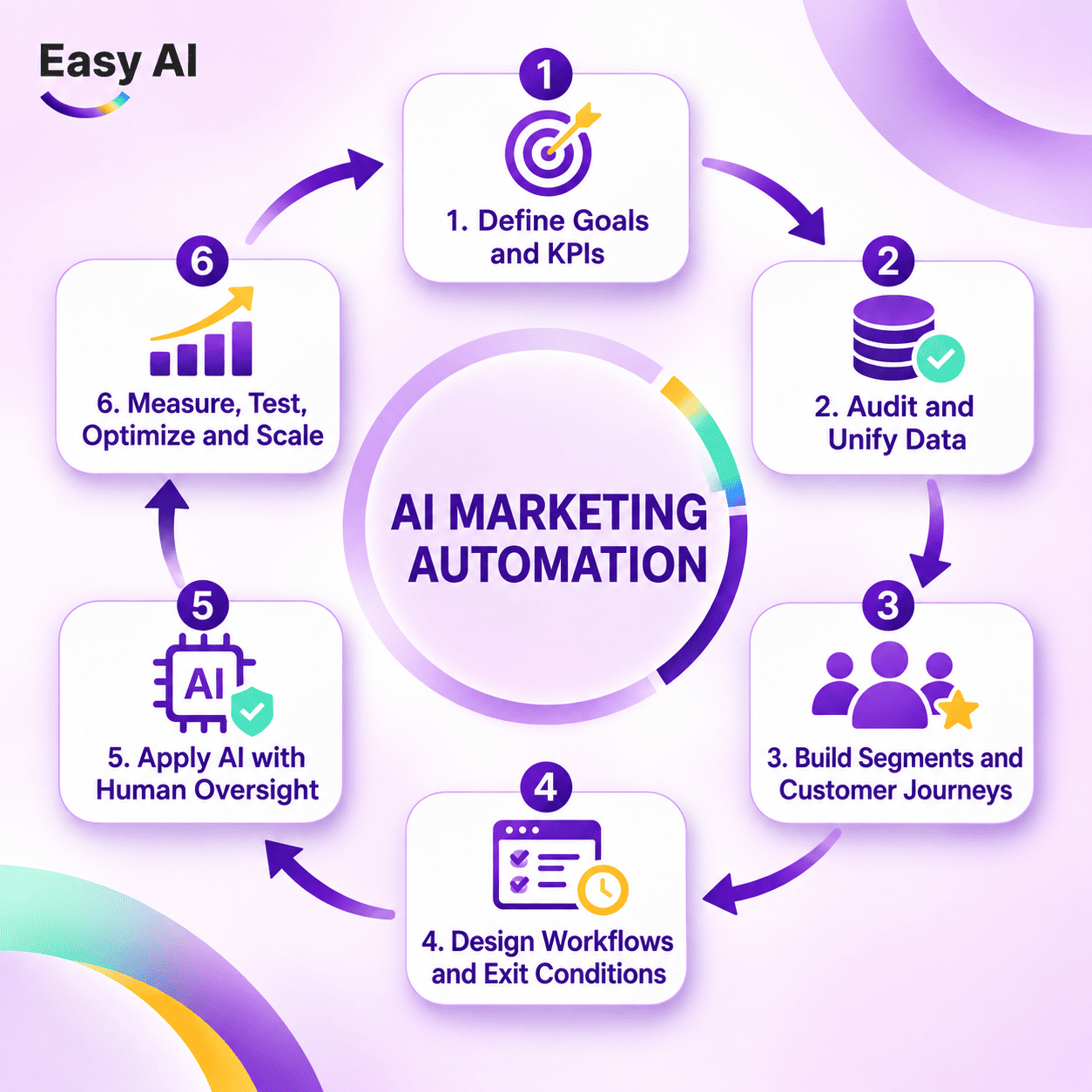
- Step 1: Define objectives and KPIs
Choose a specific objective, such as increasing the number of qualified leads, reducing follow-up time, or measuring revenue from a group of campaigns. Set KPIs before choosing a tool to avoid automating a process that does not create clear value.
- Step 2: Audit and unify your data
List the data held in your website, sales system, social media, POS, CRM, or internal files. Check identifiers, duplicate records, freshness, and access permissions. If you need to build a Customer 360 view, consider a CDP as a layer for unifying and using the data.
- Step 3: Build segments and map the Customer Journey
Identify the customer’s stage: newly aware of the brand, considering a purchase, already purchased, or due for re-engagement. Each segment should have a specific objective and action.
- Step 4: Design scenarios and stop conditions
For each workflow, define the trigger event, sending channel, content, conditions for moving to the next step, and stop conditions. For example, stop a purchase reminder sequence if the customer has already bought; if a customer asks to speak with an employee, route the request for manual handling.
- Step 5: Use AI with human review
Use AI to support analysis and suggest segments or content. Set up an approval process for important messages, check outputs before sending, and define when an employee should take over.
- Step 6: Measure, test, optimize, and scale
Run a test with a suitable group, compare it with the current approach, and track the selected KPIs. Scale only when the data, processes, and ownership of follow-up actions are clear.
6. Data governance and privacy in Marketing Automation
Before expanding workflows, businesses should establish clear data governance principles:
- Restrict data access according to roles and work requirements.
- Define the purpose of data use and an appropriate basis before sending marketing communications.
- Manage consent, opt-outs, and requests to stop contact across channels.
- Set frequency limits and check exclusion conditions to prevent duplicate or intrusive messages.
- Keep records of workflow triggers and configuration changes to support reviews.
- Control the data entered into AI systems; define a separate process for handling sensitive data.
Businesses should assess these governance principles against their own processes and applicable obligations. This list should not be treated as confirmation that any specific platform fully meets every requirement.
7. Which KPIs can measure AI Marketing Automation performance?
KPIs should align with campaign objectives and the Customer Lifecycle Marketing stage. Engagement indicates that a customer has responded to content; it does not, on its own, prove that revenue has increased. Reach is the number of unique people or accounts reached; Impressions is the total number of times content was displayed. CTR should be interpreted using the denominator for each channel and the platform’s measurement method. For email, Open Rate can be affected by privacy protection mechanisms and may not reliably reflect interest. ROAS typically compares attributed advertising revenue with advertising costs; ROI requires the full scope of investment costs and benefits to be defined, so the two metrics are not interchangeable.
| Group | KPI | Meaning and interpretation |
|---|---|---|
| Reach | Reach / Impressions | The number of people reached or times content was displayed; useful for tracking distribution |
| Engagement | Open Rate | The percentage of emails or measurable messages opened; should be considered alongside list quality and platform conditions |
| Engagement | CTR | Click-through rate based on impressions or sends, depending on the system’s calculation |
| Engagement | Engagement Rate | Engagement level based on each channel’s formula; the denominator should be consistent when comparing |
| Leads | Number of Leads | The number of contacts or opportunities recorded according to the business’s definition |
| Leads | Lead Qualification Rate | The percentage of leads that meet qualification criteria agreed with Sales |
| Conversion | Conversion Rate | The percentage completing a target action; the action and denominator should be specified |
| Cost | CPL / CPA / CAC | Cost per lead, conversion action, or new customer; definitions may differ between businesses |
| Response | Response / Follow-up Rate | The percentage receiving a response or follow-up within the specified time frame |
| Revenue | Revenue Attributed | Revenue credited to a campaign according to the selected attribution model |
| Investment performance | ROAS / ROI | ROAS compares advertising revenue with advertising costs; ROI evaluates investment performance according to the defined formula and cost scope |
Three types of conversion should be distinguished: campaign conversion, conversion within a conversation, and business conversion such as an order or revenue. To track continuously from advertising to transaction, businesses need tracking, identification, and data integration across relevant systems. They also need to agree on an attribution model: which touchpoint receives credit for revenue, over what period, and according to which rules.
8. Case studies: How businesses use AI Marketing Automation to optimize operations with Easy AI
Running marketing campaigns on fixed schedules or through manual processes causes many businesses to miss opportunities to reach customers at the right time. When data is scattered across websites, social media, sales systems, and service touchpoints, personalization and Lead Nurturing become fragmented.
Easy AI’s AI Marketing Automation solution addresses this challenge by connecting the customer data layer (AI CDP) with a scenario automation system, helping businesses personalize interactions at scale and optimize performance across the conversion funnel. Here is how large businesses have successfully applied the solution:
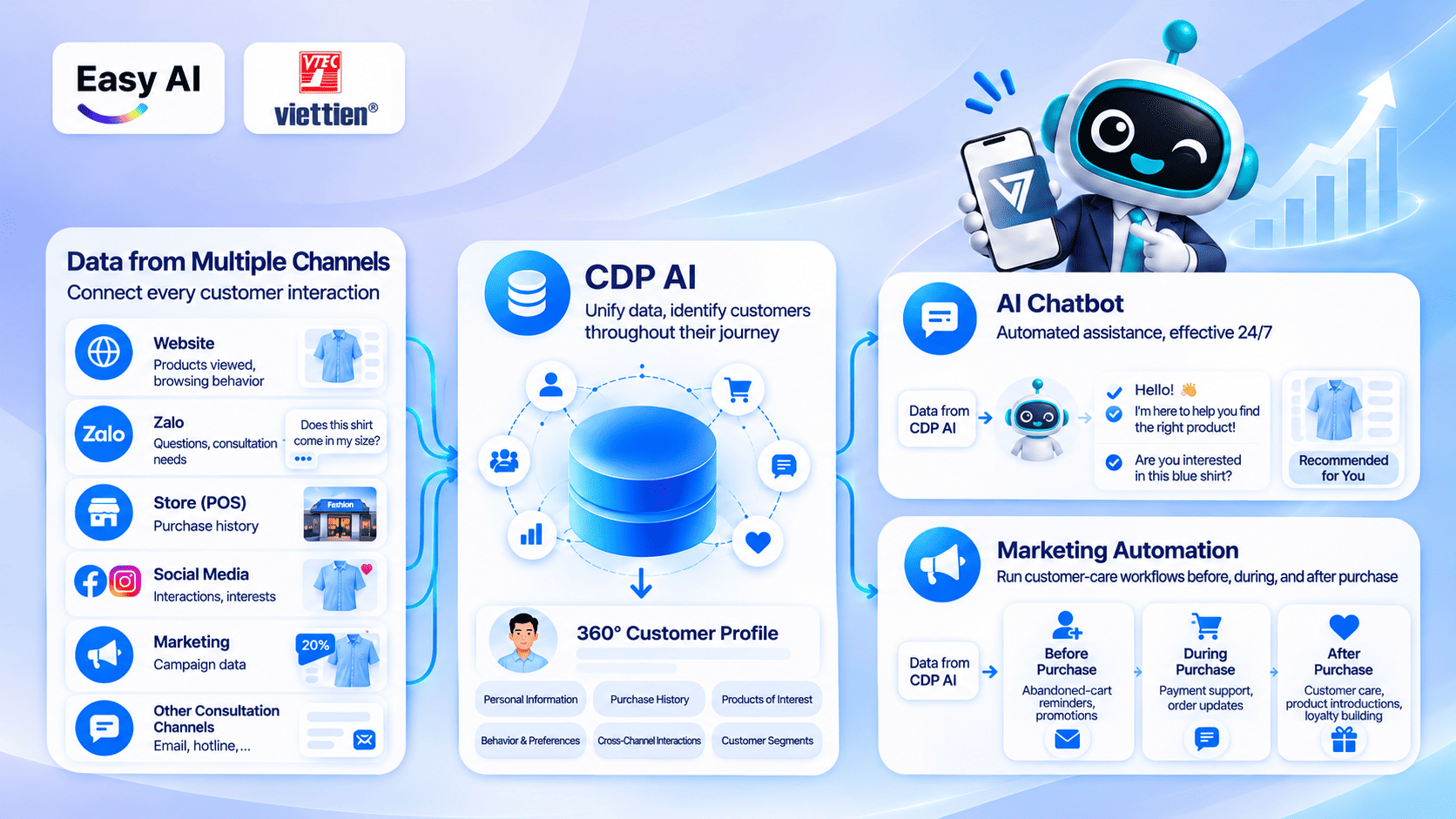
Viettien: Unifying data and personalizing the customer care journey
- Challenge: After nearly 50 years of growth, with a network of more than 1,300 stores and agents as well as online channels (Website, Facebook, Zalo), Viettien had a huge but fragmented volume of data. Each department (Sales, Marketing, Customer Service) held part of the information, making it difficult to identify customers consistently across channels and implement personalized care scenarios.
- Solution: Easy AI implemented an AI CDP system to identify and unify more than 30,000 customer profiles, building a 360-degree Customer profile. The unified data was connected directly to AI Marketing Automation, enabling the automation of entire scenario sequences: welcoming new customers, post-purchase care, purchase reminders, and exclusive offers for VIP customers.
- Results: Bringing centralized data and scenario automation together helped May Viettien improve consultation quality and optimize customer care touchpoints. Monthly net revenue increased by 6.1%, and successfully closed orders increased by 10.5%.
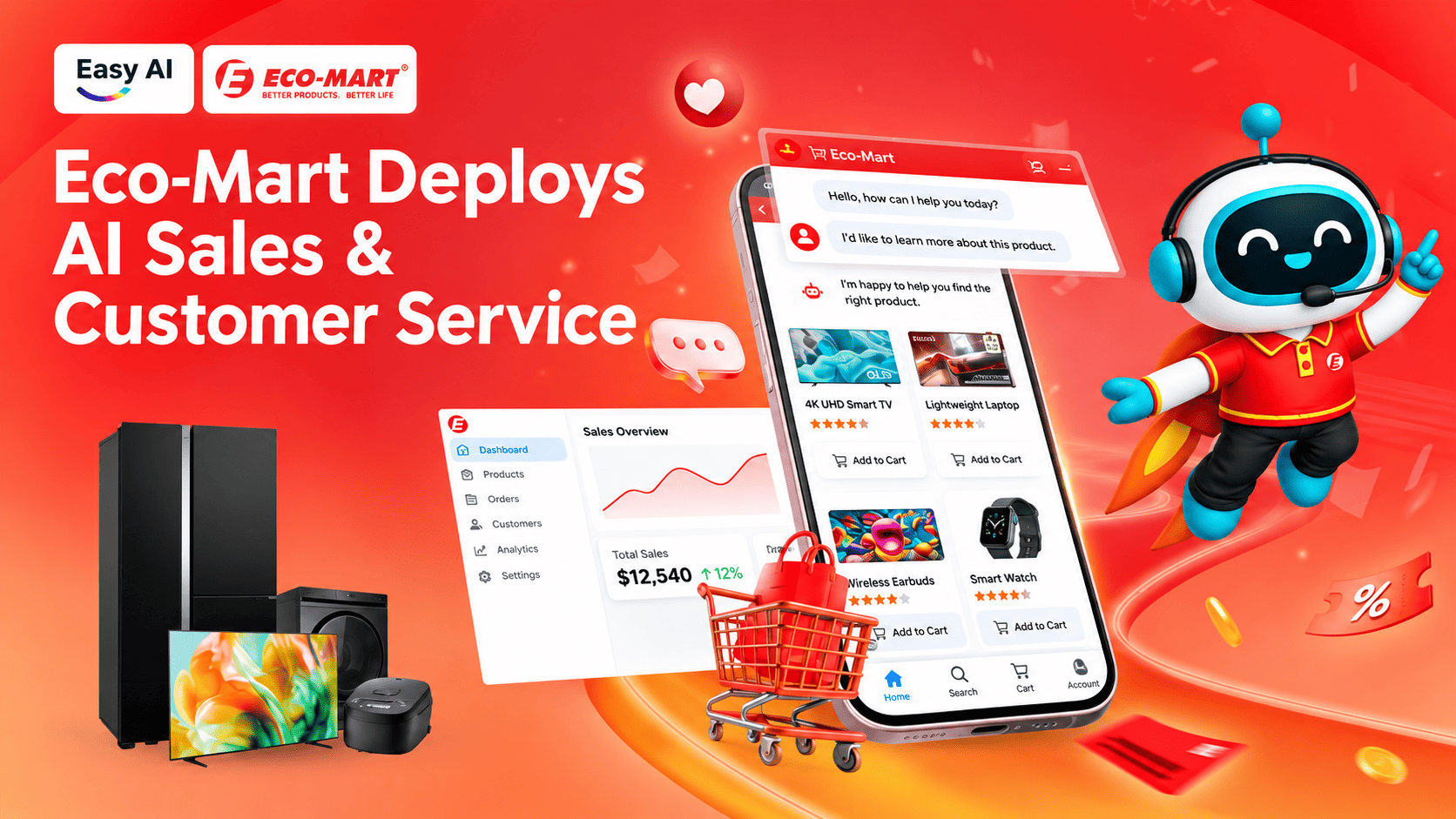
Eco-mart: Standardizing omnichannel operations and automating the retail funnel
- Challenge: Operating a hypermarket model alongside omnichannel sales (Website, Messenger, personal Zalo accounts, and Zalo OA), Eco-mart regularly faced operational overload during peak promotional seasons. Fragmented conversation data meant employees repeatedly had to ask customers for information when they switched channels, disrupting the experience and increasing the number of missed leads.
- Solution: The company implemented an AI Sales & Customer Service platform combined with workflow automation before, during, and after purchase. The system automatically synchronized omnichannel conversation histories, connected the product knowledge base to ERP, and established Marketing Automation flows to classify leads and care for customers based on their actual behavior.
- Results: After one year in operation, the solution significantly reduced pressure on the team: AI handled 50% of conversation volume automatically, response time was reduced to 5 seconds, customer satisfaction remained at 92%, and the conversion rate from system-supported consultation flows reached 35.14%.
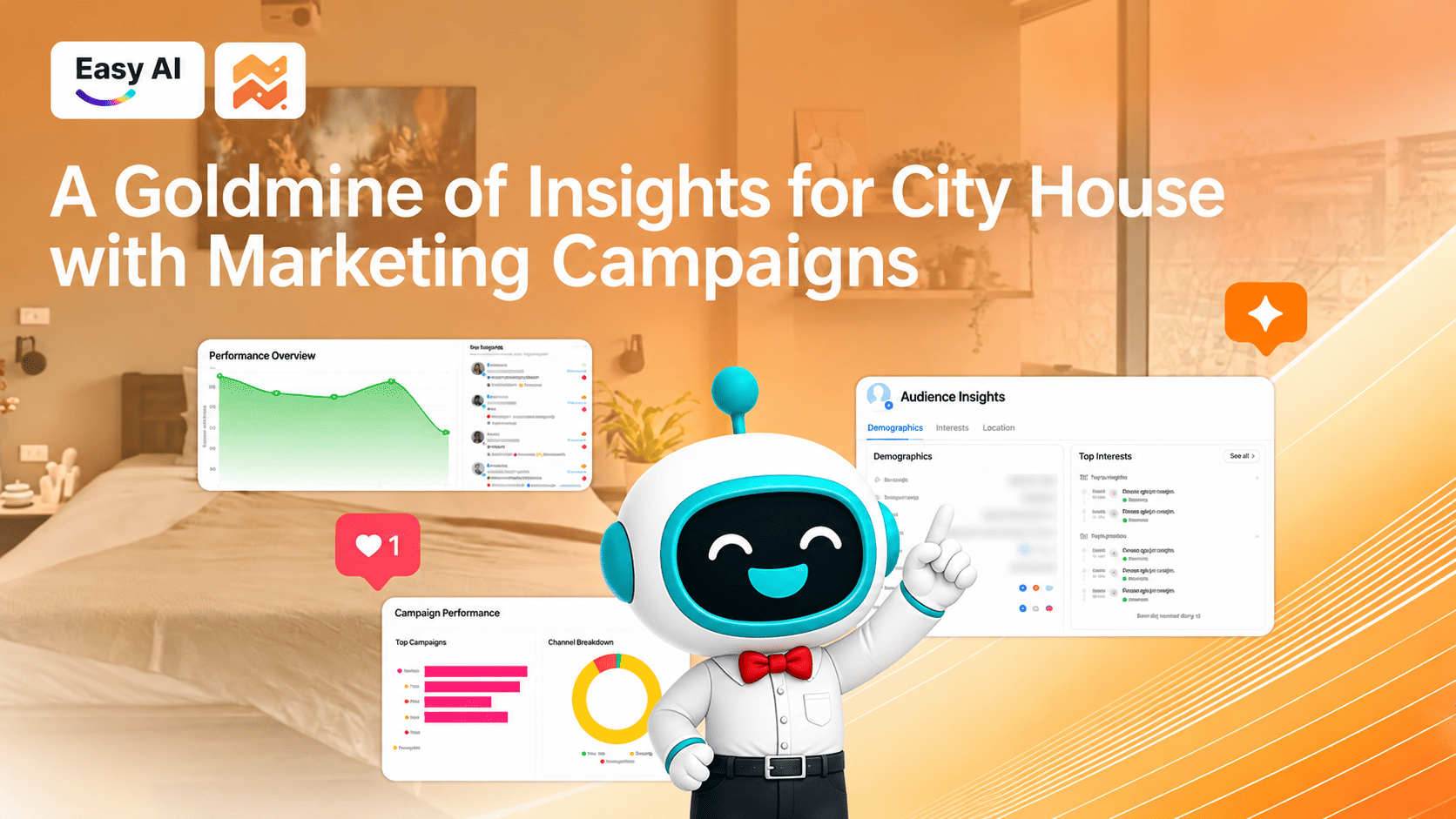
City House: Turning hospitality data into personalized marketing campaigns
- Challenge: In the hospitality industry, customers interact at multiple touchpoints, from searching for information and messaging for advice to booking a room. At City House, data from the website, conversations, and the accommodation management system (Beesky) was held in different places. As a result, customer care relied primarily on manual processes and lacked personalization for each stage of the guest journey.
- Solution: All omnichannel data was synchronized into the CDP to build 360-degree customer profiles, enabling City House to use AI Marketing Automation to trigger automated care scenarios for different contexts: from sending room information to guests considering a booking and personalizing offers based on behavior to automating check-in reminders, post-stay surveys, and rebooking prompts.
- Results: The solution helped optimize manual operational resources and maintain continuous customer engagement, contributing to an increased booking conversion rate and encouraging more guests to return for future stays over the long term.
9. AI Marketing Automation solutions from Easy AI
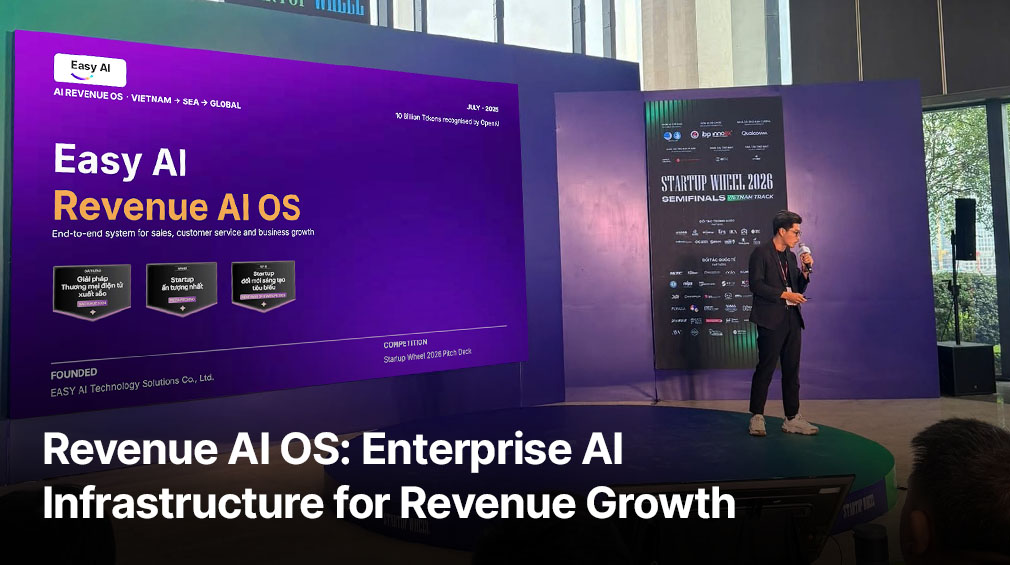
Unlike disconnected tools for sending automated messages, Easy AI is a Revenue AI OS (an AI operating system for revenue growth). Marketing Automation serves as the workflow execution engine, seamlessly connected to AI CDP (data unification), AI Chatbot & Livechat (omnichannel interactions), the conversation/ticket management system, and a centralized reporting dashboard.
This connected system helps businesses use data from every touchpoint (conversations, websites, points of sale) to segment behavior, trigger automated interactions, and smoothly hand conversations over to the advisory team when needed.
Core system features
- Scenario setup & intelligent personalization: AI supports the creation of sales and marketing scenario flows and adjusts messages for different customer segments.
- Context-based triggers (Trigger-based): Automatically sends messages, reminders, or customer care based on timing and actual behavioral signals.
- Conversation operations automation: Runs tasks that are already operating reliably in practice, such as automatically replying to Fanpage comments, tagging conversations, classifying Lead status (New, Contacting, Engaged, Potential), and automatically following up with customers who have not responded.
- Performance measurement & reporting: The Dashboard tracks the customer journey, conversion rates at each funnel stage, and combines business reports with suggested optimization actions.
Which businesses are a good fit?
The solution is particularly suited to businesses with high volumes of omnichannel interactions, multiple branches or points of sale, or separate Marketing, Sales, and Customer Service teams.
Instead of digitizing every process at once, a business can start with one specific bottleneck, such as automatically following up with unresponsive leads, re-engaging customers who abandon their carts, or reminding patients about follow-up appointments. It can then establish the data source, trigger conditions, measurement KPIs, and handoff rules for the responsible employees.
>>> Watch the demo video to see how Easy AI's AI Marketing Automation solution helps businesses optimize customer care workflows—replacing manual operations.
10. Conclusion
AI Marketing Automation delivers value when customer data is closely connected to operational workflows and core business objectives. In this model, the CDP unifies data and clarifies customer profiles; AI supports signal analysis and scenario recommendations; and Automation puts customer care actions into the right workflows at the right time. Every automation effort must ultimately be validated against meaningful business metrics such as qualified leads, conversion rate, cost (CAC/CPA), and revenue, rather than stopping at surface-level engagement figures.
Instead of launching large, complex technology projects, businesses should start by addressing a specific bottleneck, such as missed lead follow-ups or post-purchase re-engagement, and connect it to a clear KPI for measuring performance.
Optimize marketing processes and accelerate revenue growth with Easy AI
Looking for a solution to connect omnichannel data and automate customer care in a practical way? The Easy AI expert team is ready to work with your business to review its data model, design standardized workflows, and build the most suitable implementation roadmap.
Register for roadmap consultation & experience the solution now!
Topics
FAQ
Recommended for you