What is a CDP (Customer Data Platform)? CDP vs CRM Explained
1. What is a Customer Data Platform (CDP)?
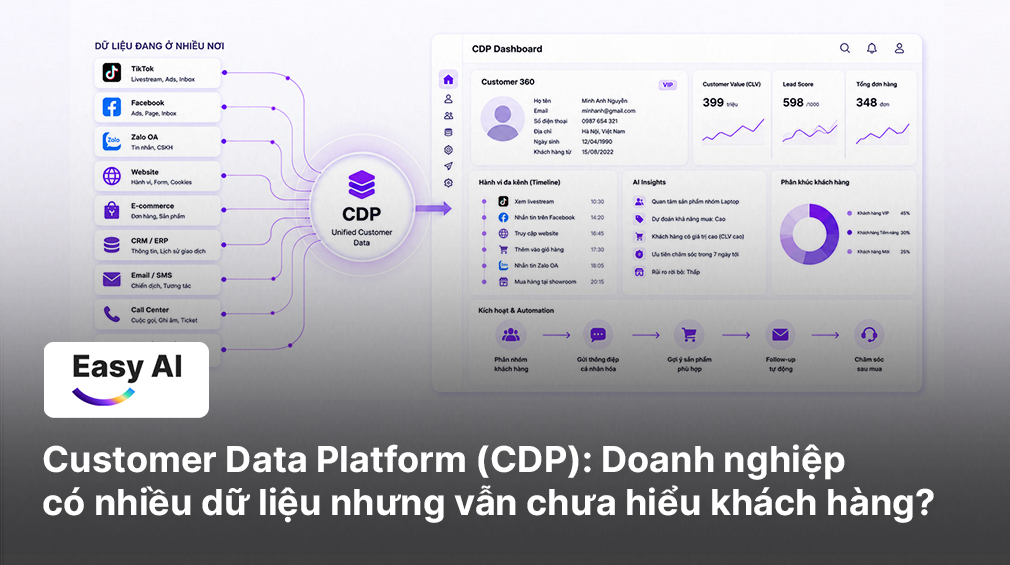
Simply put, a Customer Data Platform (CDP) is a software solution that enables businesses to unify customer data from multiple sources into a single, centralized system. Instead of data remaining fragmented across Facebook, websites, CRMs, POS systems, or chatbots, a CDP aggregates all customer interactions into a unified Customer 360 profile.
Crucially, a CDP does more than just store data. It empowers businesses to understand customers in real time and provides the foundation for AI to orchestrate customer journeys far more effectively.
Today's consumers might browse products on TikTok, message a Facebook page for pricing, revisit a website multiple times, and ultimately visit a physical showroom before making a purchase. If this data remains disconnected, the entire journey breaks down into isolated fragments. A CDP is built to solve this exact challenge.
2. Why Do Businesses with Abundant Data Still Fail to Understand Their Customers?
For years, enterprises focused heavily on data collection. However, most of today's data remains siloed across disparate platforms. Marketing manages ad performance, Sales controls the CRM, websites track online user behavior, POS systems record offline transaction histories, and Customer Support handles tickets and conversations separately.
Because these systems rarely "talk" to one another, businesses only see isolated snapshots rather than the complete, real-time customer journey. This fragmentation leads to broken growth initiatives: poorly timed remarketing, out-of-context sales follow-ups, impersonal customer service, and an inability to optimize conversions in real time.
When data is synchronized across all touchpoints, companies can build Customer 360 profiles, identify customer needs in real time, refine remarketing strategies, improve sales accuracy, and execute automated AI workflows more effectively.
According to McKinsey, companies that excel at personalization can generate $5\% \text{ to } 15\%$ more revenue. However, for personalization to drive real results, businesses require an integrated system that consolidates data and understands the customer seamlessly across every touchpoint—a role uniquely fulfilled by the Customer Data Platform.
3. Customer Data Platform (CDP) vs. Customer Relationship Management (CRM)
Criteria | CRM (Customer Relationship Management) | CDP (Customer Data Platform) |
|---|---|---|
Primary Goal | Manage leads, sales pipelines, and customer interactions. | Unify multi-source data and analyze behavioral patterns. |
Data Focus | Contact info, transaction history, and sales activity logs. | Multi-channel behavioral data (clicks, chat logs, browsing, and purchase journeys) to build Customer 360 profiles. |
Business Role | Manages sales operations and support workflows. | Manages end-to-end data integration and activates real-time data. |
Real-time Capability | Mostly updated via operational sales workflows. | Tracks behavior and updates customer profiles continuously in real time. |
Omnichannel Data | Typically restricted to native CRM ecosystem workflows. | Connects websites, mobile apps, POS, chatbots, social media, ads, ticketing systems, etc. |
Personalization | Basic; heavily reliant on manual data entry. | Automated and dynamic, driven by real-time user behavior. |
Core Value | Enhances sales management and customer service efficiency. | Boosts conversion rates, optimizes customer journeys, and elevates overall CX. |
While many businesses confuse CRMs with CDPs, the two systems serve entirely different purposes. A CRM manages sales operations and pipeline relationships, whereas a CDP provides real-time customer understanding through multi-touchpoint behavioral data and Customer 360 profiles.
This distinction is especially critical in an AI-native era, where AI no longer acts as a standalone chatbot or basic support tool. AI now actively participates across the entire lifecycle—from attraction and consultation to conversion and post-purchase care.
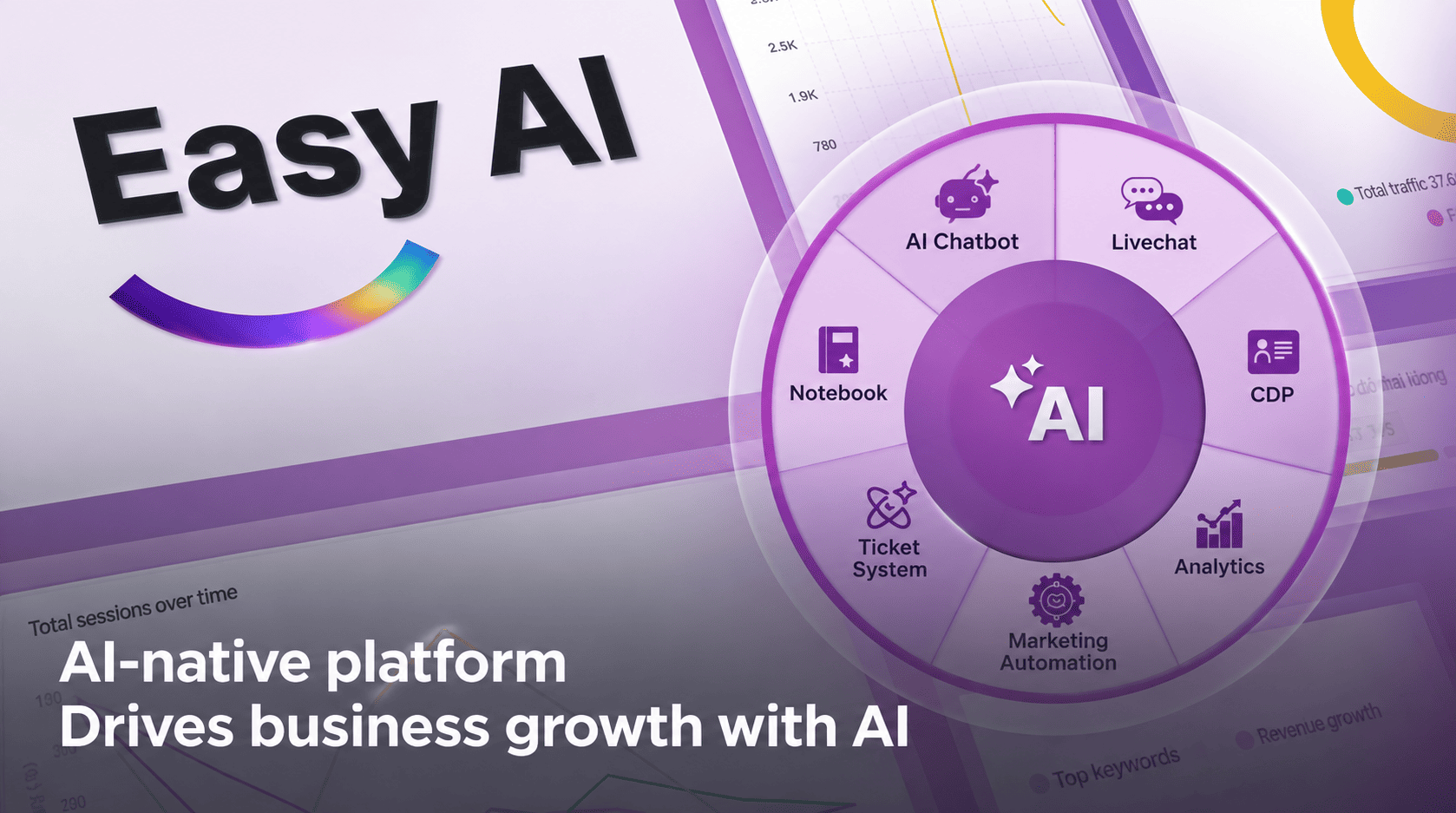
This is the exact vision driving Easy AI: an AI-native platform where data, AI engines, and automation operate within a single, unified ecosystem.
4. Customer 360: When AI Truly Understands Your Customers
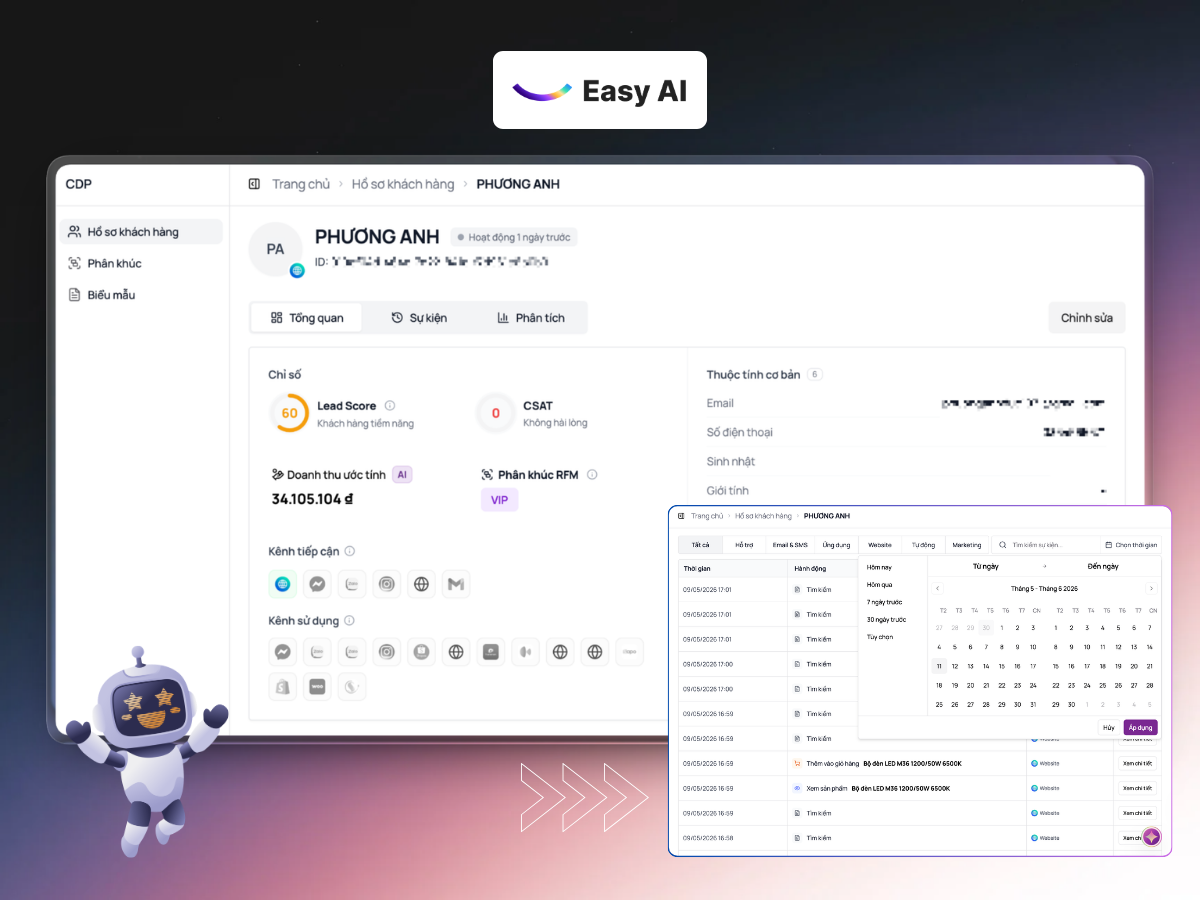
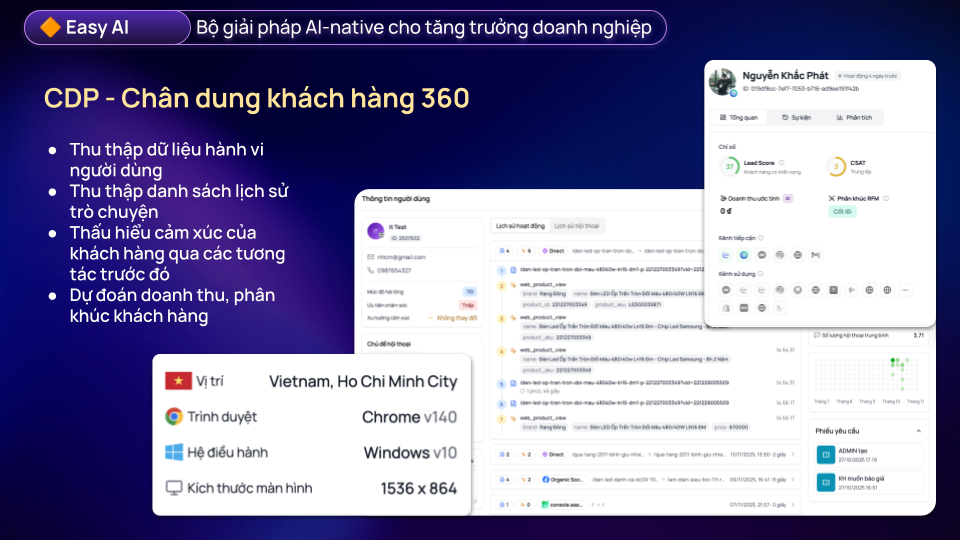
Customer 360 is a strategic model for constructing comprehensive customer profiles by connecting every touchpoint into a unified platform. Rather than merely storing contact details, businesses gain actionable insights into customer interests, optimal engagement timing, high-converting content, and purchase intent.
This unified view serves as the foundation for AI engines to deliver hyper-personalized experiences based on real behavior rather than applying static, generic scripts to every user.
With fully synchronized data, systems can automatically orchestrate content delivery, recommend products, execute sales follow-ups, and deliver customer care at specific funnel stages—eliminating operational silos across departments.
5. CDP within Easy AI’s AI-Native Ecosystem
In legacy architectures, data is used primarily for post-hoc reporting. In an AI-native platform, data acts as the central operational layer, enabling AI engines to execute real-time actions.
This principle guides how Easy AI builds enterprise AI-native environments. The architecture begins at the AI Chatbot & Livechat layer, capturing multi-channel interactions across websites, Facebook, Zalo, and e-commerce platforms. All engagement logs, behavioral signals, transaction histories, and support records are continuously synced to the CDP to construct real-time Customer 360 profiles.
From this rich data layer, AI automatically segments audiences, personalizes content, triggers automated workflows, and optimizes the end-to-end customer journey within a single operational system.
When a CDP converges with AI, enterprises can automatically segment audiences, identify high-intent prospects, tailor messaging dynamically, streamline follow-ups, and automate customer care in real time. AI evolves from a simple conversational assistant into a core growth driver that directly impacts conversion rates and revenue expansion through real-world customer data.
6. Practical CDP Applications in Retail and E-Commerce
In Retail and E-Commerce, customer data is frequently fragmented across websites, Facebook, Zalo, livestreams, physical stores, and call centers. This fragmentation makes tracking holistic purchasing behaviors and maintaining a seamless experience across channels challenging. As a result, forward-thinking enterprises are transitioning to AI-native models where data, AI, and operations operate in tandem.
With Easy AI, all interaction data—from chat logs, web analytics, and CRM records to POS transactions—is synchronized into a single platform. This allows the system to assist businesses in automating audience segmentation, tailoring sales recommendations, optimizing follow-up sequences, and driving real-time conversion gains.
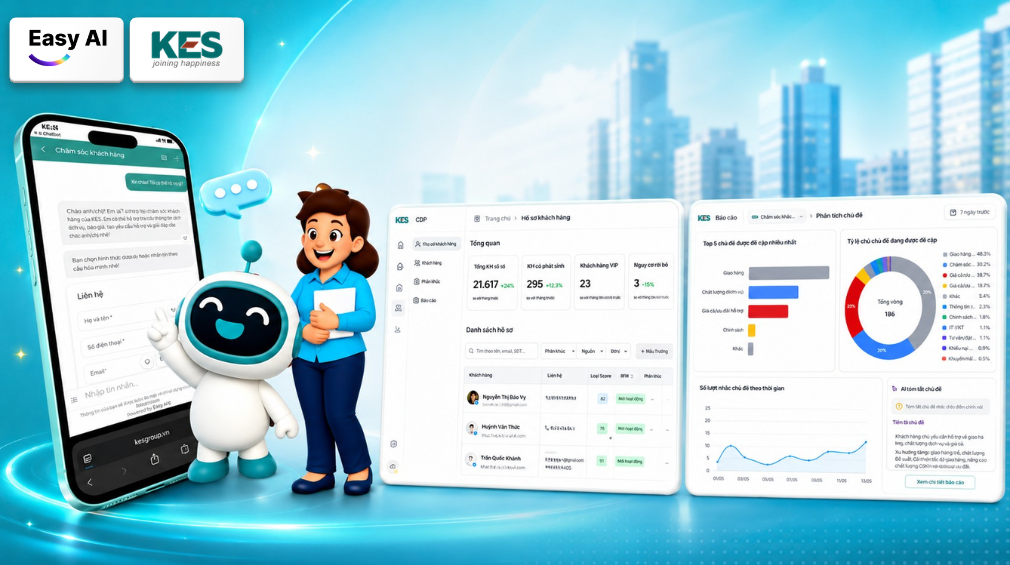
Many leading retailers now rely on CDPs as the core data engine connecting Marketing, Sales, and Customer Support. For instance, Easy AI deployed an AI-native architecture for KES Group to unify multi-channel data, streamline operations, and automate customer care workflows. Following implementation, KES Group achieved higher follow-up efficiency, faster response times, and stronger cross-departmental alignment between sales, marketing, and support teams.
Easy AI sets itself apart with Domain-Specific Models tailored for retail and e-commerce. These models help AI understand product contexts, purchasing behaviors, and operational workflows accurately. Businesses can reduce manual support workloads while maintaining personalized experiences at scale.
Today, the Easy AI platform processes over 180,000 AI conversations monthly, serving more than 1.5 million end customers with an automated resolution rate exceeding 95% without manual intervention.
7. The Future of Customer Data Platforms in the AI Era
In the coming years, competitive advantage will no longer depend on simply possessing "more data," but on the ability to comprehend customers faster, personalize deeper, and execute real-time actions more effectively.
Consequently, Customer Data Platforms are evolving from passive data tools into vital growth infrastructure within AI-native ecosystems. By continuously connecting data, AI, and automation, businesses can transform customer data into an active growth engine rather than a static repository.
8. Conclusion
As customer journeys grow increasingly fragmented, businesses no longer suffer from a lack of data; they lack the ability to connect and translate that data into real-world action. This makes the Customer Data Platform (CDP) an indispensable infrastructure layer in modern AI-native systems.
Within Easy AI, a CDP is more than a data warehouse. It is an AI-native foundation connecting data, AI intelligence, and automated workflows into a unified system designed to elevate customer experiences, boost conversion efficiency, and drive sustainable revenue growth. Easy AI’s proprietary algorithms and Specialized Language Models (SLMs) are fine-tuned for retail and e-commerce, ensuring deep operational context and maximum efficiency.
Easy AI currently partners with industry leaders—including Thế Giới Di Động, Điện Máy XANH, MediaMart, Rạng Đông, Điện Máy Chợ Lớn, Laptop88, Casper, and Pico—to integrate AI into sales, customer support, and omnichannel growth strategies.
Topics