

CDP in Marketing: Unifying Siloed Data for Growth
Websites track page views, Facebook and Zalo log conversations, POS records transactions, while ERP manages orders and inventory. When this data resides in separate systems, marketing teams struggle to know where a customer interacted, what they bought, and what message they should receive next. CDP in Marketing connects these data sources into a unified customer profile, then feeds that profile into segmentation, analytics, and campaigns. The value lies not in collecting more data, but in turning relevant data into trackable action.
1. What is a CDP? The Role of CDP in Modern Marketing
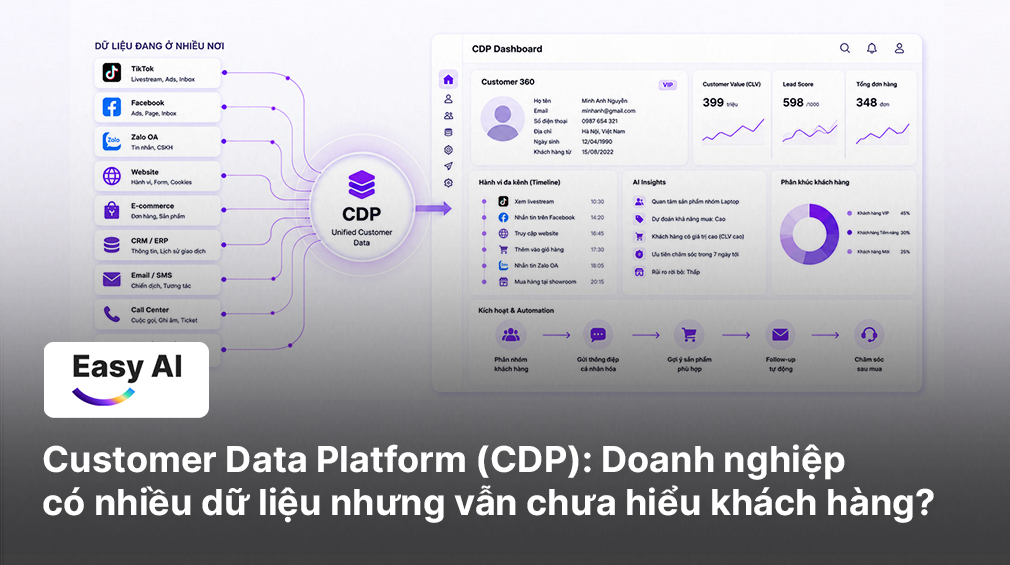
CDP stands for Customer Data Platform. It is a system that ingests data from multiple sources, standardizes information fields, matches identities, and unifies data into a consolidated customer profile. Businesses can use this profile to analyze behavior, build segments, and activate campaigns.
In practice, data is often generated at multiple points: website visits, fanpage interactions, Zalo exchanges, POS transactions, marketplace orders, or ERP records. If each system maintains its own isolated history, Marketing may send duplicate messages, miss buying signals, or fail to identify which campaign drove a transaction.
A CDP addresses this challenge by creating a connected data layer. The platform receives data through configured integrations, standardizes formats, and stitches profiles based on identifiers the business can use, such as phone numbers, emails, customer IDs, or login accounts. Profile matching must be controlled to prevent connecting the wrong individuals.
A CDP is not merely a place to store customer data. It is a data-to-marketing-action connectivity layer: from understanding customers and selecting the right segments to activating relevant messages and measuring results.
Therefore, when asking "what is a CDP," the useful answer goes beyond a technical definition. It requires looking at the ability to put unified data into practice: analyzing performance, identifying care opportunities, and operating campaigns more consistently.
2. Core Applications of CDP Solutions in Marketing
2.1 Customer 360 / Single Customer View
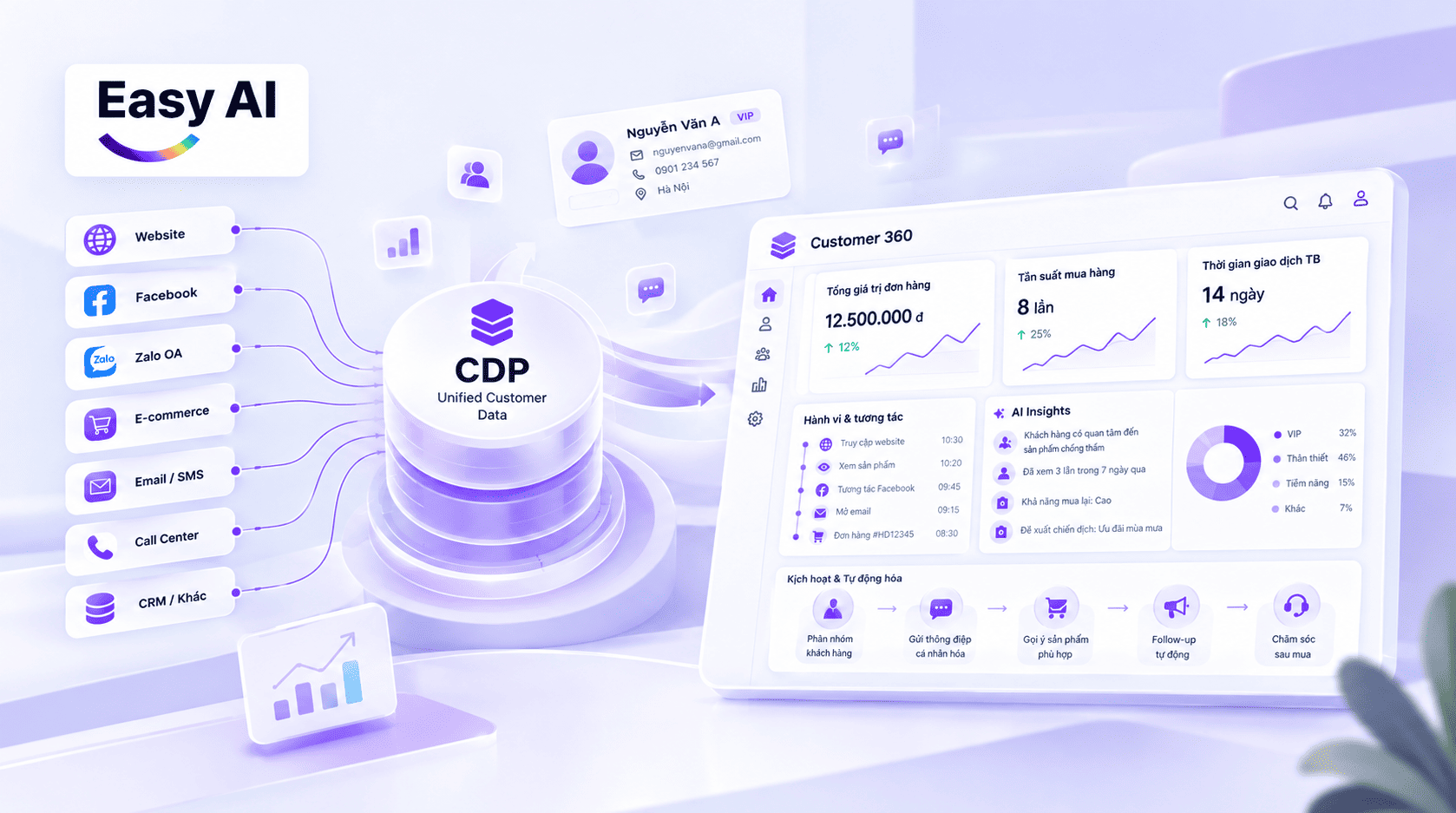
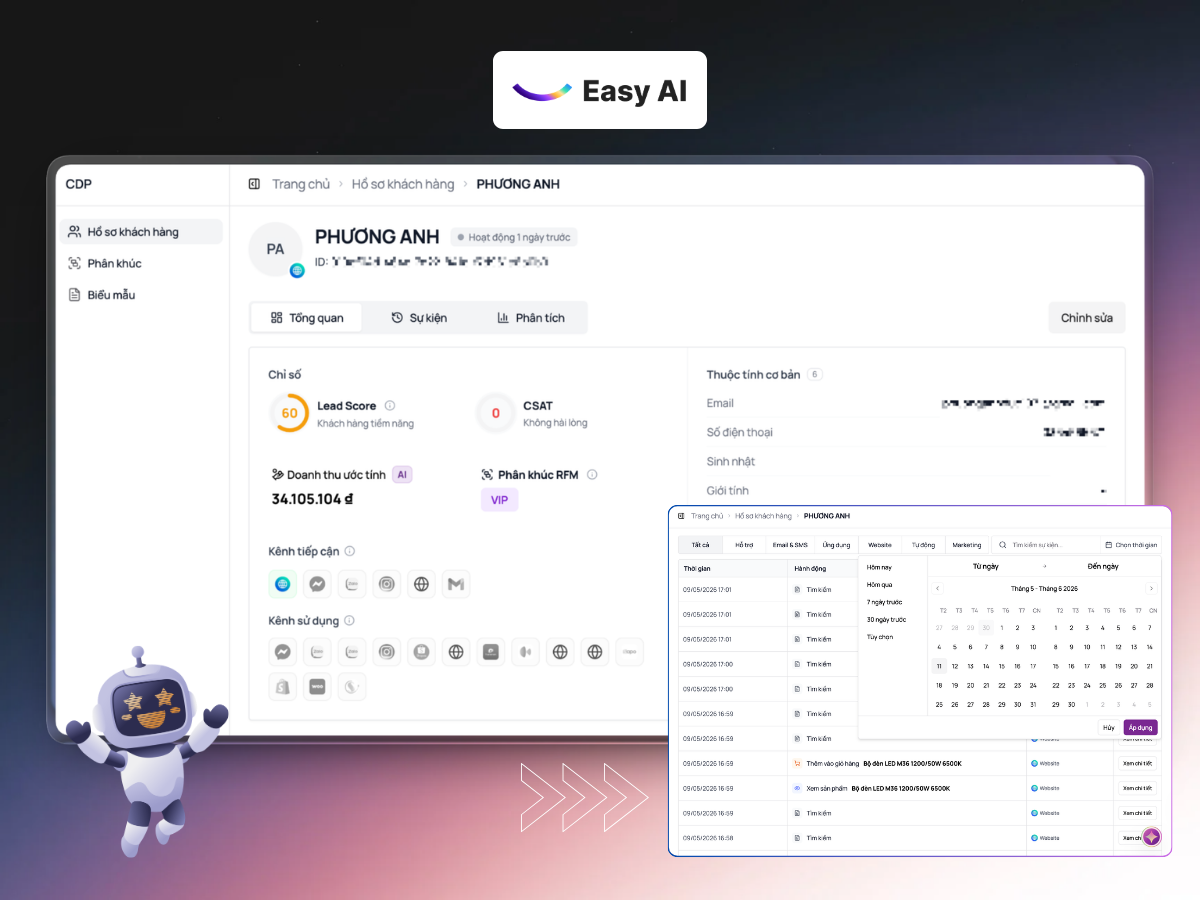
Customer 360, or Single Customer View, is a unified view of a customer across connected sources. Instead of viewing page visits, purchase history, and conversations as unrelated records, businesses can consolidate them into a single profile given sufficient identifiers and appropriate data usage rights.
For Retail and E-commerce, this profile helps marketing teams see which products a customer purchased, which promotions they engaged with, and which channel they are returning through. For B2B2C models, businesses may need to distinguish between buyers, end-users, and distribution partners rather than grouping everyone into one profile.
Customer 360 does not automatically guarantee all data is accurate. Results depend on input data quality, profile-stitching rules, and how the business manages missing or duplicate identifiers.
2.2 Segmentation and Personalization
When data is standardized, marketing teams can create segments based on behavior and purchase history rather than relying solely on static information like region or age. For example, a business can identify customers who bought a specific product line, those who frequently view products but haven't ordered, or those who haven't interacted within a timeframe chosen by the company.
These segments can be used to adjust content, timing, and outreach channels. Depending on integrated and configured systems, campaigns can be triggered via email, Zalo, push notifications, or AI chatbots. It should not be assumed that all channels are available in every CDP; implementation capabilities depend on the platform, connections, and permitted data.
To prevent personalization from becoming just more messaging, clear goals must be set for each segment. For example: increasing return visits from past buyers, guiding customers through the next step, or reminding them about a relevant service. Marketing teams can track interactions, orders, revenue, or costs by campaign to evaluate results.
3. How Do CDP, CRM, and DMP Differ?
The table below describes typical differences among the three platform categories. These are not absolute boundaries: actual features may overlap depending on the product and how the business implements it.
Criteria | CDP | CRM | DMP |
|---|---|---|---|
Purpose | Unify customer data for analytics, segmentation, and activation | Manage relationship workflows, sales opportunities, and customer interactions | Organize data sets to support advertising and audience targeting |
Input Data | Can include transaction, behavioral, interaction, and customer data from connected sources | Typically focuses on contact profiles, sales history, and team-recorded exchanges | Typically uses advertising data, including indirect identifier data |
Profile Unification | Focus is usually on connecting profiles from multiple sources using configured identifiers and rules | Manages profiles within the CRM workflow scope; unification capabilities depend on the product | Focuses on audience segments; does not necessarily create long-term customer profiles |
Experience / Application | Customer 360, segmentation, analytics, and campaign activation | Lead management, sales opportunities, and customer care activities | Build or distribute audience segments for advertising |
4. 4-Step Process for Implementing a CDP in Marketing
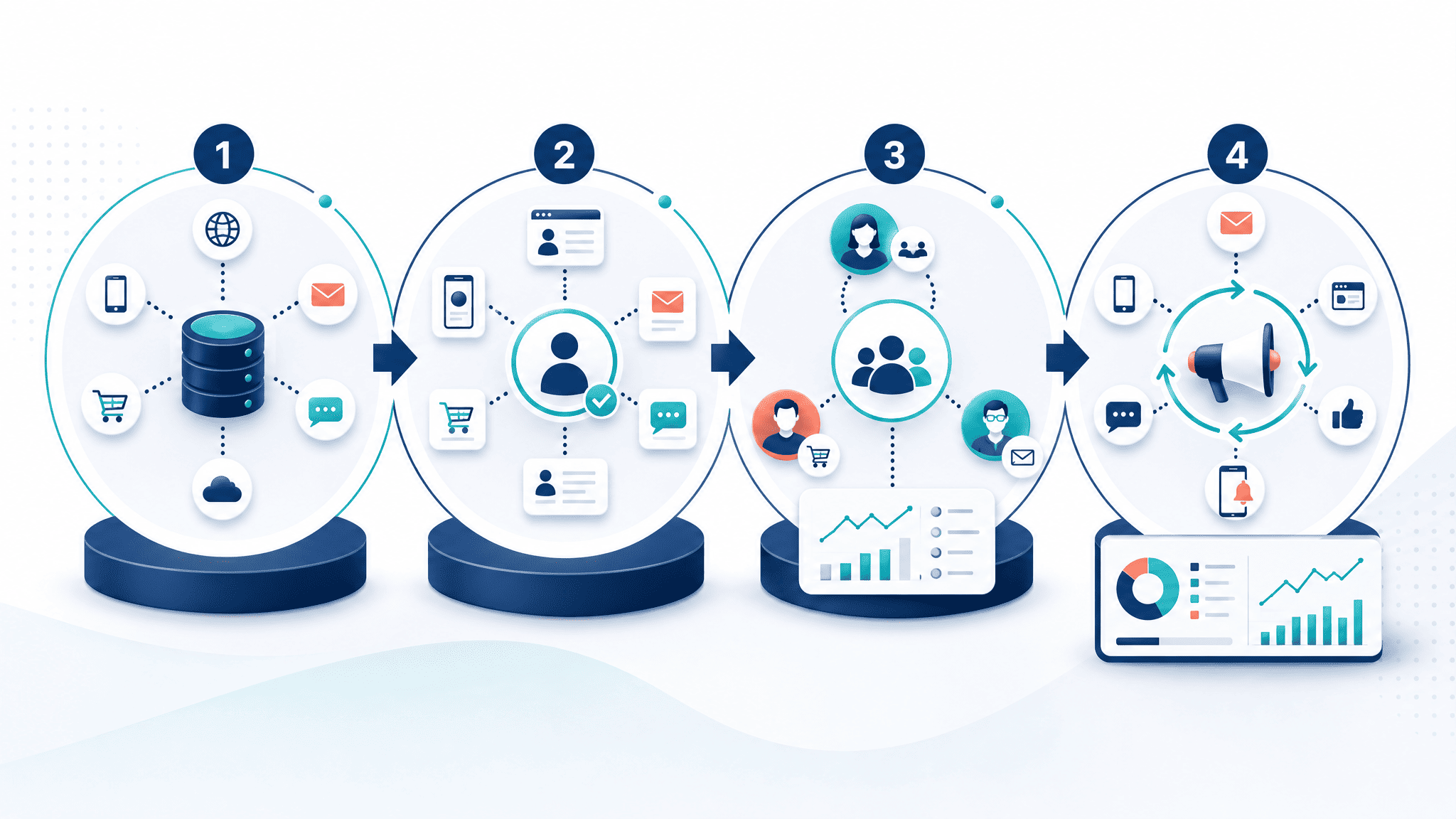
An effective CDP project begins with business problems and necessary data sources, not with the requirement to connect all systems immediately.
4.1 Data Source Integration
List sources generating customer data: website, Facebook, Zalo, POS, ERP, e-commerce platforms, or CRM systems. Determine which data needs to be ingested, which data is primary, and which data is only needed for a specific purpose.
Before collecting or combining personal data, businesses must review personal data protection obligations under Decree 13. This content does not replace legal advice; businesses should work with their designated department to determine appropriate implementation.
4.2 Customer 360 Identification and Unification
Select identifiers that can be used for cross-profiling, such as customer IDs, emails, or phone numbers. Establish rules to handle missing, duplicate, and inconsistent data. Then inspect a sample of unified profiles to detect misconnections before expanding usage scope.
4.3 Segmentation and Analytics
Start with a few segments tied to specific goals, such as new customers, buyers of a product group, or customers showing signs of declining engagement. Align segment definitions between Marketing and relevant departments so each team avoids using a different understanding.
Reports need to distinguish actual historical results from forecasts. Recorded orders and revenue are actual metrics; repurchase likelihood or churn risk generated by estimation models are forecasts and may contain errors.
4.4 Omnichannel Activation and ROI Measurement
Connect segments to selected campaigns or workflows. Depending on integration capabilities, activation channels can include email, Zalo, push notifications, or AI chatbots. Set measurement metrics prior to sending: responses, conversions, orders, revenue, or campaign costs.
At the same time, assign role-based access permissions, limit viewable data, and conduct periodic data quality reviews. These practices help reduce operational risks and ensure data is used for its defined purpose.
5. Easy AI: AI-Native Integrated CDP Platform to Accelerate Revenue
Data only creates revenue when put into operation. Easy AI thoroughly solves the fragmented data problem by unifying CDP, Marketing Automation, AI Chatbot/Livechat, and Analytics into a single Revenue AI OS.
Power from AI-Native Architecture: Unlike standalone generative AI tools, Easy AI's AI operates deep within the business's data context and operational workflows. The platform can retrieve real-time data, provide accurate consultations based on inventory/pricing, automatically follow up, assist with bookings, and smoothly hand off to Sales teams when high buying intent is detected.
Focus on Practical Use Cases: Easy AI accompanies businesses in solving specific challenges: from multi-channel data unification (Website, Facebook, Zalo, etc.) to dynamic customer segmentation and automated care workflow triggers.
6. Conclusion
CDP in Marketing is the core foundation helping businesses transition from fragmented data management to a data-driven growth strategy. By connecting individual touchpoints into standardized Customer 360 profiles, marketing teams gain sufficient foundation to segment accurately, personalize experiences, and optimize ROI across every campaign.
The CDP implementation journey does not have to be complex. Start by choosing a priority business problem: identify where data is most fragmented, which segment needs immediate activation, and specific performance metrics to measure.
>>> Register for consultation and a Demo of Easy AI solution right here to work with our team of experts in reviewing your data infrastructure and building a tailored CDP & AI Automation deployment roadmap for your business!
Topics