What Is an AI Chatbot? How It Works and Business Applications
1. What Is an AI Chatbot? Understanding AI Chatbot Technology
An AI chatbot is conversational software that uses artificial intelligence (AI) to understand requests in natural language, find relevant information, and respond or perform configured tasks. Its practical capabilities depend on the AI model, knowledge base, data, integrations and control mechanisms. Unlike a chat window that only provides a messaging interface, an AI chatbot can analyze questions phrased in different ways, retrieve business knowledge and maintain context throughout a conversation.
For example, a customer might ask, “Is this model in stock, and how long does delivery to Da Nang take?” The AI chatbot may need to identify the product being discussed, retrieve SKU and delivery information, and then answer based on an authorized source. If the customer wants to change the delivery address after the order has left the warehouse, the chatbot may need to hand the request to an employee rather than make its own decision.
Three capabilities should be distinguished: retrieving knowledge, generating a response and performing a task. AI can find information in documents, rephrase it as an answer or call an integrated system to take the next step. Its ability to do each of these depends on its configuration and access permissions.
To understand the nature, applications and operating scope of each solution, it is important to distinguish between the core concepts. In practice, related terms are often used interchangeably, even though they mean different things:
- A chat window is an interface where users send messages and receive responses. The chat window itself does not determine whether an employee, a scripted bot or AI provides the answer.
- A conventional rule-based chatbot follows predefined branches and conditions. If a customer selects “Track my order,” the bot presents the corresponding steps.
- AI Chat usually refers to the experience of chatting with AI. The term does not clarify whether the AI is connected to business data or processes.
- AI Chat Online usually refers to an online AI chat service or experience. It is not necessarily a customer service chatbot on a company website.
- An AI chatbot is deployed for a specific purpose, such as product recommendations, answering policy questions or receiving support requests.
- Automated AI responses describe the function of responding automatically, but do not necessarily indicate that AI powers the feature. It may use preset answers, rules or an AI model.
2. How Does an AI Chatbot Work?
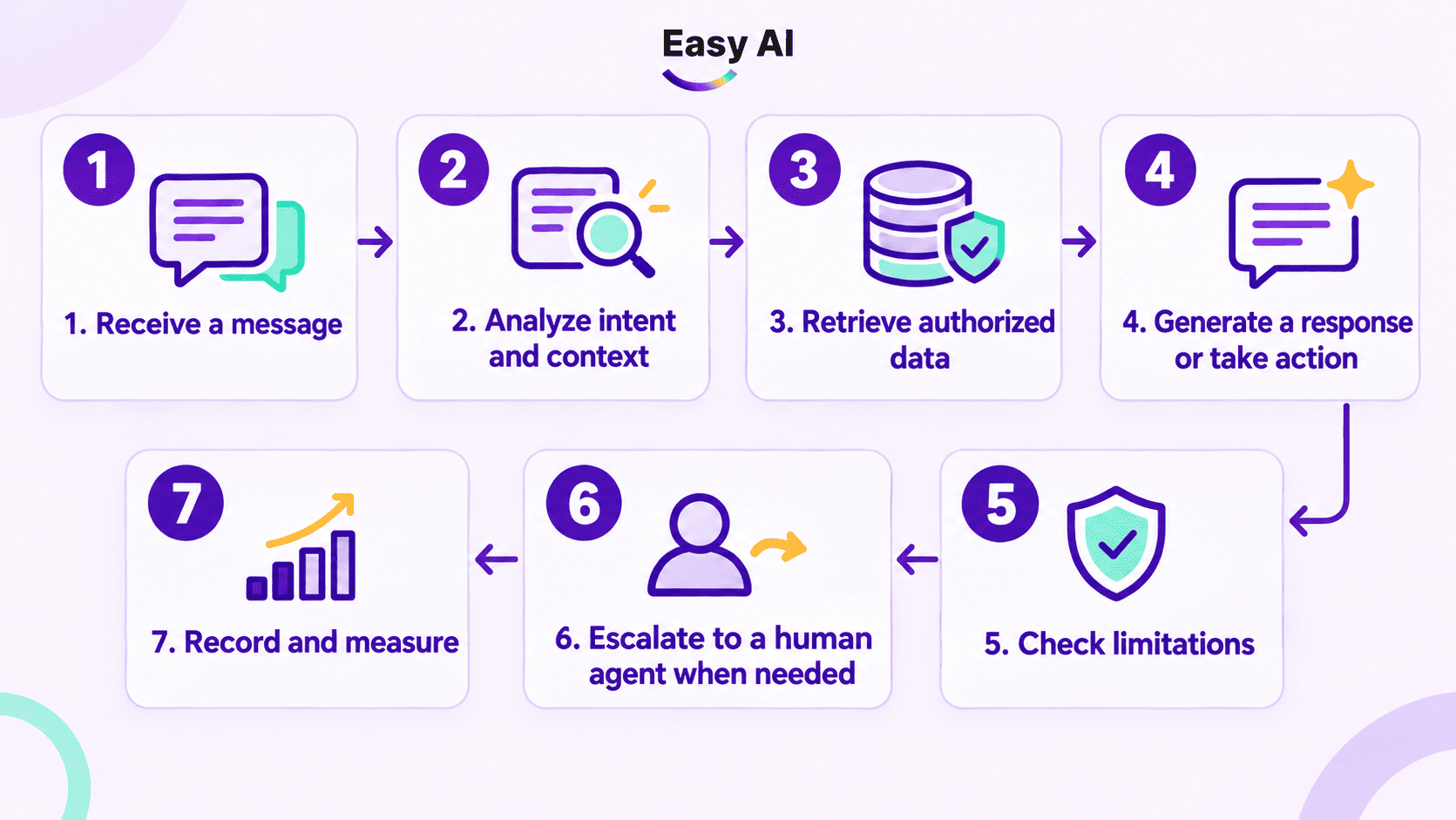
An AI chatbot workflow typically consists of seven steps:
- Receive a message: The system receives content from a website, social media or another connected channel.
- Analyze intent and context: AI identifies what the customer is asking, which product or topic they mention and what information is already available in the conversation.
- Retrieve authorized data: If the feature has been implemented, the system searches for relevant content in the knowledge base or queries an integrated system.
- Generate a response or task: AI can phrase information, ask follow-up questions for clarification or initiate an action within its permitted scope.
- Check limitations: If data is missing, information conflicts or a request falls outside the chatbot’s scope, the system should respond appropriately rather than guess.
- Hand off to an employee when needed: The conversation is transferred according to defined rules, ideally with the conversation history and information the customer has already provided.
- Record and measure: The system logs the necessary events so the business can monitor quality, human handoff rates and outcomes against selected goals.
Many systems use generative models to phrase responses naturally. One common technique is RAG (Retrieval-Augmented Generation): the system searches business sources for relevant content, then uses that information as the basis for the model’s response.
RAG helps AI draw on the knowledge provided, but it does not guarantee that every answer will be accurate. Quality depends on whether the documentation is complete, up to date, easy to retrieve and the correct version. Businesses also need to test real-world scenarios, especially ambiguous questions, exceptions and frequently changing data.
Diagram of the seven steps in an AI chatbot workflow: receive a message, analyze context, retrieve data, generate a response or task, check limitations, hand off to an employee and measure performance.
3. Conventional Rule-Based Chatbots vs. AI Chatbots
| Criteria | Conventional rule-based chatbot | AI chatbot |
|---|---|---|
| How it works | Follows predefined branches and conditions | Analyzes requests using an AI model and may combine AI with rules |
| Response phrasing | Usually limited to configured answers or choices | Can understand different phrasings and generate context-aware responses |
| Data sources | Content or answers configured in the script | Can retrieve knowledge from a knowledge base or integrated systems if authorized |
| Requests outside the script | Difficult to handle if no matching branch exists | Can handle open-ended questions within its knowledge scope; rules are still needed for out-of-scope cases |
| Personalization | Usually based on available choices and conditions | Can take conversation context and permitted data into account |
| Tasks | May route or call tasks, depending on the product | Can call integrated tasks, depending on configuration and access permissions |
| Risks | Rigid scripts can make it difficult for customers to find the right branch | May generate incorrect or unsupported answers if knowledge and controls are inadequate |
| Cost | Depends on script complexity and operations | Depends on the model, usage volume, integrations, controls and operations |
A conventional rule-based chatbot can still support reporting, routing or system integrations; this depends on the product. AI is not always the better choice. Stable processes with few variations and a need for fixed answers may be well suited to rule-based systems. Use cases involving varied phrasings, knowledge retrieval or context may require AI. Businesses can also combine the two approaches: use rules for predictable flows and AI for flexible conversations.
4. Common AI Chatbot Models for Businesses Today
4.1 AI Chat Online
AI Chat Online is an experience that lets people interact with AI over the internet, usually to ask questions or get help with online work. For example, a user asks a question and AI generates a response in the chat interface.
Before choosing a service, verify what data enters the system, how that data is stored, whether user permissions are available and whether the service connects to the company’s internal information sources. A shared AI Chat Online service does not automatically understand a company’s specific products, policies or processes.
4.2 Website AI Chatbot
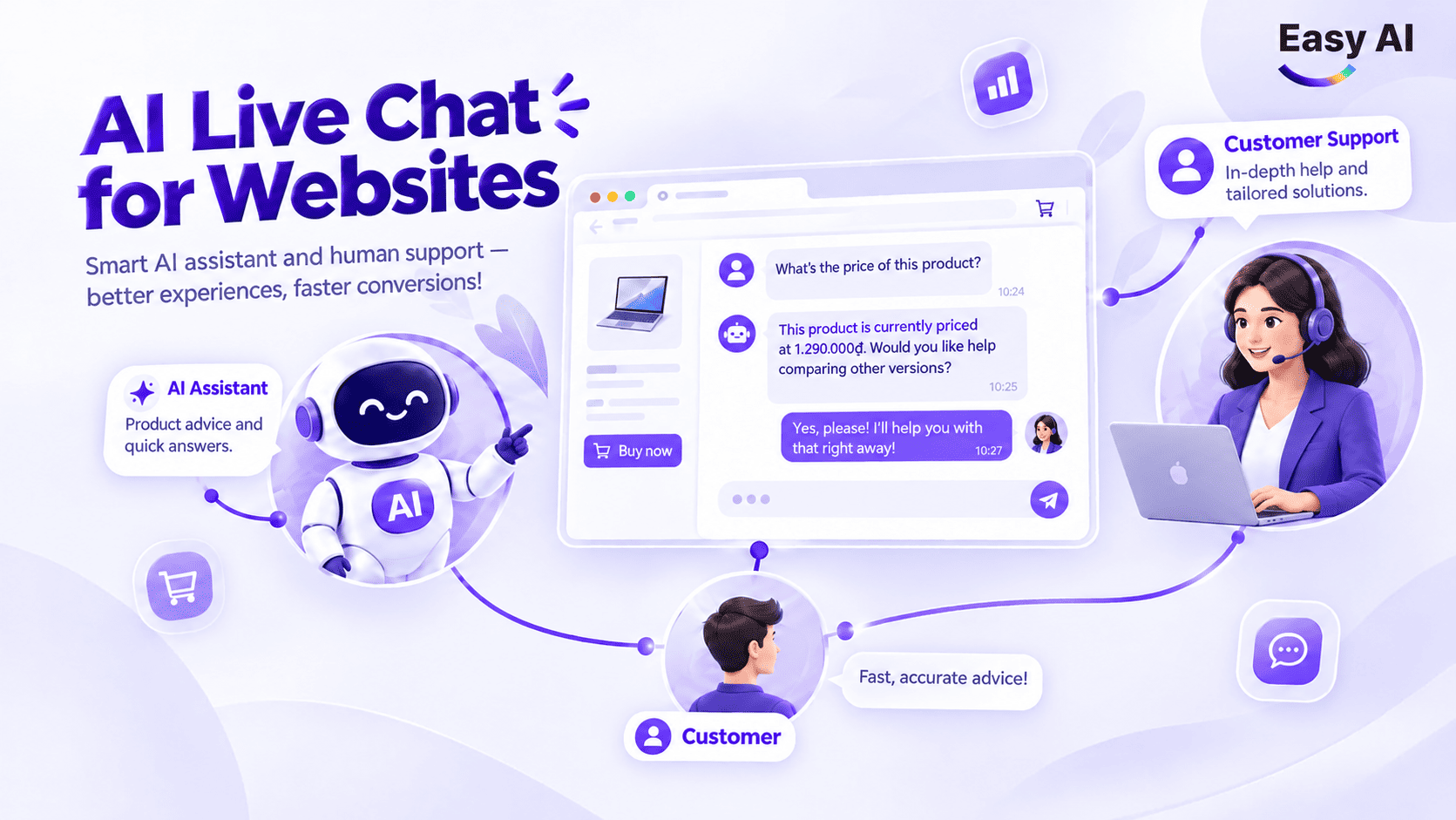
A website AI chatbot is embedded on a website to receive questions, provide information or guide customers to the next step. For example, a user might ask about a product line, a delivery policy or how to register for a service.
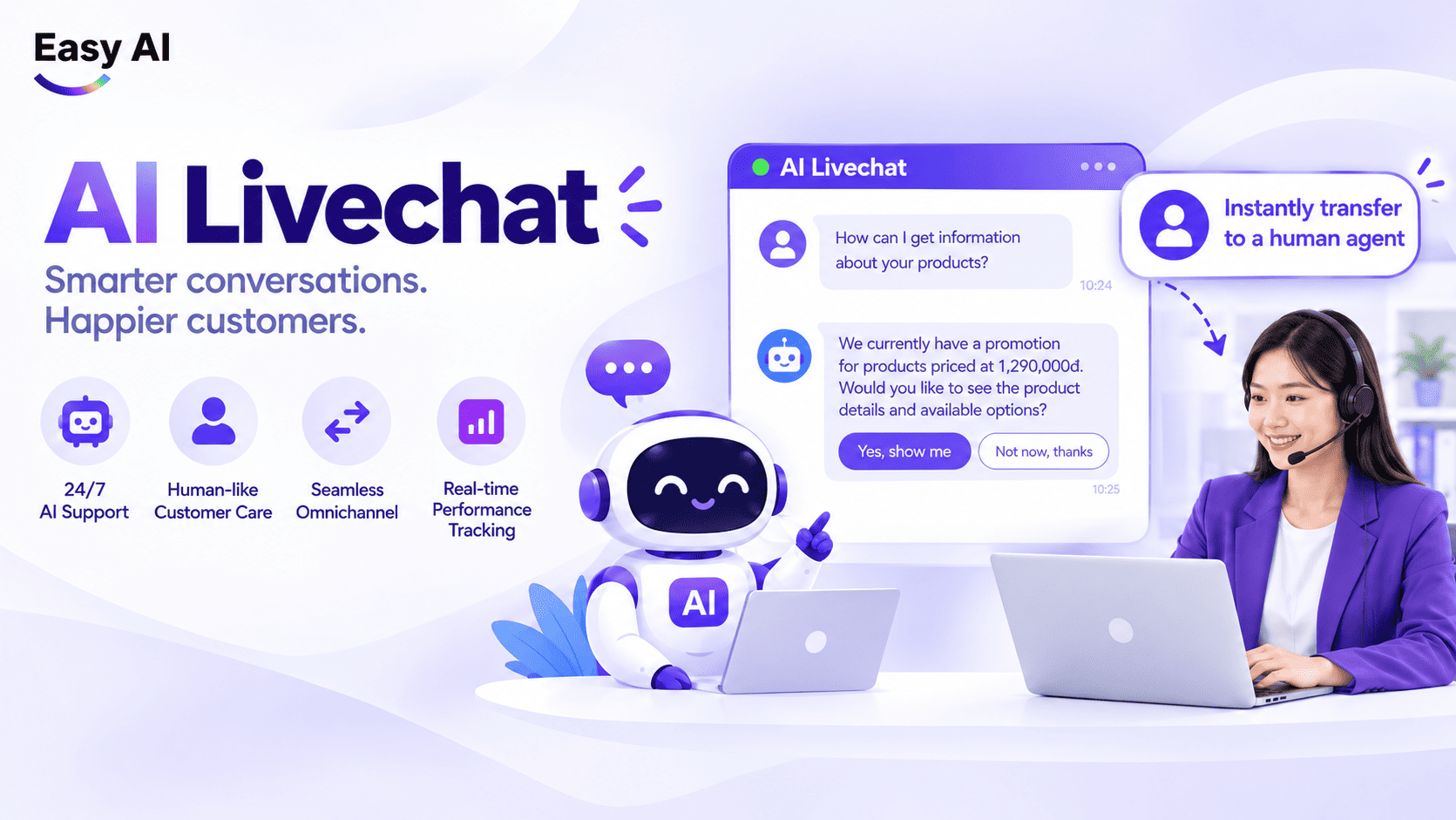
Businesses should clarify where the chatbot gets its content, whether it can hand conversations over to employees via live chat (a direct chat with an employee) and what information it is allowed to display.
4.3 Multichannel AI Chatbot
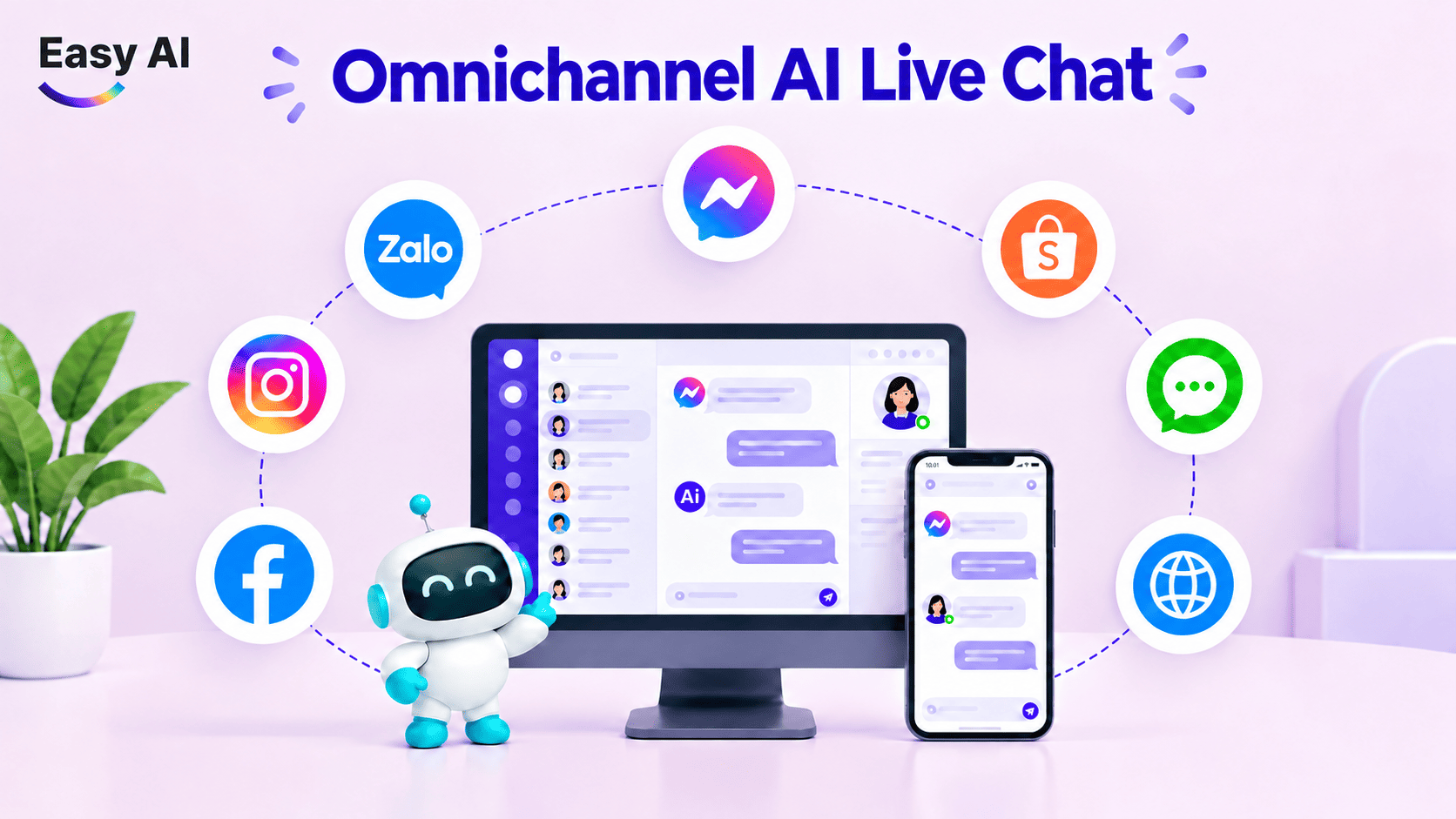
A multichannel AI chatbot can receive conversations from multiple touchpoints, such as a website, Facebook or Zalo OA, depending on the scope of integration. However, being present on multiple channels does not mean customer data and conversation histories have been consolidated.
When evaluating a solution, ask whether employees can see conversation history from other channels, how customer identities are matched and how permissions to handle requests are assigned.
4.4 AI Chatbots by Business Function
An AI chatbot can be configured for specific business functions, such as:
- Sales: Recommend products from a catalog, ask about customer needs, suggest products and capture required information. Verify whether pricing, inventory and promotion data are connected and kept up to date.
- Customer Service: Answer frequently asked questions, explain processes and route complaints, exceptions or sensitive cases to employees.
- Internal support: Retrieve documents, processes and policies for employees. Access controls should ensure users can only view content appropriate to their roles.
5. AI Chatbot Applications in Marketing, Sales, Customer Service, B2B and E-commerce
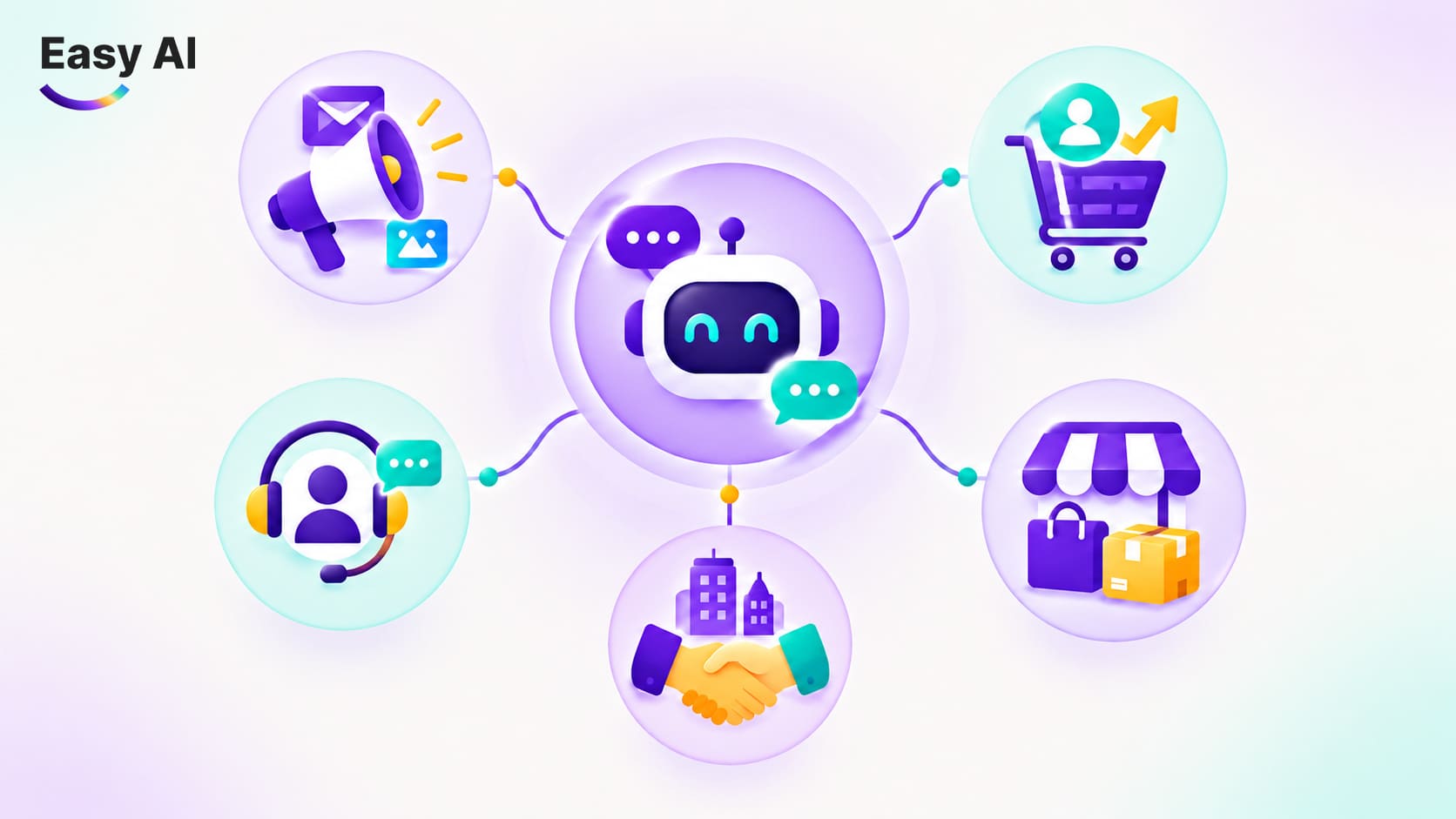
Overview illustration of an AI chatbot connecting applications across Marketing, Sales, customer service, B2B and e-commerce.
- Marketing: A chatbot can record needs customers share in a conversation, ask relevant follow-up questions and route data according to a defined process. Businesses should specify the purpose of collection, what questions are asked and how consent is managed; they should not collect unnecessary information.
- Sales: AI can provide initial recommendations, classify customer needs, answer product questions and hand customers with more complex needs to employees. Employees still need to handle negotiations, complex solution recommendations and cases that require individual assessment.
- Customer Service: A chatbot can explain processes, retrieve authorized information and receive requests outside business hours. Complaints, exceptions and requests requiring decisions that may affect customers’ rights should have a handoff path to the responsible employee.
- Retail and e-commerce: AI can help customers look up SKUs (product identifiers), compare features and ask about prices or promotions if the data source is connected and kept up to date. For orders, the chatbot should only look up or change information if the system is integrated and authorized to perform that task. Allowing agents to upload a product-code file is only feasible if that feature has been implemented in the project.
- B2B: A chatbot can receive requests from agents or business customers, help them find products and guide them through ordering steps. Special pricing, commercial terms and large orders generally require clear access rules and a handoff point for employees.
6. Benefits and Limitations of AI Chatbots
| Expected benefit | Conditions for achieving it |
|---|---|
| Respond outside business hours | The channel is connected, the system operates reliably and the response scope is clear |
| Handle multiple requests at once | System capacity meets actual traffic levels; content and rules have been tested |
| Standardize responses | An approved knowledge source and a process for updating versions are in place |
| Reduce repetitive employee tasks | The right types of questions are identified for automation |
| Preserve context during handoff | Employees can see conversation content and related data according to their permissions |
| Support performance monitoring | Reports measure KPI definitions and conversation scope accurately |
An AI chatbot may give incorrect answers, use outdated content or mishandle requests outside its scope. Businesses also need to control data access, protect personal information and design a clear enough handoff flow for employees to continue providing support.
Three states should be distinguished: the AI has responded, the request has been handled according to defined criteria, and the issue has been resolved successfully. An AI-generated message does not, by itself, prove that the customer is satisfied or that the business has generated additional revenue. To evaluate outcomes, conversation data must be connected to resolution status and the relevant business goals.
7. Criteria for Choosing the Right AI Chatbot for Your Business
Use the checklist below to evaluate a solution against real work requirements rather than choosing based on a feature list or the “AI” label:
- Goals and processes: Do you want to shorten response times, reduce repetitive work, support appointment booking or improve product recommendations? Where does the process start and end?
- Knowledge base: Which documents will the AI use? Who is responsible for approving and updating them when policies change?
- Vietnamese language: How does the system handle abbreviations, spelling mistakes, local expressions and industry terminology?
- Integrations: Do you need to connect a website, CRM, order system, appointment system or internal software? What data can each integration read or act on?
- Employee handoff: When a conversation is transferred, can the employee retain the history, customer information and reason for the handoff?
- Security and access controls: Who can view documents, conversation data and customer information? Can permissions be restricted by role?
- Reporting: Can the solution measure response time, resolution rates according to defined criteria, handoffs, customer satisfaction and business outcomes?
- Scalability: Can the solution add channels, business functions or conversation volume in line with your operating plans?
- Total cost: What costs are included: platform, usage, integration, implementation, maintenance and operational staff?
- Vendor capabilities: Will the implementation partner work with the business to define scope, test scenarios and monitor quality after launch?
8. Steps for Implementing an AI Chatbot
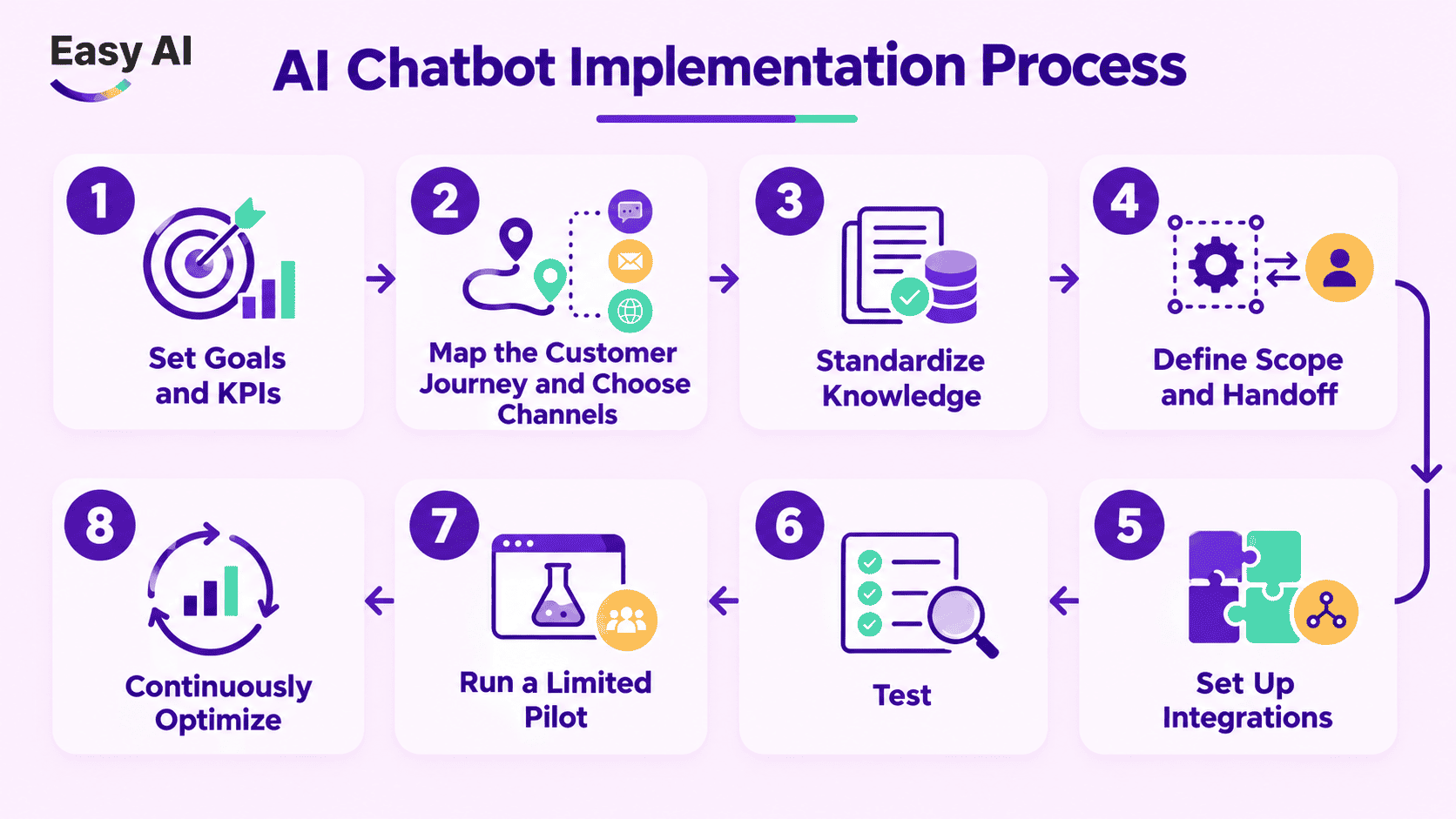
Infographic showing the eight steps in AI chatbot implementation, from defining KPIs to continuous optimization.
An implementation process can follow eight steps:
- Define goals and KPIs. Deliverable: metrics, definitions and measurement milestones. Risk: choosing a vague objective that is not tied to a specific process.
- Map the customer journey and select channels. Deliverable: a map of touchpoints and the steps customers need to take. Risk: launching across too many channels before understanding traffic and operations.
- Standardize knowledge. Deliverable: categorized documents with an owner and update schedule. Risk: duplicate content, outdated versions or missing exception cases.
- Define scope and handoff. Deliverable: a list of tasks AI can perform, requests it must decline and conditions for transferring to an employee. Risk: allowing AI to handle requests beyond its authority.
- Set up integrations. Deliverable: a data map, access permissions and a list of permitted tasks. Risk: incomplete data synchronization or granting broader access than needed.
- Test. Deliverable: a set of real-world questions, edge cases and acceptance criteria. Risk: testing only easy questions and missing data errors or ambiguous requests.
- Run a pilot. Deliverable: a defined group of users or channels for testing, with reports against KPIs. Risk: scaling before common issues have been addressed.
- Continuously optimize. Deliverable: a schedule for updating knowledge, analyzing conversations and releasing new configurations. Risk: treating the chatbot as a one-time installation project and leaving it unchanged.
9. Which Metrics Should You Use to Measure AI Chatbot Performance?
| Category | KPI or formula | Meaning and considerations |
|---|---|---|
| Conversations | Total conversations within scope | Break down by channel, time and request type |
| Response time | Time of first response minus time the request was received | Specify whether time outside business hours is included |
| AI resolution | Number of conversations reaching a defined resolution status / total conversations within scope | Agree on what “resolved” means; do not equate it with a single AI response |
| Quality | Percentage of answers that meet requirements in the test set | The test set should include common questions, ambiguous questions and out-of-scope cases |
| Handoff | Number of conversations transferred to employees / total conversations | A high or low rate must be considered alongside request complexity and resolution outcomes |
| CSAT | Number of satisfaction ratings, using the selected calculation method | State the survey response rate and when feedback is collected |
| Conversion | Number of conversions recorded under the attribution rules / total conversations in the measured group | Agree on the attribution window and source tracking; do not attribute every transaction to AI |
| Cost per request | Total implementation and operating costs for the period / number of requests that meet the measurement criteria | Specify the cost items and define which requests meet the criteria |
Metrics should be considered together. For example, a high AI response rate does not prove that customers received good support if many conversations require follow-up or are not handled according to agreed criteria.
10. Case Studies: Leading Businesses Improve Operations with AI Chatbot Solutions from Easy AI
In-depth AI chatbot applications, combined with a standardized knowledge base and task automation, help businesses address peak-season service pressure, understand digital customer behavior and improve the shopping experience for both B2C and B2B customers:
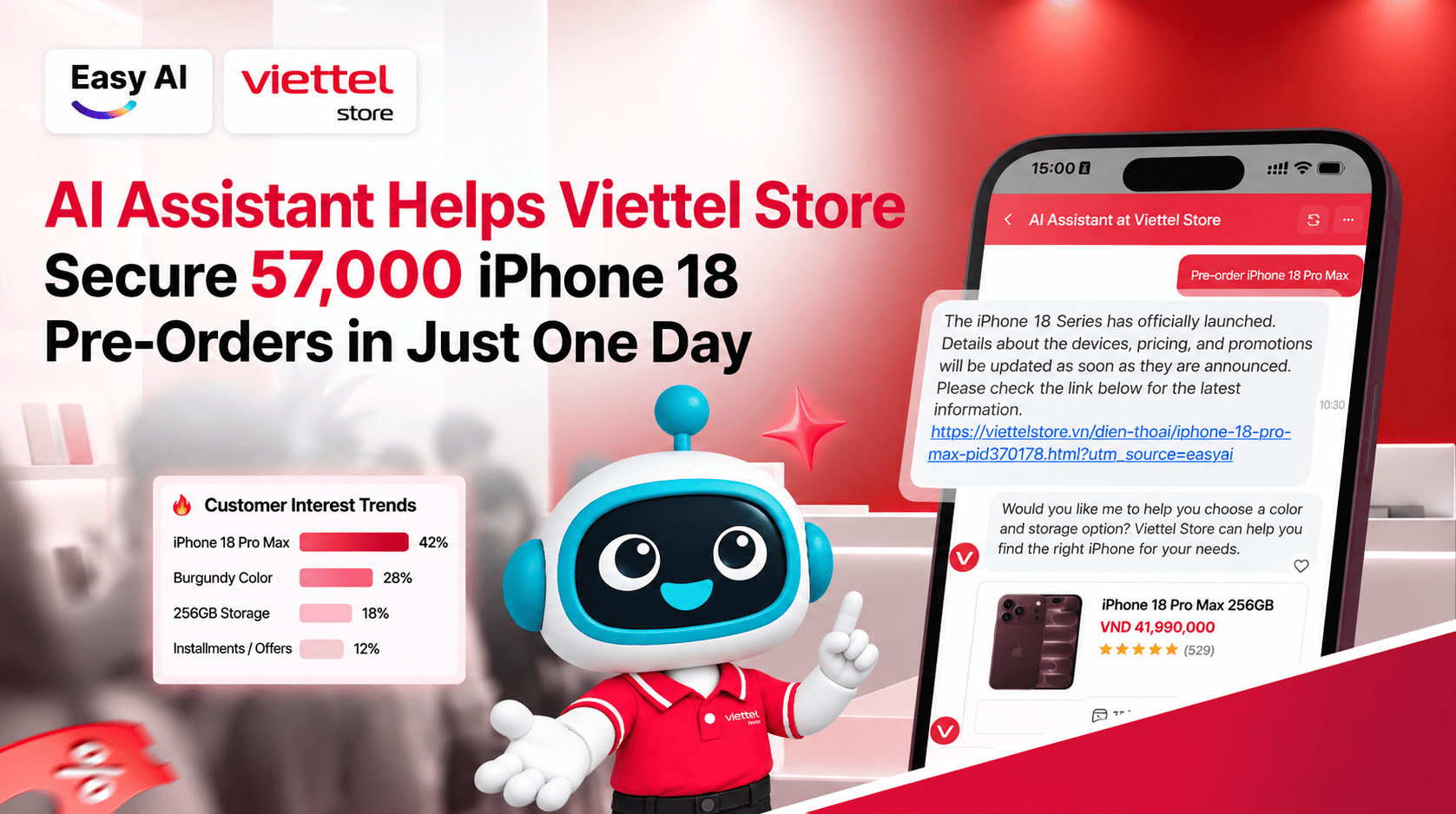
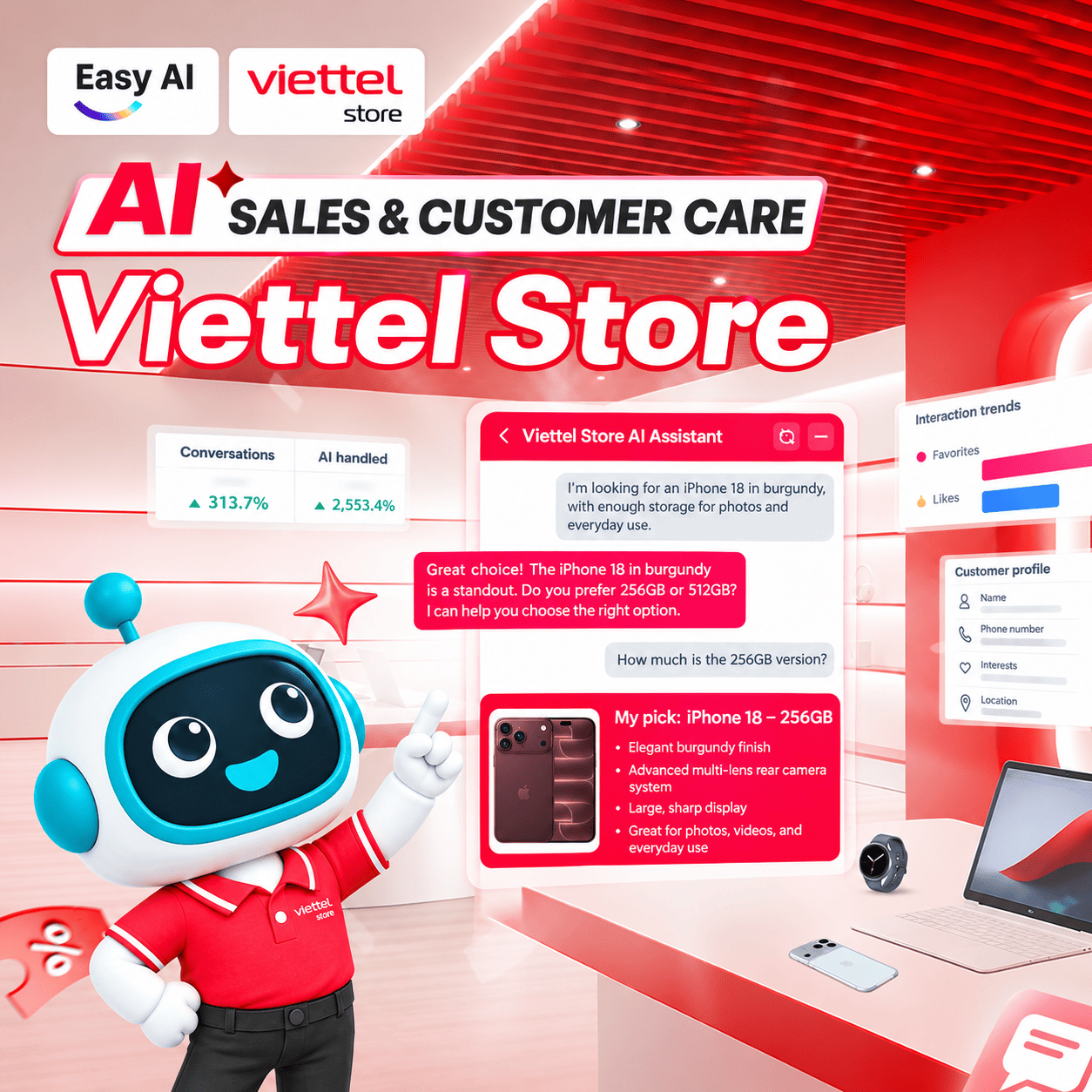
Viettel Store: Large-Scale AI Sales Assistant Handles a Surge of 57,000 Pre-orders
- Challenge: During the iPhone 18 launch, a large volume of incoming inquiries placed severe pressure on the Sales and Customer Service teams. The risk of inaccurate recommendations due to frequently changing product and price information, combined with missed “hot leads” outside business hours, directly threatened sales opportunities.
- AI chatbot solution: Easy AI implemented a 24/7 AI sales advisory system built on a standardized knowledge base covering products, prices, promotions and policies. The AI does more than answer questions: it also supports Upsell & Cross-sell strategies by recommending suitable versions and related accessories such as cases, chargers and headphones, and smoothly connects customers to Livechat when an employee needs to handle the request in greater depth.
- Results: Successfully handled more than 15,000 requests in a short period, contributing to Viettel Store recording 57,000 pre-orders in less than a day, maintaining continuous advisory support and substantially reducing pressure on the operations team.
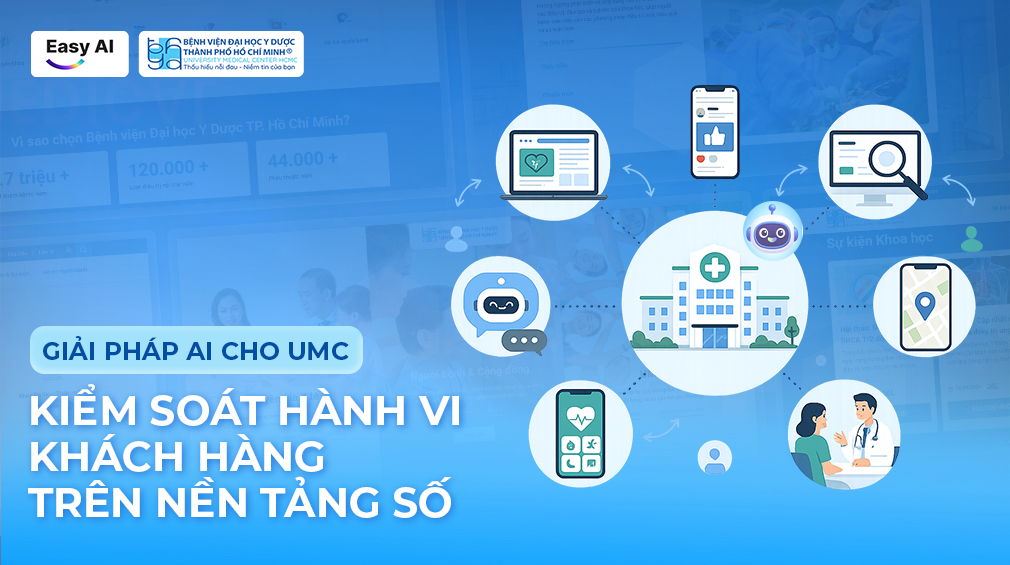
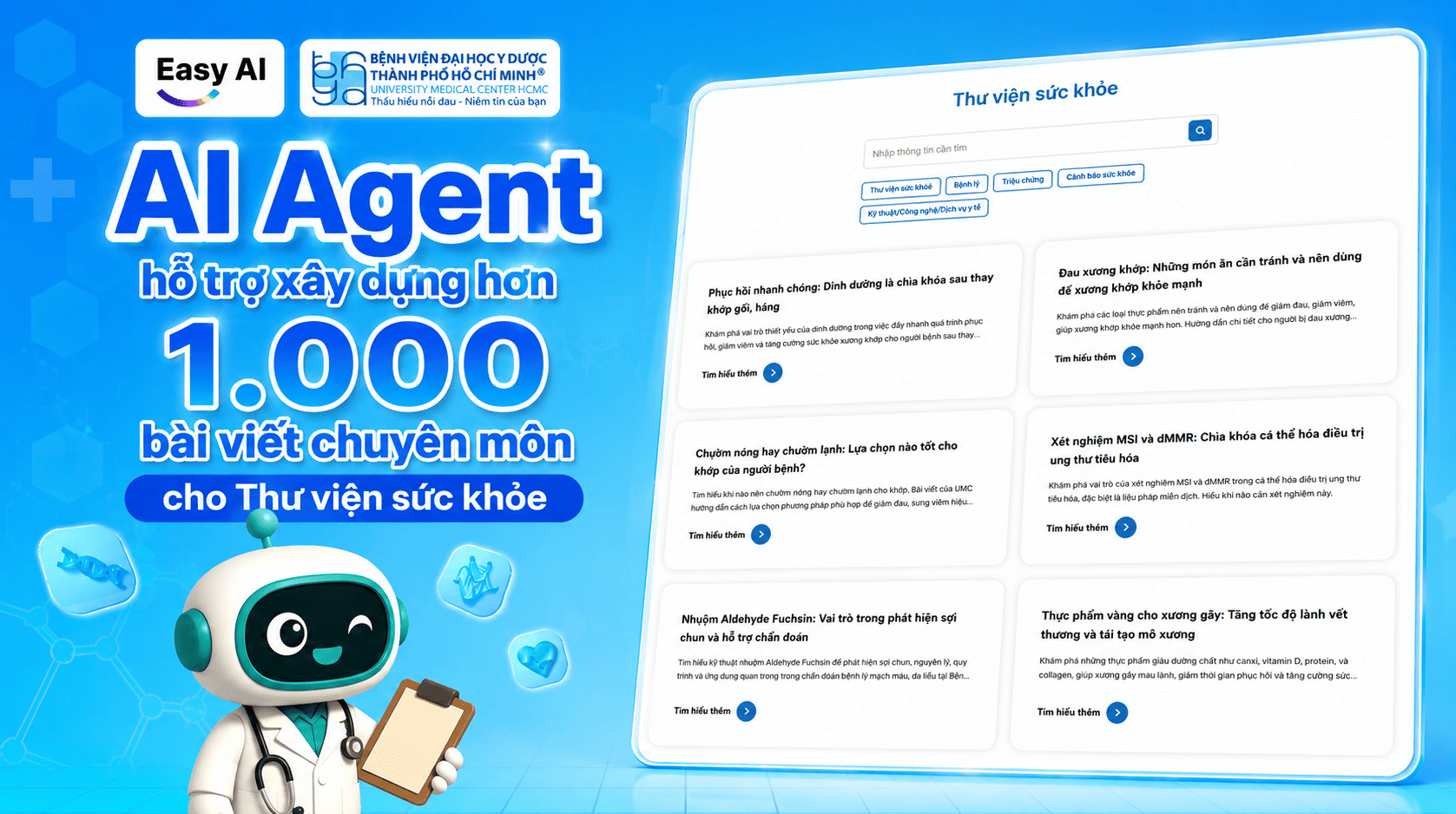
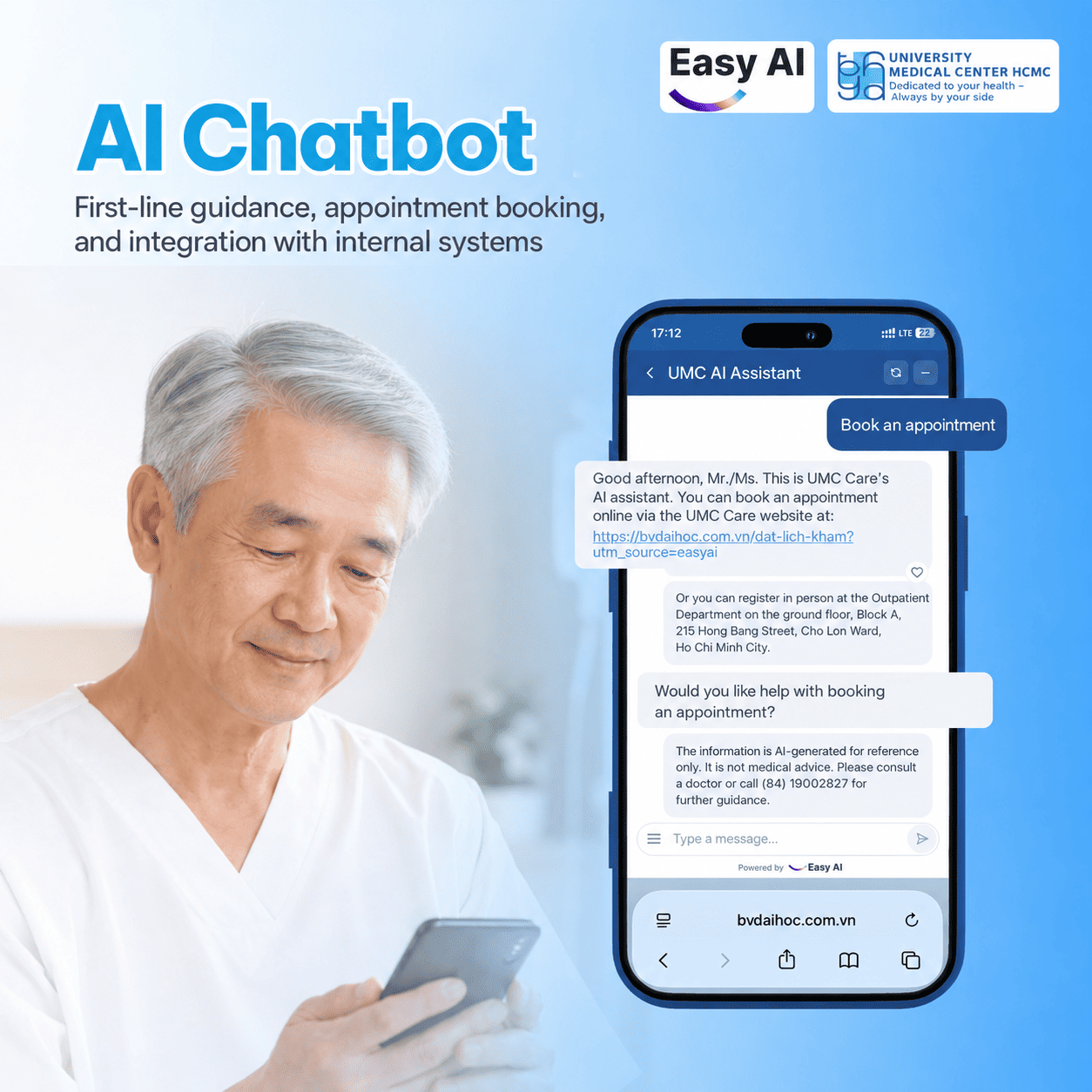
University Medical Center Ho Chi Minh City (UMC): Monitors Digital Behavior and Improves Access to Healthcare Information
- Challenge: As a Class I public hospital receiving a huge volume of information requests every day through its website, social media and other digital touchpoints, UMC faced fragmented data. Medical staff spent considerable time answering repetitive questions, while the hospital had difficulty understanding the public’s actual information needs and search behavior.
- AI chatbot solution: An AI chatbot was deployed as part of an AI-native model, serving as the first point of contact to help people quickly look up examination procedures, appointment schedules and service information 24/7. The system also connects to Customer 360/CDP to automatically record interaction data, analyze the topics users are interested in and turn those findings into insights for management.
- Results: Helped people access official information quickly, significantly reduced repetitive questions for hospital staff and provided clear digital behavior reports to support improvements in service quality.
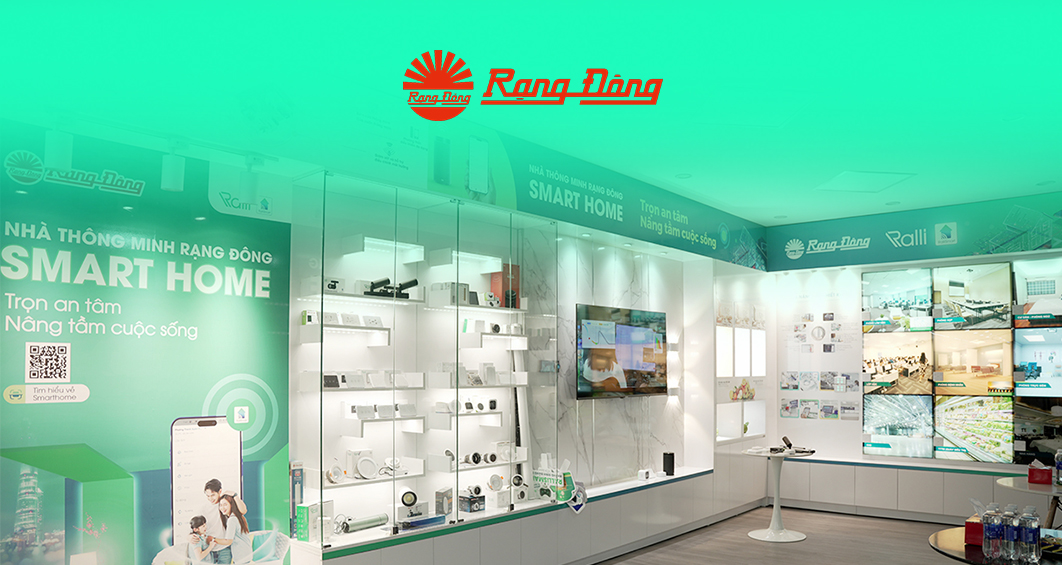
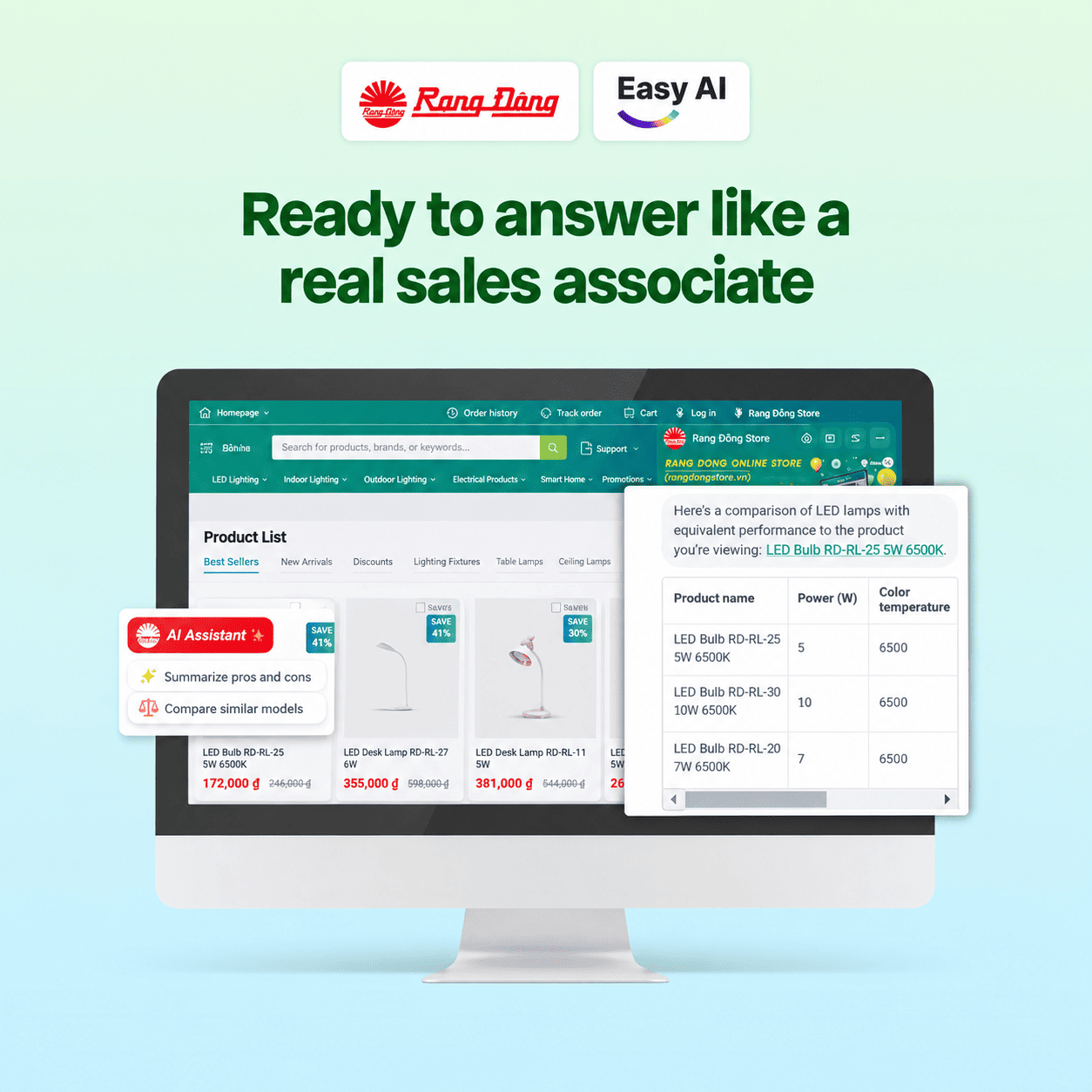
Rạng Đông Store: A Tailored AI Assistant for B2B Agents Increases Conversion by 8.2%
- Challenge: Rạng Đông, a leading lighting brand, faced barriers in its digital transformation because internal data was fragmented. In particular, B2B agents had difficulty finding information, manually placing large orders and accessing specialized support features on the e-commerce platform.
- AI chatbot solution: Easy AI tailored an AI chatbot system and integrated it directly into Rạng Đông Store. Trained on the website’s standardized knowledge base, the chatbot supports OTP login, cart synchronization and personalized promotions for different agent groups. It also lets agents upload a product-code file to place large orders automatically.
- Results: More than 95% customer satisfaction, over 2,000 AI-assisted order survey responses, 100% of product data updated in real time and, in particular, an 8.2% increase in order conversion.
11. Conclusion: AI Chatbots Create Real Value When They Support Operational Needs
An AI chatbot delivers value when it is designed around a specific process, uses a standardized knowledge base, integrates within a defined scope and has clear controls and handoff mechanisms for employees. Rather than treating a chatbot as a standalone response layer, businesses should start with a measurable use case, then monitor quality and optimize continuously based on real-world results.
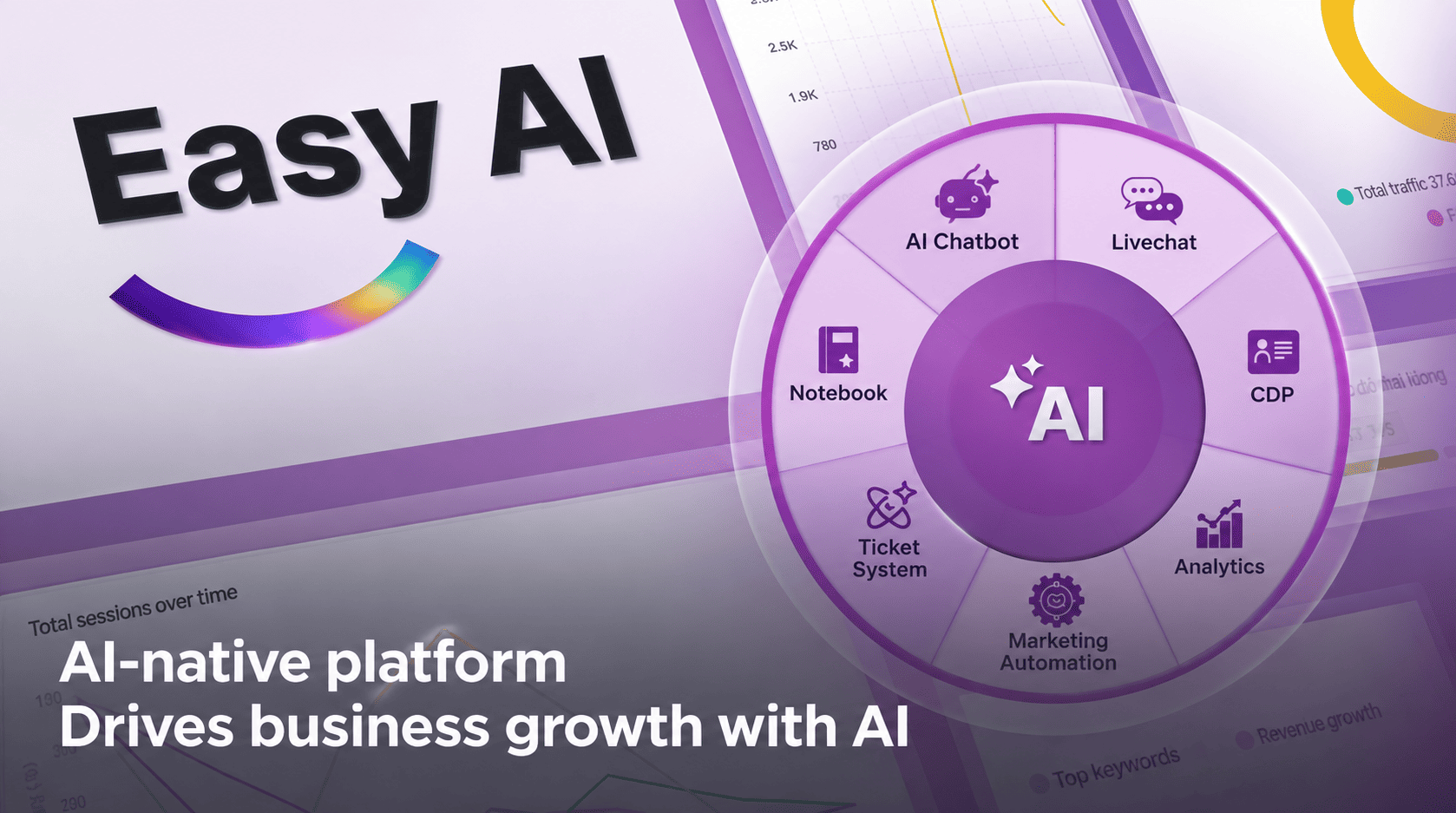
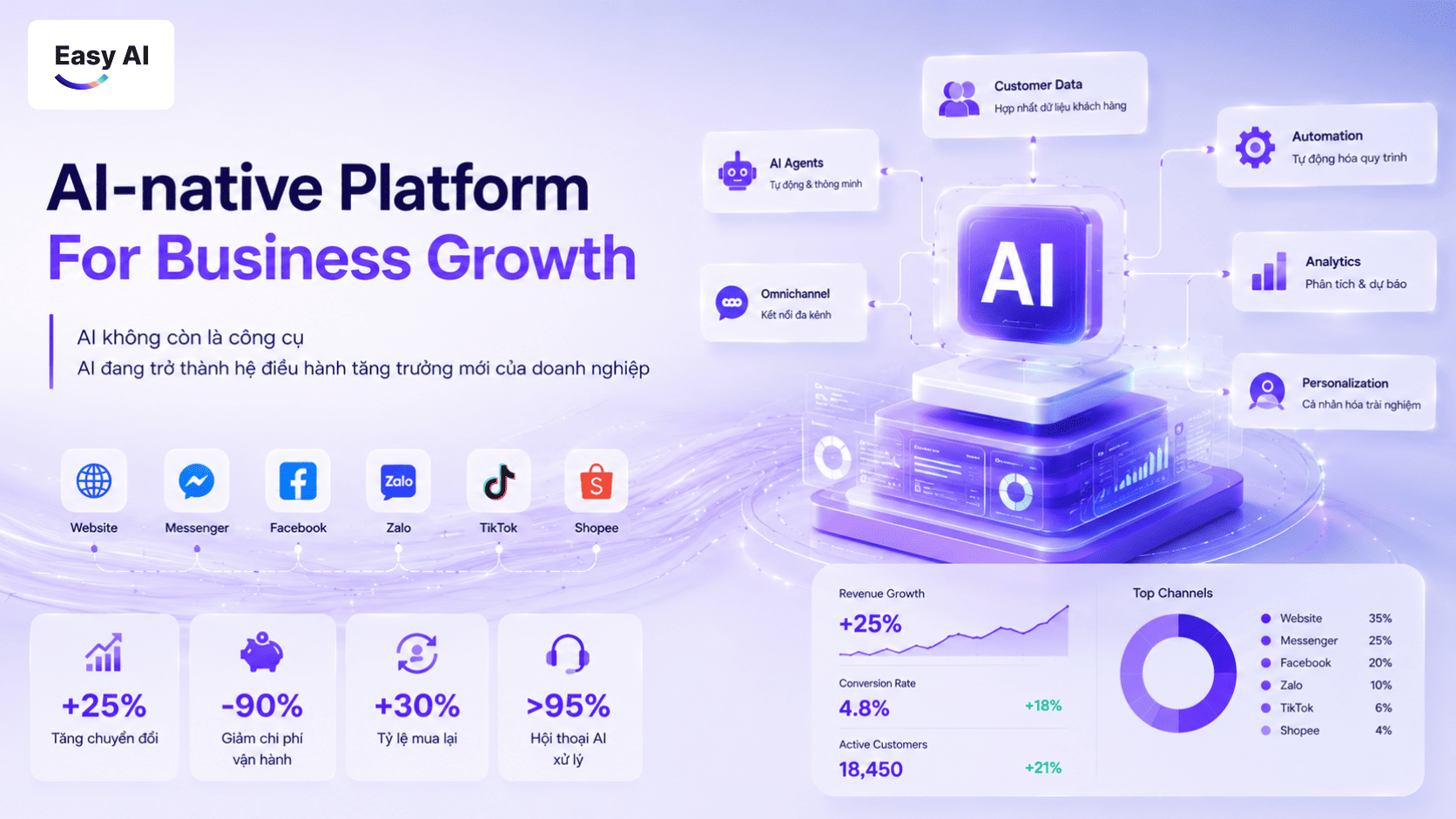
With this in mind, Easy AI provides an AI chatbot and Livechat solution that helps businesses receive customer requests, respond automatically 24/7 using internal knowledge and smoothly hand more complex cases over to employees. Depending on project scope, the solution can integrate deeply with Customer 360/CDP and data analytics systems to optimize workflows across Marketing, Sales and Customer Service.
Are you evaluating AI chatbot solutions to improve your business operations?
Talk with the Easy AI expert team to define the right use case, choose integration channels and build an implementation scope suited to your business model.
Register for a 1:1 consultation and experience an AI solution demo with Easy AI now!
Topics
FAQ
Recommended for you