AI for Enterprise: From Support Chatbots to AI-Native Systems
1. Why Is AI for Enterprise Becoming the New Operational Trend?
Over the past 2 years, AI has evolved from an experimental technology into a daily working tool for millions of office workers. From content writing and report generation to customer care, AI for enterprise is transforming operational methods faster than any previous wave of technology.
However, most businesses today are still applying AI at an individual level, where each employee independently uses chatbots to boost isolated work efficiency. While this increases short-term productivity, it is insufficient to build organizational-level AI operational capabilities.
According to McKinsey & Company (1), 65% of global enterprises have deployed GenAI in at least one operational function in 2024, nearly double the previous year. This is also why AI is no longer viewed as an auxiliary tool, but is gradually becoming a new operational infrastructure layer for enterprises.
In Vietnam, the AI adoption trend is accelerating rapidly across retail, finance, healthcare, and services as businesses face pressure to optimize operations, reduce labor costs, and enhance real-time customer experiences.

2. Comparing Personal AI Chatbots and AI for Enterprise
The popularity of ChatGPT caused many businesses to pay greater attention to AI. In the early stages, simply having employees use AI chatbots to write content, answer conversations, or assist with daily tasks was considered "applying AI for enterprise."
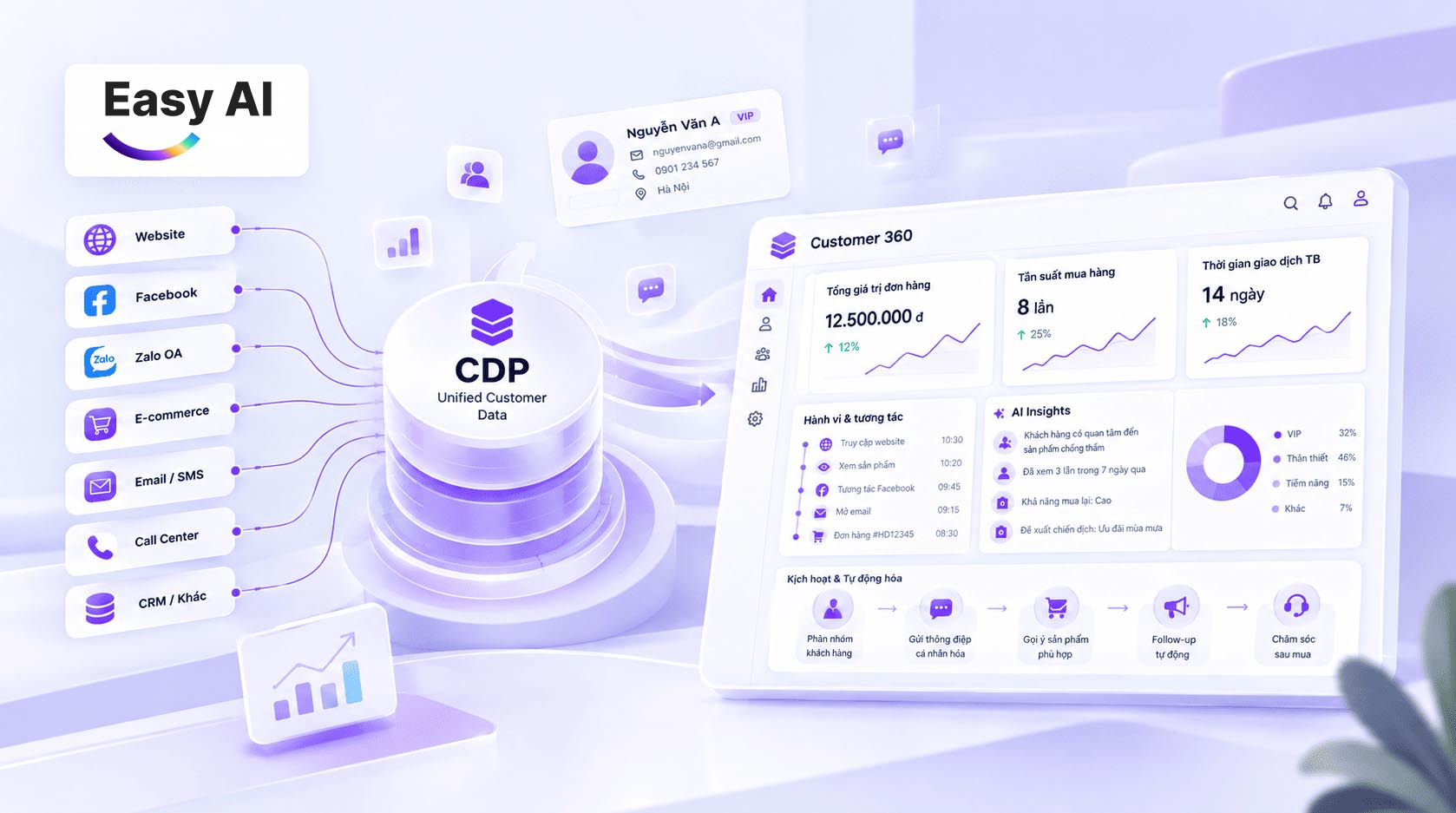
However, when AI stops at the individual level, businesses still encounter familiar issues: fragmented data, disconnected workflows, difficulty integrating with internal systems, and virtually no way to measure real operational impact. Meanwhile, AI-native platforms are taking an entirely different direction. AI no longer merely supports individual employees, but begins connecting directly with CRMs, customer data, workflows, and operational systems to participate in real-time customer care, sales, marketing, and business automation.
This is why an increasing number of businesses are transitioning from standalone chatbots to AI-native models, where AI does not just "chat," but directly participates in operations and growth.
Standard AI Chatbots | AI for Enterprise |
|---|---|
| Supports individual employees | Connects entire business operations |
| Content writing, chat responses, handling individual tasks | Automates CS, sales, marketing, and workflows |
| Fragmented data, unable to connect internal data | Connects CRM/CDP/POS and customer data |
| Does not form cross-departmental processes | Supports cross-departmental real-time workflows |
| Difficult to measure real business impact | Measurable performance, revenue, and conversion rates |
| AI responds to conversations | AI directly participates in operations |
In reality, many businesses currently have hundreds of employees using AI every day, yet the organization has not truly become an "AI-driven company." The root cause lies in AI still operating in silos per individual, rather than being connected into shared data, workflows, and operational systems.
AI at the enterprise level is therefore not just about deploying chatbots, but is the process of making AI part of the operational system to support customer care, data processing, and workflow optimization at scale.
3. How Is AI-Native Changing the Way Enterprises Operate?
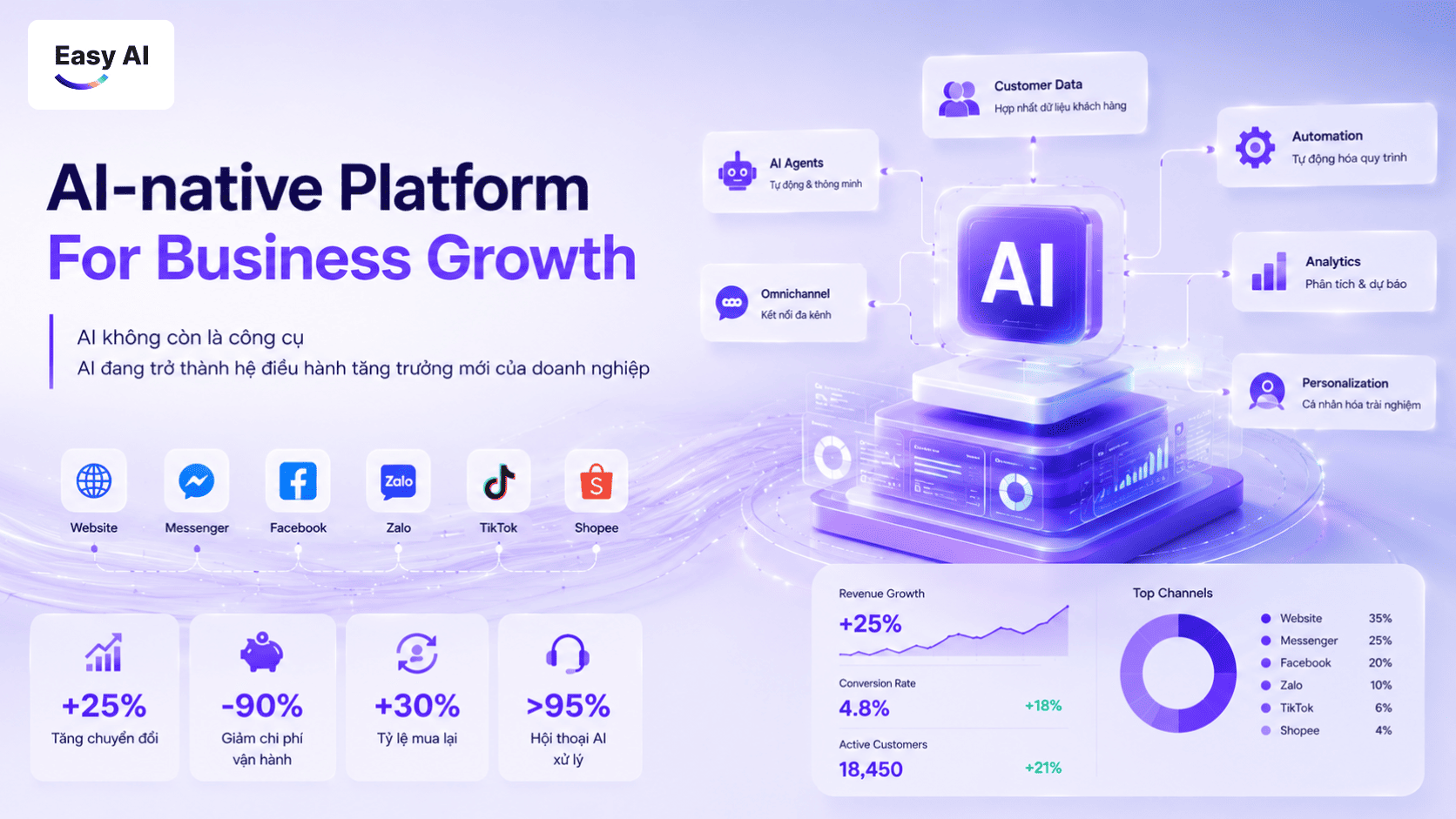
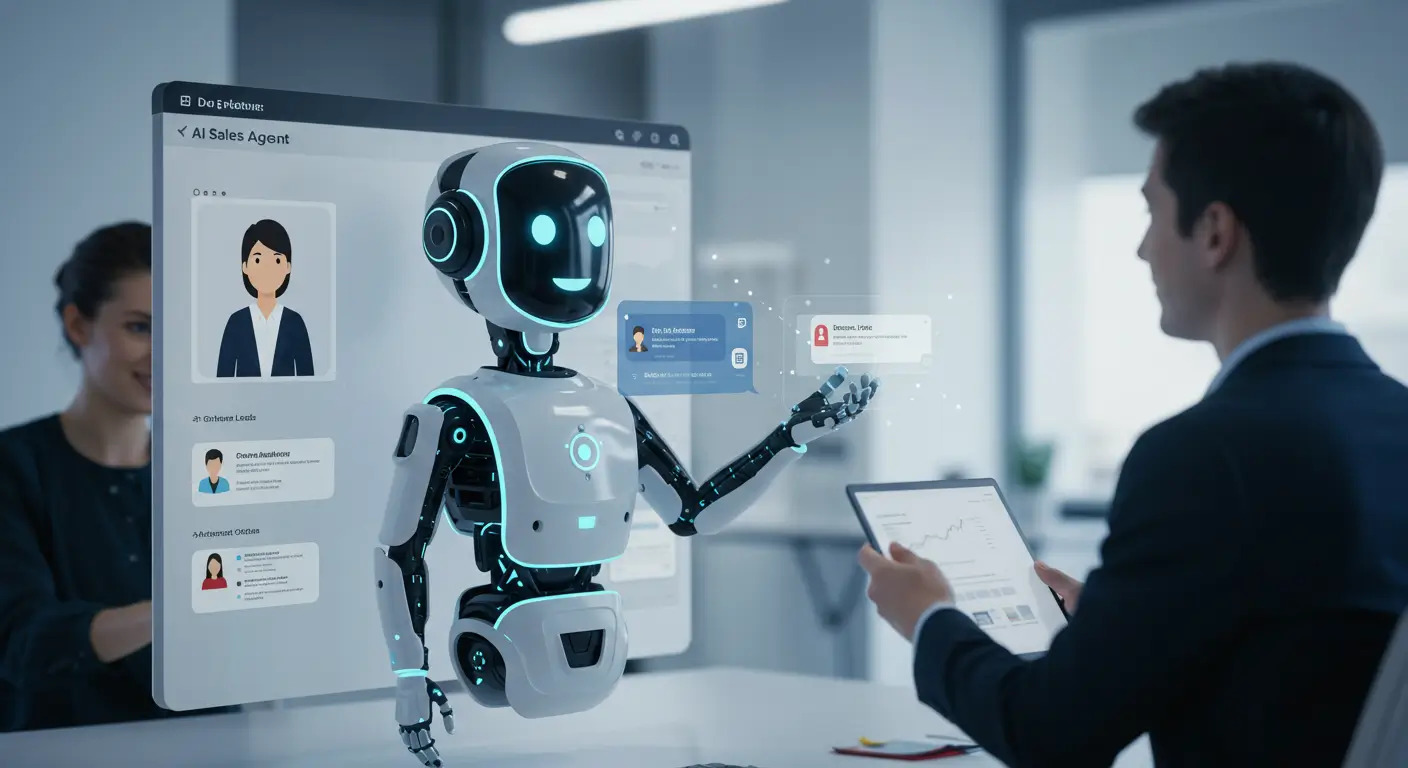
AI-native is an enterprise model where AI not only supports staff but directly participates in operations, customer care, and real-time revenue optimization. Easy AI helps businesses build AI-native platforms with the capability to master AI models and operational data, embedding AI throughout the entire sales journey, customer service, and operational automation.
Unlike the initial phase of digital transformation, businesses today are no longer just digitizing processes, but are beginning to insert AI directly into operational activities. In an AI-native model, AI becomes an "intelligent operational layer" connecting data, customers, and internal systems in real time.
This is why more and more businesses are starting to build:
Omnichannel customer service AI
AI workflow automation
AI CRM
Internal AI agents
AI knowledge base
Instead of hiring more staff to handle growth, businesses are beginning to build an "AI workforce" to scale operations more efficiently.
As AI-native goes deeper into operations, customer service AI no longer just sends automated responses, but begins to understand context, data, and customer journeys to provide more accurate real-time consultations, answers, and care.
(*AI workforce: an operational model where AI Agents and automation participate in processing part of the work such as CS, sales, data, and workflows alongside humans.)
4. Enterprise AI Chatbots Are Changing Customer Operations
One of the fastest-growing applications today is customer care AI. As customers expect faster, more personalized responses operating 24/7, traditional customer service models begin hitting limits in cost and scalability.
Enterprise AI chatbots are no longer simple automated reply systems. When connected to CRM, conversation data, and customer journeys, AI can:
Provide contextual consultation
Collect and classify leads
Deliver post-sales care
Support omnichannel sales
Automatically route to operational teams
AI chatbots can learn from enterprise data to continuously improve conversation quality in real time. Simultaneously, this serves as the first touchpoint helping businesses gather customer data to optimize conversions and omnichannel operations.
5. Enterprise AI Use Cases by Industry
Industry | Common AI Use Cases | AI Application Goals |
|---|---|---|
Retail | Product advisory AI chatbots, remarketing AI, buying behavior analytics AI | Increase conversions, reduce missed leads |
Finance | CS support AI, process automation AI | Speed up processing, reduce operational costs |
Healthcare | Appointment booking AI, patient AI CRM, medical AI chatbots | Optimize patient experience |
Booking & Services | Booking support AI, upsell AI, CS automation AI | Increase booking rates and customer retention |
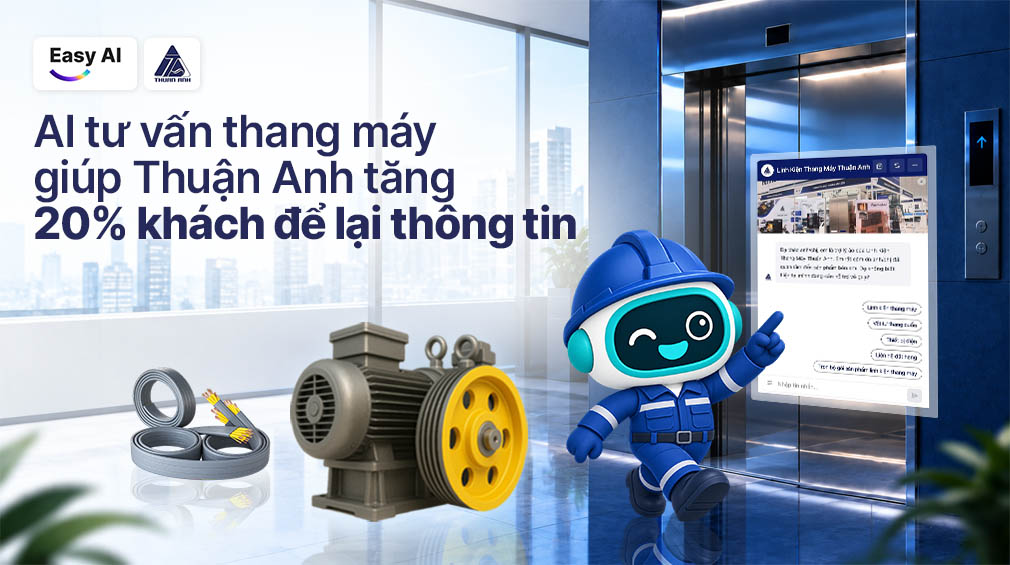
Furniture | Product advisory AI, preliminary quotation AI | Speed up consultation and reduce sales workload |
6. The Impact of AI on Business Operations and Revenue
In practice, the ultimate goals for enterprise AI implementation usually revolve around two problems: increasing revenue and reducing operational costs.
While AI was previously viewed as a tool to help staff work faster, businesses are now measuring AI by concrete business metrics like conversion rates, customer response speeds, or system scalability without a corresponding increase in headcount.
From a revenue perspective: AI helps businesses respond to customers faster, reduce missed leads, and personalize experiences based on user behavior.
From an operational perspective: AI helps automate repetitive tasks such as customer service, request classification, report generation, and internal workflow processing.
More importantly, when AI is connected to business data, every conversation and every workflow becomes operational data that helps the system continuously learn and optimize in real time.
7. Easy AI and AI-Native Architecture for Enterprise
In Vietnam, many enterprises have begun moving past the single-AI experimentation phase to build AI systems at actual operational scale.
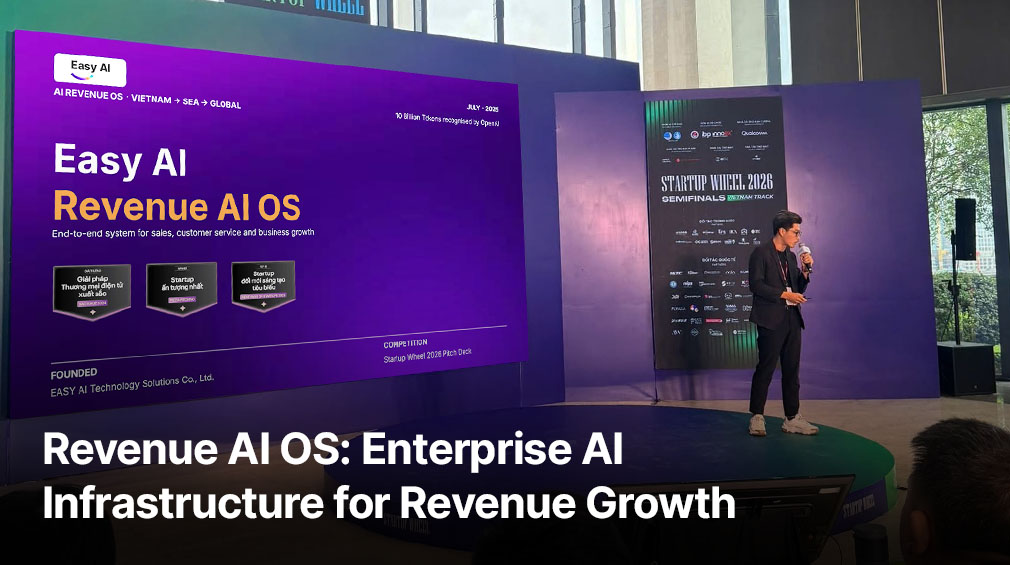
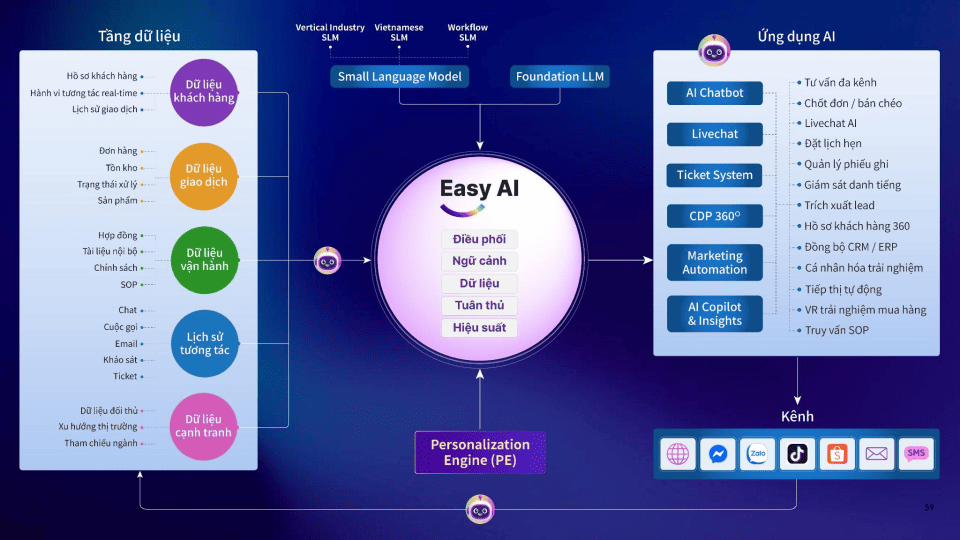
Easy AI currently focuses on developing enterprise AI solution layers to optimize the entire customer journey, from acquisition, consultation, and care to post-sales retention.
Instead of deploying fragmented AI per department, many businesses are starting to build AI-native architecture capable of connecting data, workflows, and the entire customer journey within a unified system. This is also the approach Easy AI is pursuing in the Vietnamese market.
In this new phase, the question is no longer "whether to use AI," but how fast a business can build AI capabilities to create a competitive advantage in a market shifting toward AI-native.
Topics