




AI Agent vs Chatbot for Sales: Route Each Conversation Step
A sales conversation rarely contains one kind of task. A buyer may ask about a published plan, answer qualification questions, describe an unusual requirement, and request a custom discount in the same exchange. The team should not choose one system for the whole chat.
Choose each step instead: chatbot for the conversation, workflow for known rules, a bounded agent where the path varies, and human approval where evidence or authority ends. The routing model below helps sales and RevOps teams define that route and its handoff—not select a vendor or reach a legal conclusion.
Use one routing model for every conversation step
Start by changing the unit of comparison. The model works at step level because “qualify this lead” is still too broad: answering a plan question, validating team size, interpreting an unusual requirement, and approving a discount can need different controls.
This layered view is also consistent with Salesforce's current category explainer, which separates scripted chatbot paths from agents that reason and act while allowing for a hybrid choice by scenario (Salesforce). The useful implication is composition rather than replacement; the model here turns that boundary into an operating decision without inheriting Salesforce's product claims.
Record these six inputs for each step:
- Consequence: what happens if the answer or action is wrong—minor friction, recoverable rework, or a commercial commitment?
- Path variability: is the next step fixed, selected by explicit rules, or chosen from context?
- Permitted action: may the system answer, read, draft, or execute?
- Reversibility: is the result easy to undo, costly to undo, or difficult to reverse?
- Evidence state: is the required source current and approved, or missing, stale, or conflicting?
- Control readiness: can the team restrict data, tools, actions, retries, and stopping conditions and review what happened?
Apply these rules in order:
- Stop at the evidence gate. Missing, stale, conflicting, or unapproved evidence means clarify or hand off; fluent generation does not repair the source.
- Stop at the authority gate. A binding price, custom discount, contract term, guarantee, credit decision, or other difficult-to-reverse commitment requires the accountable person's approval.
- Keep known paths deterministic. A fixed response can stay in the controlled chatbot; an enumerable branch or validation rule belongs in a deterministic workflow.
- Use a bounded agent only for variable paths. The next step must depend on context, while the available sources and tools remain approved, narrow, observable, and stoppable.
- Grant the smallest action. Start with read or draft. Add execution only for an allowlisted, tested, reversible action with a named owner and recovery path.
- Write the handoff trigger before launch. It must be observable—for example, “price source older than 30 days” or “buyer requests any non-standard discount”—not “when confidence is low.”
Your completed route card has only four columns:
| Conversation step | Selected route | Permitted output or action | Handoff trigger |
|---|---|---|---|
| One buyer job, not a whole channel | Chatbot, deterministic workflow, bounded agent, or human approval | Answer, read, draft, or execute | Specific evidence, authority, limit, failure, or buyer-request condition |
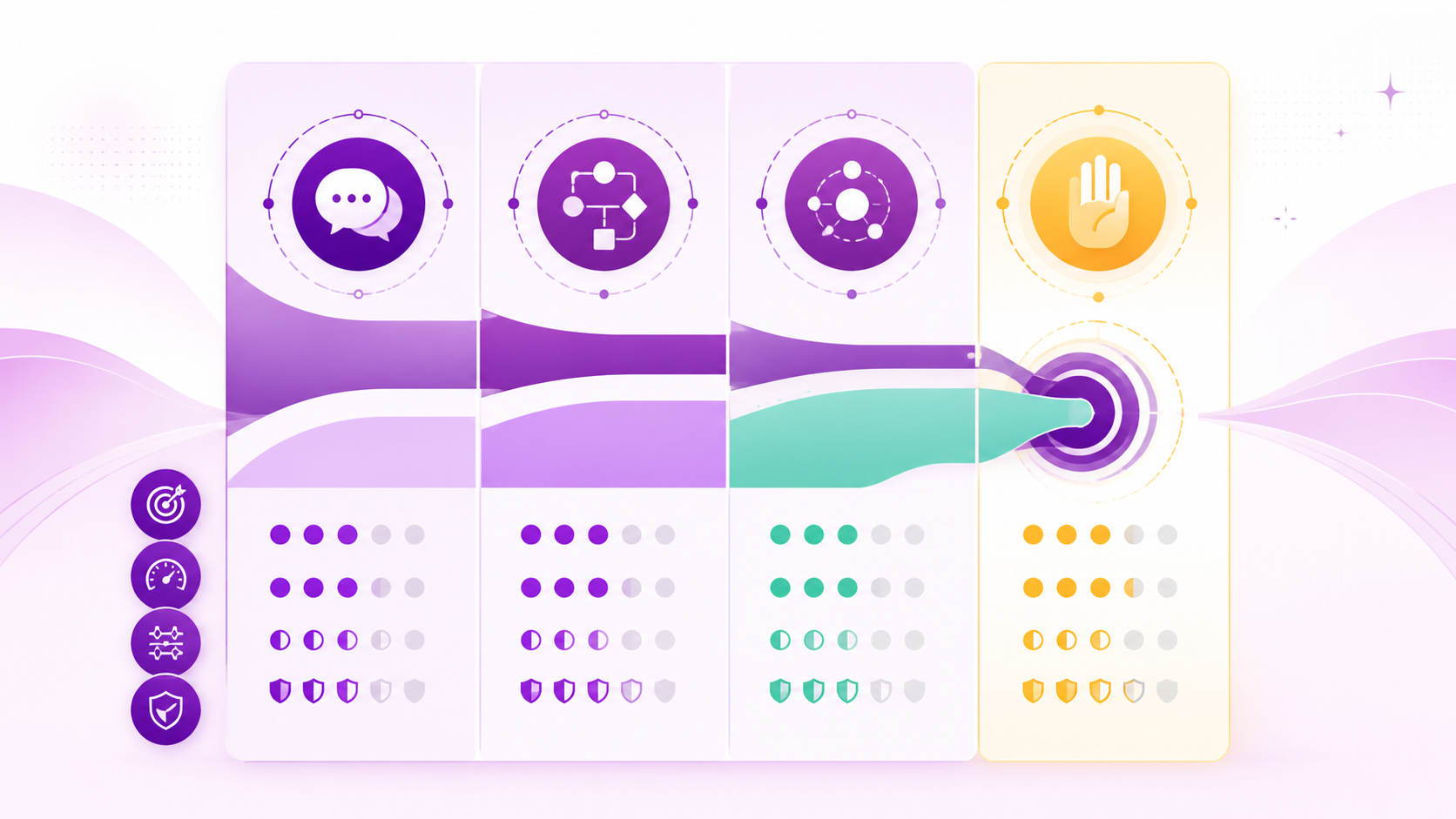
The four routes are not peer products. The chatbot is the conversational surface. The workflow enforces known state and rules. A bounded agent selects among permitted paths when context makes a fixed branch impractical. Human approval is an authority layer that can interrupt or complete any of the other three.
Anthropic draws a similar architectural boundary between predefined workflows and agents that direct their own process and tool use, and says the patterns can be combined (Anthropic). Its page now notes that parts of its December 2024 tooling discussion are dated, so use it for the boundary and composability—not current tool selection.
Worked example: plan guidance, qualification, and a price hold
Assume a buyer writes: “We have 20 salespeople, need three managers to review conversations, and want to start next month. Which plan fits, and can you hold the price until next quarter?” This is an editorial scenario, not an Easy AI or vendor capability, price, or policy claim.
First, split the conversation into four steps and record the inputs. The two tables are one route card split for mobile readability.
| Step | Consequence | Path variability | Evidence and reversibility |
|---|---|---|---|
| 1. Explain published plan differences | Moderate if wrong | Fixed answer plus one clarification | Current approved plan source; an answer is easy to correct |
| 2. Validate team and reviewer counts | Low to moderate | Explicit field and eligibility rules | Buyer-provided fields; validation is easy to rerun |
| 3. Interpret the review requirement | Moderate | Several valid follow-up paths depend on context | Approved capability notes plus buyer language; a draft is easy to revise |
| 4. Decide whether to hold a price | High commercial consequence | Requires exception authority | No approved promise in the scenario; a stated commitment is difficult to reverse |
| Step | Permitted action | Selected route | Handoff trigger |
|---|---|---|---|
| 1. Plan differences | Answer from the approved source; ask one clarification | Controlled chatbot | Source missing, stale, conflicting, or buyer asks for a non-standard term |
| 2. Required fields | Read the reply and validate fields; do not infer missing values | Deterministic workflow | Required field remains missing after one clarification or rule returns no valid route |
| 3. Review need | Read approved notes and draft a structured requirement summary | Bounded AI agent | Required source is absent, a tool fails twice, or the next action is outside the allowlist |
| 4. Price hold | Draft a request for review; do not promise or execute | Human approval | The request itself triggers handoff because it creates a time-bound commercial commitment |
A complete conversation can then run like this:
- Chatbot: states the approved plan differences and asks, “Do the three managers need to review all conversations or only escalated ones?”
- Workflow: stores
sales_users = 20andreviewers = 3, rejects an empty start date, and routes the validated record to the next step. - Bounded agent: summarizes, “Buyer needs 20 sales users, three reviewers, an escalation-only review path, and a next-month start,” then drafts one follow-up question from approved capability notes. It cannot change price, send a quote, or write an opportunity stage.
- Human approver: receives the summary, source links, unanswered price-hold request, and actions already taken. The person accepts, modifies, or declines the request and owns the message sent to the buyer.
The output is reconstructable: another reviewer with the same evidence and rules can see why each route was selected and exactly where authority changed hands.
Define the boundary of each layer
Controlled chatbot: conversation without open action authority
A controlled chatbot can understand phrasing, retrieve approved content, ask designed questions, and present the next known choice. It may use generative AI and still remain a chatbot in this model; natural language does not itself grant control of workflow execution.
Deterministic workflow: state and policy that should not improvise
A workflow applies explicit validation and routing rules. The same validated inputs should lead to the same branch. Use it for required fields, eligibility checks, queue assignment, approval requests, and other paths the team can enumerate and test.
Bounded AI agent: context-selected steps inside a narrow envelope
An agent enters only when a model must choose the next step or tool based on context. Its envelope names the goal, approved sources, allowlisted tools, read/draft/execute rights, maximum steps and retries, stopping conditions, and handoff packet. OpenAI's guide defines agents partly by model control of workflow execution and dynamic tool selection, then recommends layered guardrails and human intervention for failure thresholds and high-risk actions (OpenAI guide, PDF).
Human approval: accountable authority, not a failure state
Human approval is a deliberate layer for judgment, exceptions, disputes, and commitments. It can sit after a chatbot, workflow, or agent. A useful handoff preserves the buyer's goal, verified facts, sources used, unresolved question, attempted actions, and expected next step.
Test the route, not only the quality of the reply
Build a versioned test set from real conversation shapes without exposing private customer data. Include common questions, paraphrases, incomplete or conflicting inputs, edge cases, prohibited requests, tool failures, and explicit requests for a person.
Intercom's evaluation guidance recommends testing multi-turn, vague, fragmented, edge-case, multi-source, and handoff scenarios, then checking the review and improvement loop after launch (Intercom). This is vendor-authored guidance from customer-service operations, so apply the test mechanism to sales routing; do not treat its product conclusions as independent proof.
Track rates with explicit denominators:
| Metric | Formula | Owner and cadence | Threshold response |
|---|---|---|---|
| Routing accuracy | Correct routes ÷ all evaluated cases with a human-approved expected route × 100 | Sales operations; weekly during pilot, monthly after stabilization | Review every high-consequence misroute; set the release threshold from the approved test baseline |
| Grounded material-answer rate | Material answers supported by a current approved source ÷ all sampled material answers × 100 | Knowledge owner; weekly | Remove or reroute any topic that misses its required source; do not fill the gap from model memory |
| Boundary adherence | Cases with no prohibited tool, data use, or commitment ÷ all evaluated cases × 100 | System owner; every release | Any prohibited high-consequence action blocks expansion until cause and control are verified |
| Handoff completeness | Handoffs containing every required packet field ÷ all reviewed handoffs × 100 | Sales queue owner; weekly | Repair missing fields or routing ownership before increasing automation |
| Recovery-safe rate | Tested failure cases with no duplicate or conflicting action ÷ all tested failure cases × 100 | Workflow owner; every release | Pause the affected execute permission until retry and idempotency behavior passes |
There is no credible universal threshold for these rates. Set thresholds by consequence, baseline, and the accountable owner's risk decision. NIST's AI RMF Playbook says evaluation methods should fit the intended context, acceptable limits should be defined, and errors and controls should be reviewed over time (NIST Measure); it also recommends mapping human roles and considering non-AI alternatives (NIST Map). NIST currently warns that AI RMF 1.0 and the Playbook are being updated, so re-check these references before publication or a substantive refresh.
Limits of this model
This model compares operating patterns, not vendors. Actual behavior depends on the model, implementation, knowledge quality, channel, permissions, monitoring, and team operations. “Chatbot” and “agent” are inconsistent market labels, so inspect workflow control and authority rather than accepting the label.
The model does not guarantee conversion, savings, compliance, or safe operation. It is not legal, contracting, or pricing advice. NIST's Manage guidance says teams should explicitly decide whether AI is appropriate for the task and keep monitoring risks and benefits through the lifecycle (NIST Manage). Product-specific evaluation still requires current documentation, hands-on testing where behavior matters, an as-of date, and the same evidence standard for every option.
What to do next
Apply the route card to one current conversation and name the handoff trigger for every step. If the result is a controlled conversational path, use the AI sales chatbot design guide. If it depends on qualification fields and queue rules, continue with the lead qualification flow. If a bounded agent remains justified after testing, use the enterprise AI agent readiness playbook before expanding authority.