




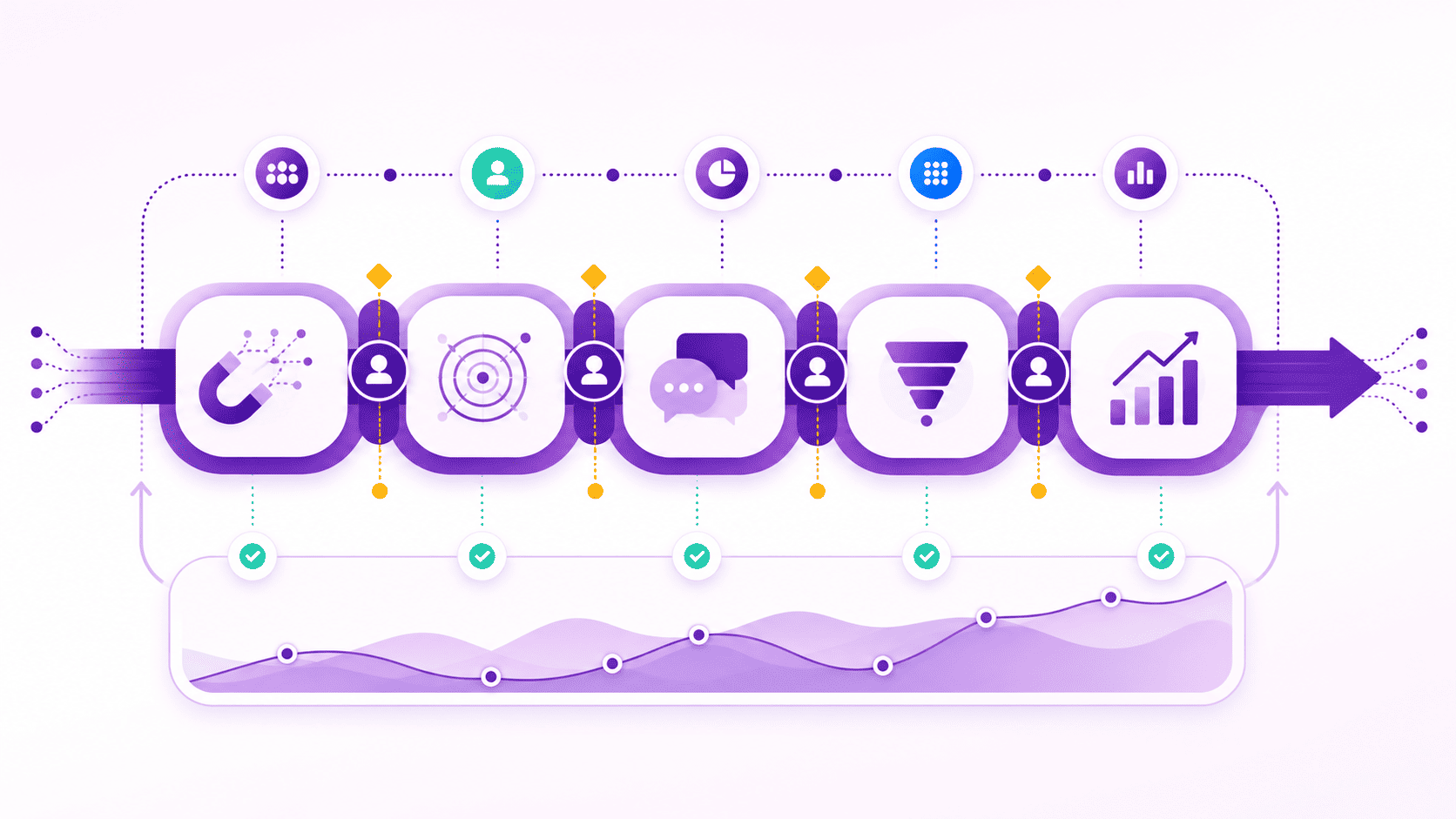
Lead Qualification Scorecard for AI Chat and Sales Routing

If your team cannot explain how a lead should be qualified, AI will not fix the problem. It will simply automate inconsistency faster. A useful lead qualification system needs clear signals, routing rules, CRM fields, and handoff expectations before any chatbot or agent goes live.
Use this scorecard to determine whether you are ready for AI-assisted qualification, or whether you still need to tighten the operating model first.
How to use this scorecard
Score each section from 1 to 5:
1means the area is mostly undefined or handled ad hoc.3means the basics exist, but quality depends on individual team members.5means the rule is explicit, repeatable, and measurable.
Add the five section scores for a total out of 25.
| Section | What good looks like |
|---|---|
| Qualification logic | You know exactly what counts as fit, intent, urgency, and disqualification |
| Conversation design | The chatbot asks short questions that change the decision |
| Routing and handoff | Escalation and ownership are explicit |
| CRM and data capture | Required fields, summaries, and source tags are structured |
| Measurement and review | You can review quality, not just volume |
Section 1: Qualification logic
Ask whether your team has a practical decision model, not just a vague idea of what a “good lead” means.
| Score | Readiness signal |
|---|---|
| 1 | Reps qualify leads differently, and no shared criteria exist |
| 2 | A few fields matter, but exceptions dominate the process |
| 3 | The team uses a framework such as fit, need, timing, and buyer role, but thresholds are loose |
| 4 | The criteria are documented and used across teams |
| 5 | The criteria are documented, tested, and tied to routing and reporting |
Minimum questions to answer
- What makes a lead worth routing to sales?
- Which questions change the next step?
- Which signals indicate poor fit, low urgency, or nurture instead of sales?
- What must never be guessed by the AI?
If you cannot answer those questions in one page, the qualification model is not ready.
Section 2: Conversation design
The chat flow should behave like a guided decision, not a form disguised as a chatbot.
| Score | Readiness signal |
|---|---|
| 1 | Questions are long, generic, or copied from a lead form |
| 2 | The sequence exists, but many questions do not affect the recommendation |
| 3 | The flow captures useful context, but branches are incomplete |
| 4 | Questions are short, purposeful, and tied to the next action |
| 5 | The flow has tested branches, fallback prompts, and a safe human exit |
Review the flow against these rules
- Ask only what changes the recommendation or handoff.
- Explain why a question is being asked when the purpose is not obvious.
- Offer a human path when the buyer is high intent or outside scope.
- Avoid collecting data “just in case” it might become useful later.
For a deeper design model, pair this scorecard with the lead qualification flow guide.
Section 3: Routing and handoff
Most failed qualification projects break at the point where the conversation stops being “AI” and starts becoming “sales.”
| Score | Readiness signal |
|---|---|
| 1 | Nobody owns the next step after a qualified conversation |
| 2 | Routing depends on manual judgment without shared rules |
| 3 | Basic ownership exists, but summaries and escalation criteria are inconsistent |
| 4 | Routing thresholds, SLAs, and summary fields are documented |
| 5 | Routing, ownership, and handoff quality are reviewed regularly |
Your process is strong enough when
- a qualified lead has a named destination;
- a conversation summary is structured, not free-form only;
- the sales team knows what “ready for handoff” means; and
- response timing is part of the operating process.
If that is not true, use the AI Sales Handoff Template before increasing automation.
Section 4: CRM and data capture
An AI qualification flow without structured data capture creates reporting noise instead of pipeline clarity.
| Score | Readiness signal |
|---|---|
| 1 | Chat data is not written back consistently |
| 2 | Notes are captured manually and fields are often missing |
| 3 | Some key fields exist, but naming and ownership vary |
| 4 | Required fields and summary format are standardized |
| 5 | CRM capture is structured, auditable, and tied to reporting |
Required outputs
At minimum, the flow should capture:
- lead source;
- buyer goal or use case;
- fit indicators;
- timing or urgency;
- requested follow-up;
- summary of the conversation; and
- routing outcome.
If the CRM cannot accept that structure, the AI should not pretend the handoff is complete.
Section 5: Measurement and review
The goal is not more conversations. The goal is more qualified, better-routed, better-followed-up conversations.
| Score | Readiness signal |
|---|---|
| 1 | The only metric is chat volume or form submissions |
| 2 | Basic lead counts exist, but quality is not reviewed |
| 3 | Handoff volume and response time are visible |
| 4 | Qualification rate, accepted handoffs, and follow-up speed are tracked |
| 5 | The team reviews quality, conversion, and failure reasons on a steady cadence |
Core metrics to track
- completion rate of the qualification path;
- handoff acceptance rate by sales;
- median time to first human follow-up;
- proportion of routed leads that were actually sales-ready; and
- pipeline or meeting outcomes from AI-assisted conversations.
Score interpretation
| Total score | Meaning | Recommended next step |
|---|---|---|
| 5-11 | Not ready | Document criteria, routing, and CRM capture before automating |
| 12-17 | Partially ready | Pilot one narrow segment with human review |
| 18-21 | Ready for controlled rollout | Launch one use case with clear measurement and handoff rules |
| 22-25 | Operationally strong | Expand to more segments, branches, and optimization loops |
Fast diagnostic: where teams usually fail
Teams rarely fail because the model cannot ask a question. They fail because:
- sales and marketing disagree on what counts as qualified;
- handoff summaries are too vague for a rep to trust;
- routing rules are informal;
- CRM fields are inconsistent; or
- nobody reviews the conversations after launch.
That is why the scorecard should be treated as an operating readiness test, not a prompt exercise.
What to do next
Use this sequence:
- Score the current state honestly.
- Fix the weakest section first.
- Design the qualification path in detail.
- Standardize the handoff.
- Roll out one controlled sales segment.
The next three assets are designed to support that path: