




EBOOK
24/7 Customer Response: A Coverage and Human-Handoff Model
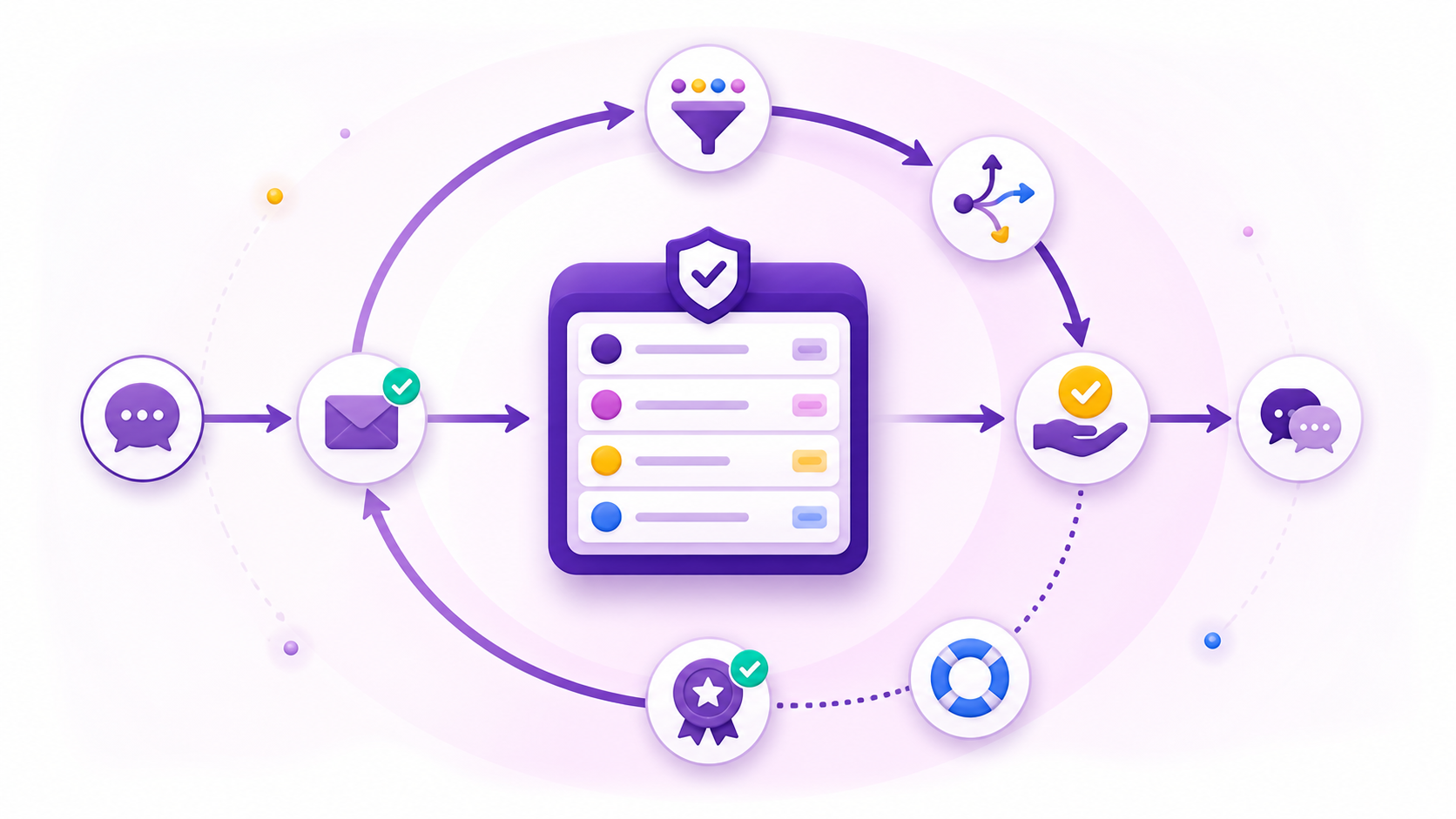
Choose an honest after-hours service promise, then implement acknowledgement, routing, human acceptance, fallback, and audit controls.
View details
A customer can ask a routine delivery question, dispute a charge, report a repeated failure, and request a person in the same conversation. “Low confidence” alone is too vague to decide when AI should stop.
Use five signals the team can see: the customer asks for a person, information is missing, approval is required, the same action keeps failing, or the consequence may be serious. When one appears, pause the affected action, preserve the conversation, and require a named person to accept the case.
| Signal | AI may still do | AI must not do | Who receives it |
|---|---|---|---|
| Customer asks for a person | Acknowledge and prepare context | Continue blocking access to a human route | Service queue |
| Required knowledge is missing, stale, or conflicting | Name what was checked | Fill the gap from model memory | Knowledge owner or specialist |
| The next step needs commercial or operational authority | Draft a request | Approve refunds, discounts, exceptions, or commitments | Authorized owner |
| The same route fails twice | Preserve attempts and error state | Repeat the failing action indefinitely | Technical or operations owner |
| Possible safety, security, privacy, legal, financial, or widespread impact | Capture facts and restrict action | Diagnose, promise a remedy, or expose sensitive data | Approved specialist route |
Sentiment can help prioritize review, but it should not be the only trigger. A calm message can describe serious harm; an angry message can still be resolved from approved knowledge.
Copy this list into the service record: case ID, customer's exact request, short summary, known facts, unknowns, sources checked, actions taken, promises made, stop signal, proposed next step, receiving team, and requested acceptance time. A notification is not acceptance: record accepted, rejected, or timed out beside a named owner.
Fin's vendor guidance also argues that context should move with an AI-to-human handoff so the customer does not repeat the issue. The packet above is an editorial implementation of that principle, not a claim about Fin or Easy AI performance.
Digital.gov separates acknowledgement, routing, tracking, status, and completion. That distinction prevents a notification from being mistaken for resolved ownership.
This is a fictional test case, not customer evidence.
B-204, preserves the exact statement, and retrieves the approved cancellation article.The case passes only when ownership, next action, and the customer update are recorded—not when the routing message is sent.
NIST's AI RMF treats governance, context, measurement, and management as continuous functions. Apply that principle by reviewing missed triggers, unnecessary handoffs, timeouts, and unsafe continuations on a fixed cadence.
Copy the transfer-note fields into one service form and test the five signals against recent anonymized scenarios. Then use the 24/7 response control model to add staffed routes, backup handling, and quality checks.
This neutral guide does not define legal duties, staffing ratios, service levels, or Easy AI capabilities. A service owner and relevant domain specialists must approve consequential triggers and destinations.
Choose an honest after-hours service promise, then implement acknowledgement, routing, human acceptance, fallback, and audit controls.
View details.jpg)
Use a six-part note to turn a shopper's question into a supported product choice, a clear next step, or a safe transfer to a person.
View details
Use seven filters and an industry-state matrix to select one bounded AI job with current evidence, an owner, a safe fallback, and a measurable end.
View details
Design a Zalo OA conversation workflow from verified account identity, message rules, approved knowledge, bounded automation, accepted human handoff, QA, and rollback.
View details
Decide what to automate by checking the source, observable change, allowed action, accepted handoff, and recovery path for one sales job.
View details
Decide when customer context is safe and useful, when a generic answer is better, and when a person must take over.
View details