
What is Vietnamese SLM? Evaluating Sales Quality Using AI
1. Vietnamese SLM Is Becoming a New Direction for Enterprise AI
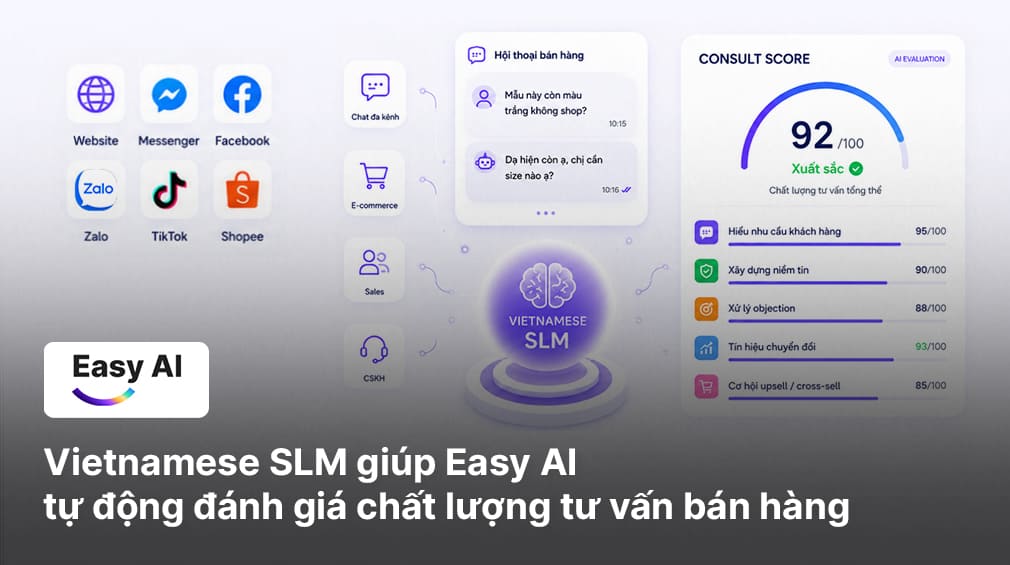
Vietnamese SLM (Vietnamese Small Language Model) is a small language model trained and optimized specifically for the Vietnamese language and dedicated business tasks. Unlike generalized LLMs designed to handle broad categories of requests, a Vietnamese SLM focuses on specialized problems such as sales, customer care, conversation analytics, or knowledge management.
By optimizing for actual operational contexts, a Vietnamese SLM delivers higher accuracy, faster processing speeds, and lower deployment costs across numerous business operational scenarios.
In an implementation project for Laptop88, the business recorded customer response rates increasing from 40% to 60% after adopting AI across omnichannel operations. Advisory quality and customer experience improved noticeably due to faster, more consistent responses, reducing off-hours missed leads.
According to the Easy AI team, a key factor driving these results was early investment in developing Vietnamese SLMs optimized for the data, behaviors, and communication contexts of Vietnamese users.
In practice, an AI that "knows everything" does not necessarily help a business grow better. An AI may reply naturally without understanding how to sell, evaluating advisory quality, or grasping Vietnamese buyers' purchasing behaviors during real operations.
This is why Easy AI chose a path focused on Vietnamese SLM rather than relying solely on generalized language models. Following the successful deployment of Vietnamese Sentiment SLM, Easy AI's R&D team developed Consult Score—a model trained to evaluate advisory quality in Vietnamese sales and customer care conversations.
Instead of pursuing an all-knowing AI, Consult Score focuses on a specific task: evaluating advisory effectiveness based on actual conversation context. This exemplifies how Vietnamese SLMs apply to business operations, where AI must grasp the exact context rather than just generating natural responses.
.jpg)
2. How Does AI Evaluate Advisory Effectiveness and Conversion Potential?
Many businesses currently use sentiment analysis to measure customer emotions in conversations—such as whether a customer is satisfied, neutral, or dissatisfied. However, positive sentiment does not automatically guarantee an effective consultation. A customer can be polite yet refrain from making a purchase.
This led Easy AI's R&D team to develop Consult Score. While sentiment analysis focuses on assessing customer emotions, Consult Score evaluates the advisory effectiveness of both Human Agents and AI Agents.
In real-world operational environments:
A polite customer is not necessarily satisfied
An agent responding quickly is not necessarily consulting effectively
Many seemingly ordinary conversations yield very high conversion rates
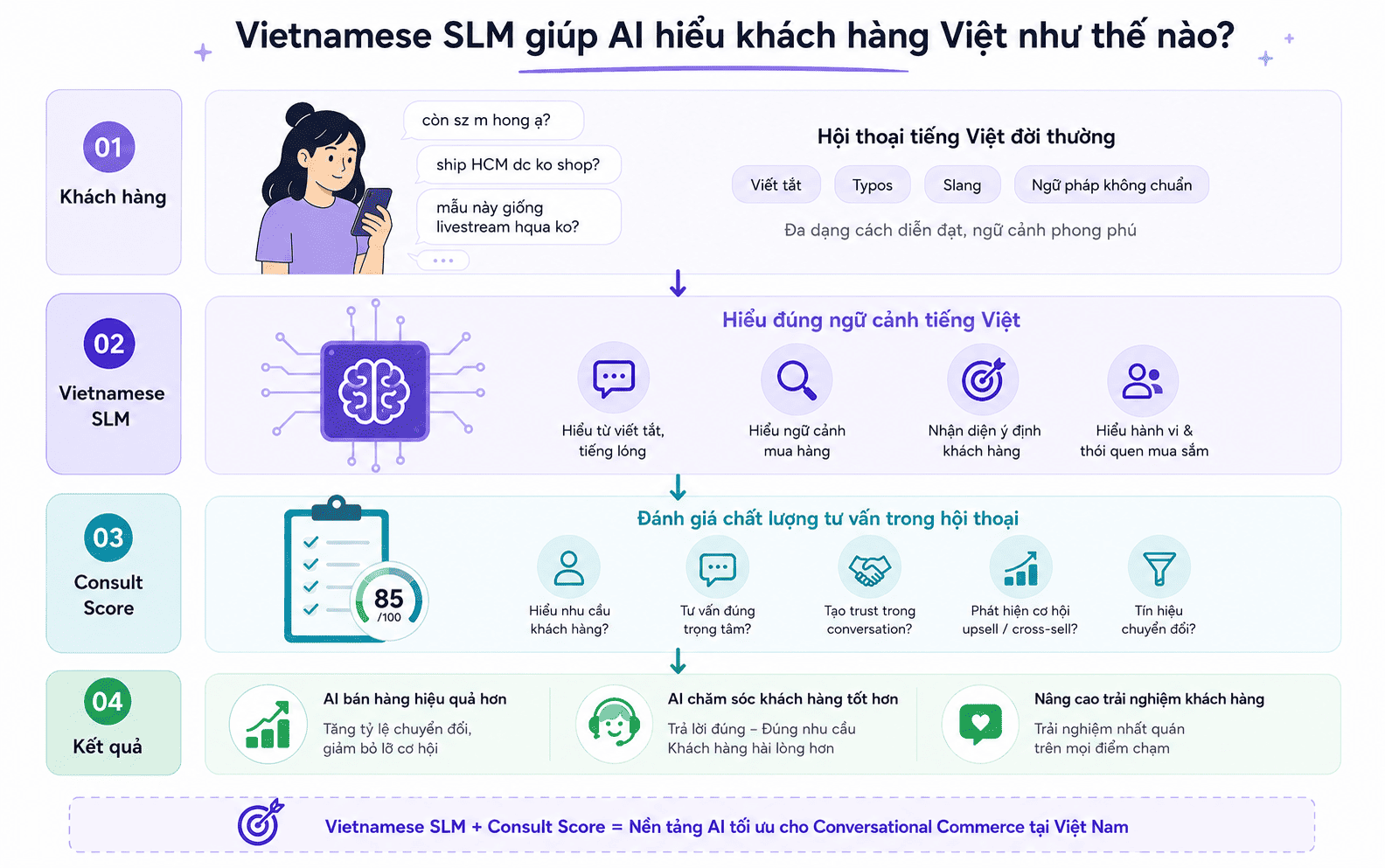
To provide accurate evaluations, AI must understand not only conversational content, but also sales context, customer needs, objection handling capabilities, trust-building levels, and conversion signals appearing throughout the conversation.
3. Why Are Small Language Models Crucial for Conversational Commerce?
Most international AI models are trained on English or generalized multilingual datasets. Meanwhile, the conversational commerce environment in Vietnam contains distinct nuances.
Customers frequently message: "còn sz m hong", "ship HCM dc ko", "mẫu này giống livestream hqua ko shop".
While human agents understand this naturally, it presents a difficult challenge for AI unless fine-tuned on the right data. Consult Score is built to process precisely these scenarios. The model reads the conversation and automatically evaluates whether the agent understands customer needs, asks for the right insights, delivers focused advice, builds trust within the conversation, or misses upsell and cross-sell opportunities.
Accurately grasping Vietnamese context enables Conversational AI systems to interact more naturally with customers and minimize intent misinterpretations.
4. AI Automatically Benchmarks Advisory Quality at Scale
Instead of requiring businesses to manually inspect every conversation's quality, AI can automatically benchmark advisory quality at scale. This is especially vital for sales and customer care departments operating across multiple channels.
A small business with a few sales representatives can generate hundreds of daily conversations across:
Website
Facebook
Zalo
E-commerce platforms
Livestream commerce
After about 10 days of operation, conversation volumes can reach thousands of sessions. Manual quality control becomes virtually impossible.
Consult Score enables businesses to:
Automatically evaluate advisory quality
Measure first response times
Analyze resolution rates
Assess conversion rates
Identify root causes of failed conversations
Discover high-performance conversation patterns
As a result, businesses can understand how effectively their team operates, what the market cares about, and why certain conversations achieve better conversion than others.
5. Understanding Vietnamese Context Enhances Customer Experience AI
Beyond evaluating advisory quality, Vietnamese SLM enhances customer experience across the entire interaction journey. When AI understands Vietnamese contexts and actual buying behavior, businesses can deliver a more consistent experience across multiple touchpoints—from consultation and support to post-sales care. This is increasingly critical in conversational commerce environments, where every chat directly impacts conversion rates and customer trust.
Consequently, Customer Experience AI goes beyond replying to customers, helping businesses maintain consistent experiences across diverse touchpoints.

6. Easy AI Builds AI-Native Systems for Enterprises
This represents a new advancement in the AI-native Platform development strategy pursued by Easy AI. Instead of building a generic "know-it-all" AI, Easy AI focuses on developing specialized Vietnamese SLMs for specific workflows in Sales, Customer Service, and E-commerce.
The operational workflow follows a continuous feedback loop: omnichannel data is consolidated into a single system, AI automatically classifies and labels data, identifies high-performing human agent behaviors, continues training task-specific models, and deploys AI into live environments to keep learning from real-world data.
This enables AI systems to gradually reach an operational scale that would be impossible through manual methods.
7. Small Language Models (SLMs) Optimize AI Deployment Costs
A major advantage of Vietnamese SLM is its ability to optimize deployment costs. This fits the Vietnamese and Southeast Asian markets well, where businesses require practical, easy-to-deploy AI solutions that generate fast value.
Criteria | LLM (Large Language Model) | Specialized Vietnamese SLM / SLM |
|---|---|---|
Goal | Solves broad, generalized tasks | Optimized for specific problems like Sales, CS, Conversational Commerce |
Business Logic Understanding | Requires heavy prompting and guidance | Trained directly on domain-specific business contexts |
Response Speed | Slower with large models | Faster, suitable for real-time operations |
Operating Cost | Higher due to computational resource consumption | Lower, suitable for large-scale deployment |
Enterprise Fine-tuning | Time-consuming and expensive | Easily customizable by industry or enterprise |
On-premise Deployment | More difficult to deploy | Flexible deployment on private cloud or on-premise |
Data Security | Often relies on third-party infrastructure | Easier control over internal data |
Best Suited For | Multipurpose AI assistants, research, content creation | Sales AI, CS AI, Vietnamese AI Chatbots, conversation evaluation |
Effectiveness in VN | Good at a general level | Optimized for Vietnamese data, language, and user behavior |
8. Conclusion
In the early stages of GenAI, businesses often cared about what AI could do. In the next phase, however, the more important question is which AI actually helps the business grow more effectively.
This explains why Vietnamese SLM is becoming a key development path for sales AI, customer care AI, Conversational AI, and enterprise AI platforms in Vietnam.
With Vietnamese Sentiment SLM and Consult Score SLM, Easy AI is step-by-step constructing a specialized AI ecosystem tailored to operational challenges facing Vietnamese businesses. This forms the foundation to continue developing additional small language models for Sales, CS, E-commerce, and conversational commerce—better aligned with real data, behaviors, and operational needs of the Vietnamese market.
Industry Terminology Glossary:
- Sentiment Analysis: An AI technique used to identify customer emotions in conversations, such as positive, neutral, or negative.
- Conversational Commerce: A sales model conducted through messaging interactions on Facebook, Zalo, Website, Livestream, or other messaging platforms.
- Benchmark: The process of measuring, comparing, and evaluating performance based on defined criteria or reference standards.
- Conversation with Conversion: Conversations leading to desired outcomes such as placing orders, leaving contact details, booking consultations, or completing conversion actions.
- Vietnamese Sentiment SLM: A small language model developed by Easy AI, trained specifically to analyze customer sentiment in Vietnamese conversations.
- Consult Score SLM: An AI model developed by Easy AI to evaluate the advisory quality of Human Agents and AI Agents based on uncovering needs, handling objections, building trust, and creating conversion signals.
- GenAI (Generative AI): A category of AI technology capable of generating new content such as text, images, audio, video, or code based on trained data.
- Customer Experience AI: AI systems used to personalize interactions, elevate service quality, and improve customer experience across the buyer journey.
- Human Agent: Human sales or customer service personnel directly interacting with customers.
- AI Agents: AI personnel capable of automatically performing tasks such as consulting, customer support, data analysis, or process execution according to set objectives.
Topics