

AI-Native Platform – The Key to Growth in the AI Era
1. What Is an AI-Native Platform?
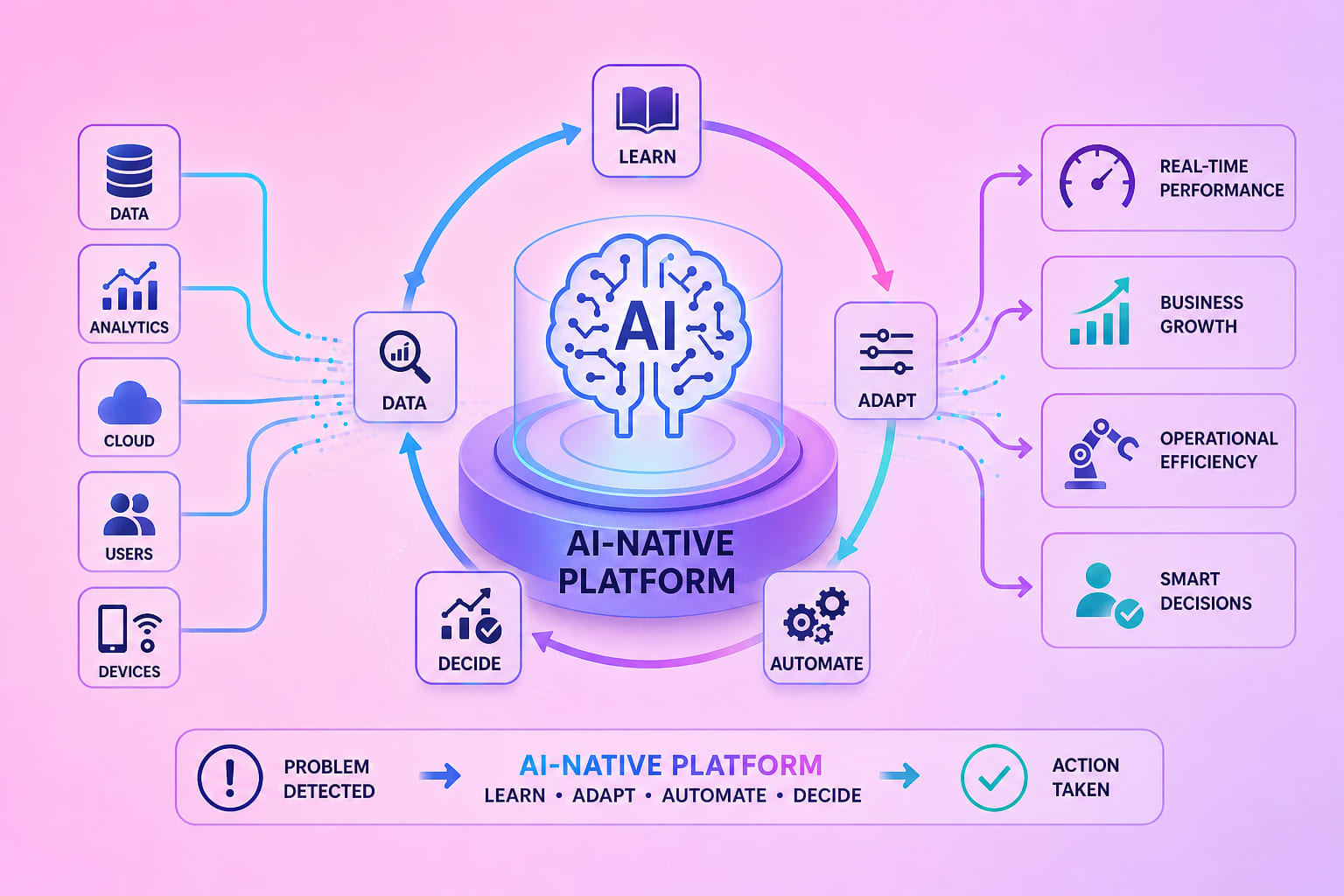
Understanding what an AI-native platform is requires looking at it from an architectural perspective. It is a system architecture in which AI is integrated from the ground up and plays a central role in orchestrating operations across the system.
Unlike traditional systems, an AI-native platform can:
- Learn from data continuously
- Adapt in real time
- Automate end-to-end processes
- Support intelligent decision-making
This approach significantly shortens the gap between identifying an issue and responding to it, improving operational efficiency in fast-changing business environments.
2. AI-Native Platform vs. AI-Enabled: What’s the Difference?
AI-native platforms and AI-enabled systems are two different approaches to applying artificial intelligence in business. The key difference lies in how deeply AI is integrated into the system.
An AI-native platform is designed from the ground up with AI as a core operating capability, while an AI-enabled system adds AI to an existing system to support specific tasks.
| Criteria | AI-Native Platform | AI-Enabled |
|---|---|---|
| Role of AI | AI is the core operating capability, directly involved in analysis, decision-making, and execution | AI is an added capability that supports specific parts of an existing workflow |
| System Architecture | The system is designed from the ground up around data, AI models, automated workflows, and continuous learning | The existing system remains largely unchanged, with AI added to selected functional areas |
| Learning Capability | Continuously learns from data, user behavior, and real-world operational outcomes | More limited, often relying on rules, predefined scenarios, or manual updates |
| Level of Automation | Can automate a significant portion of the process, from identifying needs and handling tasks to recommending actions | Primarily assists employees, while most decisions and actions remain human-led |
| Decision-Making Speed | Analyzes and responds in real time, making it suitable for rapidly changing business environments | Relies more heavily on reports, aggregated data, and approval processes |
| Personalization | Personalizes experiences based on individual customers, context, and interaction timing | Personalizes based on customer segments or predefined scenarios |
| Data Integration | Data is connected across the system and serves as the foundation for AI-driven operations | Data is often distributed across multiple systems, making it harder to synchronize and fully leverage |
| Scalability | Scales flexibly with data volume, task complexity, and operational requirements | Scaling is slower because it depends more heavily on existing infrastructure and processes |
| Value Creation | Directly contributes to revenue growth, operational efficiency, and customer experience | Primarily improves productivity or reduces workload in specific areas |
| Competitive Advantage | Creates compounding advantages over time as the system continuously learns and improves | Easier to replicate because the value often resides in individual features or tools |
For example, in customer service, an AI-enabled system might be a chatbot that answers basic questions on a website. An AI-native platform, by contrast, can support the broader customer journey—from identifying customer needs and segmenting customers to recommending products, driving conversion, and capturing customer data.
AI-enabled systems optimize individual touchpoints, while AI-native platforms optimize the system as a whole. When data, intelligence, and actions are continuously connected, businesses can make faster decisions, deliver more personalized experiences, and drive more measurable growth.
3. Key Characteristics of an AI-Native Platform
- AI across the entire system: AI is integrated from the data layer to customer touchpoints, ensuring that actions are driven by a consistent analytical logic.
- Continuous learning from data: The system improves over time based on real-world data, increasing accuracy without relying solely on manual updates.
- Operational automation: A significant portion of operational processes can be handled by the system, from resource allocation to handling emerging situations.
- Real-time decision-making: Data is processed as events occur, which is particularly important for AI-powered e-commerce systems.
This is also the approach Easy AI takes when building and deploying AI solutions in real-world business environments. AI does not simply provide assistance; it actively participates in operations, from customer interactions to revenue optimization.
4. Why Do Businesses Need AI-Native Platforms for Growth?
| Aspect | Traditional Model | AI-Native Model |
|---|---|---|
| Decision-Making Speed | Relies on weekly or monthly reports, with data often lagging behind real-world market conditions | Data is analyzed in real time, allowing the system to recommend and execute actions as issues emerge |
| Customer Experience Personalization | Personalization is based on customer segments or predefined scenarios, resulting in relatively standardized experiences | Personalization is tailored to individual customers based on behavior and context at each interaction, optimizing the entire customer journey |
| Operational Efficiency | Highly dependent on employees and manual processes, increasing the risk of errors | Automates a significant portion of tasks, reduces reliance on manual work, and enables more consistent operations |
| Long-Term Cost | Costs increase with operational scale and headcount, making optimization more difficult as the business grows | Costs can become more optimized over time as the system learns and improves, creating operational leverage |
| Competitive Advantage | Easier to erode because similar operating models are widely available and difficult to differentiate over the long term | Builds compounding advantages from data and continuous learning, making the system harder to catch up with over time |
| Accessibility | Traditionally more suitable for large enterprises due to resource and infrastructure requirements | Can be implemented incrementally through specific business use cases, making it suitable for small and medium-sized businesses as well |
Adopting an AI-native platform allows businesses not only to optimize operations but also to build a foundation for long-term growth. This is particularly evident in AI-powered e-commerce, where response speed and personalization can directly influence revenue.
A real-world example is ERADO, an e-commerce furniture brand with a showroom network in Hanoi. The company implemented an AI Chatbot to automate website sales interactions, handling approximately 10,000 messages per month. The system can advise and support customers directly through chat and operate continuously without requiring a dedicated team to monitor and handle conversations manually.
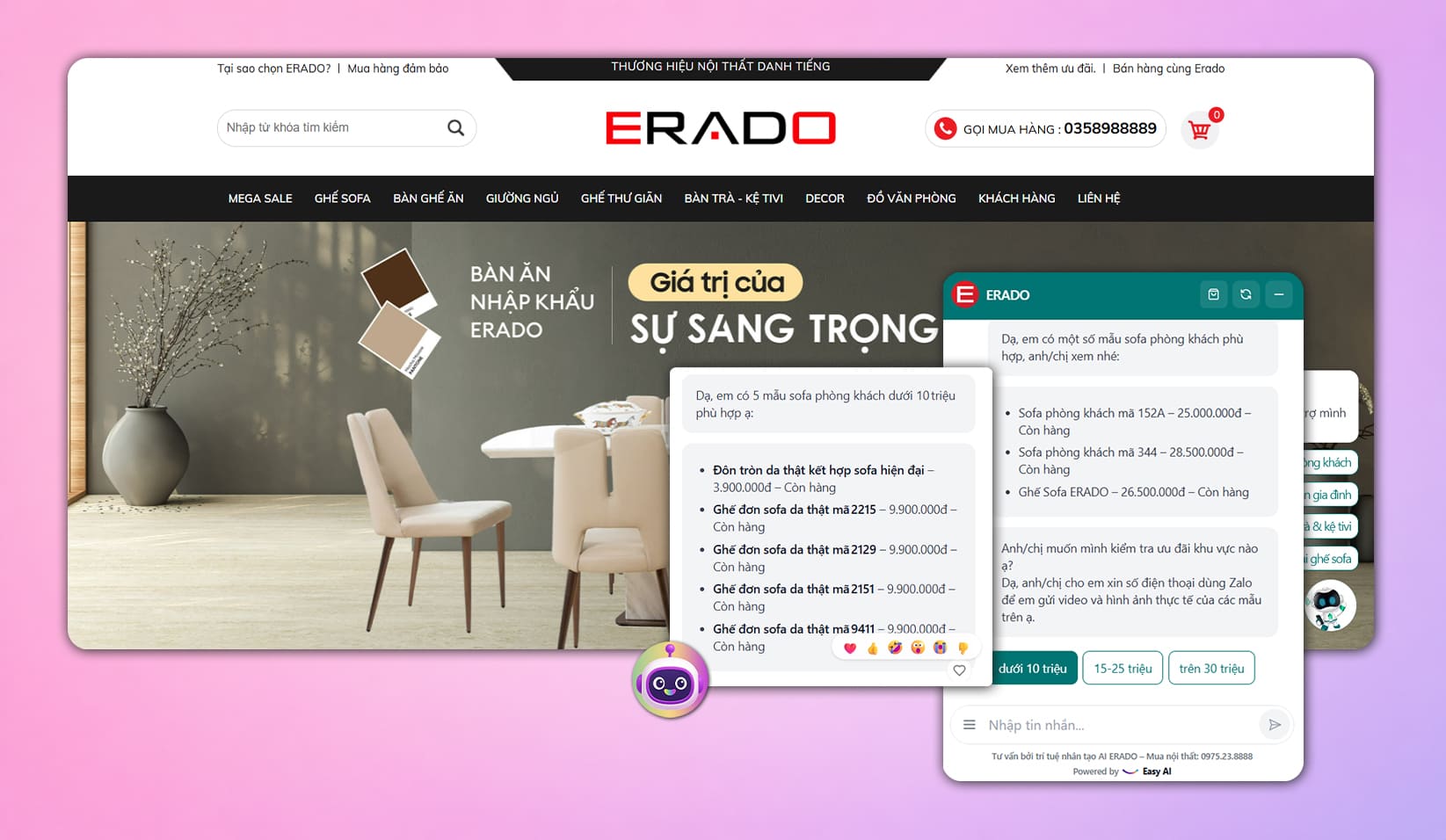
This case demonstrates that the value of an AI-native platform is not determined by deployment scale alone, but also by when and how the system is designed. When a system is built around data-driven operations and automation from the outset, businesses can create advantages faster and compound those gains over time.
5. AI-Native Platform Applications in Business
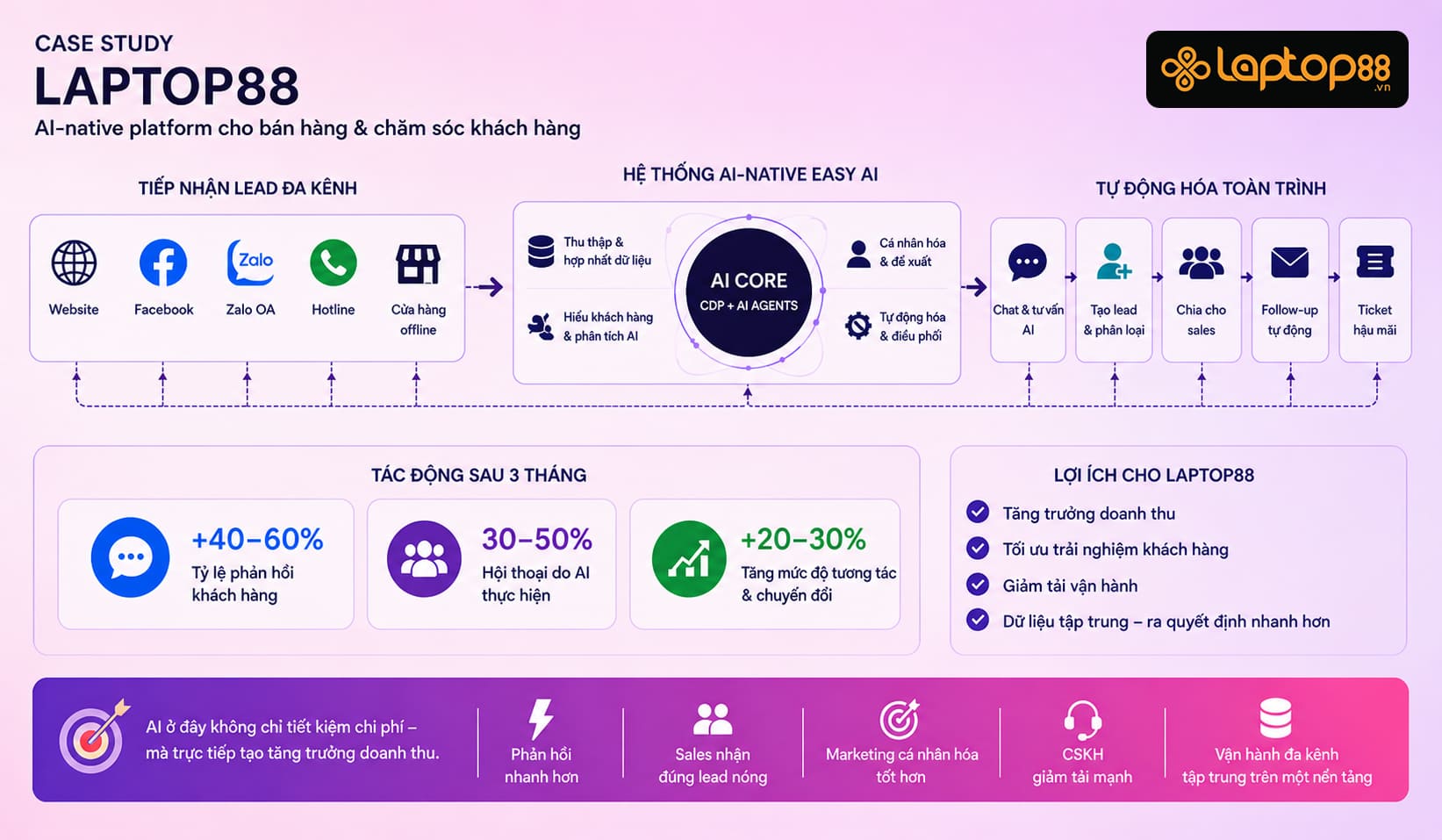
Case Study: Laptop88 (Technology Retail / Omnichannel E-Commerce)
Laptop88 is a laptop and technology retailer operating across its website, Facebook, Zalo OA, hotline, and physical stores. The company receives a large volume of leads, but customer data is distributed across channels, response times are slow, and scaling the sales advisory team is challenging. The issue was not a lack of traffic, but the ability to convert traffic into revenue.
After implementing AI, Laptop88 was able to respond to customers faster, route high-potential leads to the right sales representatives, improve marketing personalization, and significantly reduce the customer service workload through automation. At the same time, omnichannel operations were consolidated on a unified platform, helping the company optimize team performance.
In this case, AI did more than reduce operational costs. It directly supported revenue growth and strengthened the company's competitive capabilities.
6. Architecture of an AI-Native Platform
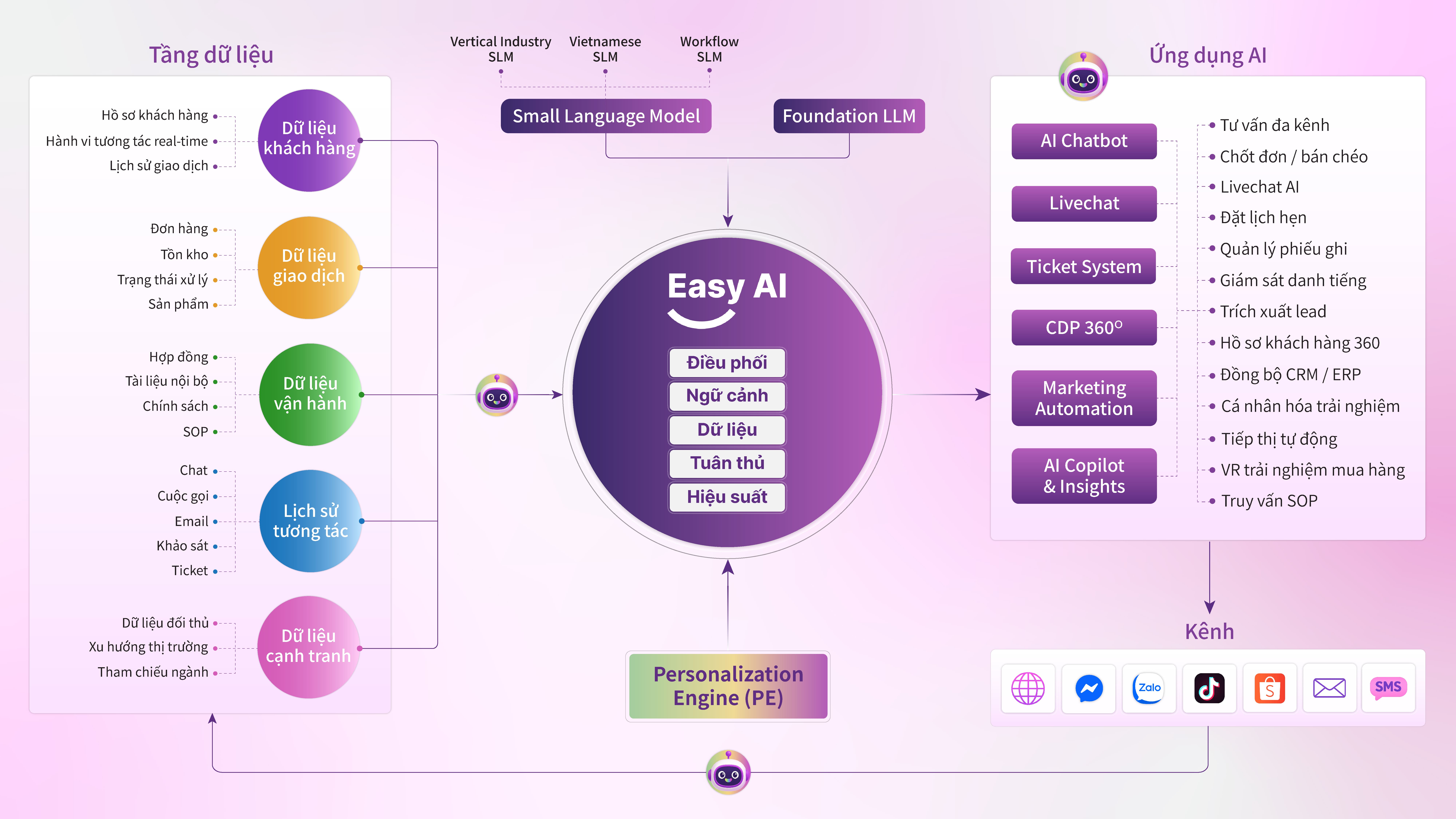
An AI-native platform is typically built across several functional layers to support data processing, decision-making, and automated operations.
6.1 Data Layer – Real-Time Data
- Continuously collect and process data from multiple sources, including websites, CRM systems, and operational systems
- Prioritize streaming or near-real-time architectures to reduce data latency
This layer provides the foundation for the system to respond quickly to customer behavior and emerging events.
6.2 Multi-Agent System
- Consists of multiple AI Agents responsible for different roles, such as advising, classification, prediction, and recommendation
- Agents coordinate through workflows to handle complex tasks
Instead of relying on a single model, the system distributes responsibilities across multiple agents to improve flexibility and scalability.
6.3 Knowledge Layer
- Standardizes data, product definitions, business processes, and business context
- Combines internal data with language models to help AI understand business requirements accurately
This layer plays a critical role in output quality, helping prevent incorrect or inconsistent AI responses.
6.4 Governance & Trust
- Ensure that AI outputs can be explained and understood
- Monitor and audit system activity
- Manage risks such as data quality issues and bias
This layer helps ensure that the system operates reliably, transparently, and in line with enterprise requirements.
7. Examples of AI-Native Platforms
Although the term AI-native platform is still relatively new in Vietnam, the underlying approach has already been applied across many familiar technology systems worldwide. What these systems have in common is that AI is integrated from the beginning and plays a central role in coordinating system operations.
In autonomous vehicles, AI processes sensor and environmental data to make real-time decisions. Modern search engines go beyond keyword matching to understand search intent and context. Digital content platforms, particularly streaming services, personalize user experiences based on behavior and interaction history.
In these models, the Personalization Engine plays a central role by analyzing data and recommending relevant content, helping maintain user engagement and optimize the value generated from each user.
These examples demonstrate that AI is no longer simply an additional layer within a system. Instead, it is becoming a core operating capability that directly creates value by optimizing user experiences and business performance.
8. Common Mistakes When Implementing AI
- Treating AI as a standalone tool: Adding AI to a small part of the system without changing the broader operating model
- Keeping the legacy system unchanged: Failing to redesign the architecture, limiting the potential impact of AI
- Fragmented and poorly standardized data: Preventing the system from learning and improving effectively over time
- Disconnected implementations without a clear strategy: Deploying isolated AI solutions that do not work together, reducing overall effectiveness
- Short-term expectations: Focusing only on immediate benefits while overlooking the long-term compounding value of an AI-native approach
9. The Future of AI-Native Platforms for Businesses
Over the next 3–5 years, the way businesses build and operate software is likely to change significantly. Traditional systems built around manual processes and slow update cycles will gradually lose their competitive advantage.
AI-native platforms will become an increasingly common approach, connecting data, intelligence, and actions from the outset. As AI takes on a more central role in operations, competitive differentiation will increasingly depend on how quickly businesses can adapt and how effectively they can leverage their data.
Organizations that are slow to transform may face increasing disadvantages in decision-making speed, operational efficiency, and growth.
10. Conclusion
AI-native platforms are evolving from a technology concept into a foundational approach to business operations. When AI is integrated at the system level, its value extends beyond improving efficiency to continuously learning from data and directly supporting revenue generation.
Competitive differentiation is no longer simply about whether a business uses AI, but how quickly it can deploy AI and how deeply it can integrate AI into real-world operations. When AI participates directly in customer interactions, data processing, and sales activities, the system can begin building compounding advantages over time.
In practice, major businesses such as Thế Giới Di Động, Điện Máy XANH, Rạng Đông, and the University Medical Center Ho Chi Minh City have moved into real-world operational deployment, where AI has become part of their day-to-day systems.
The question is therefore no longer whether businesses should adopt AI, but whether they have started moving toward an AI-native operating model.
Is your business ready to operate with an AI-native model?
Easy AI provides standardized AI-native solutions tailored to different industries. Contact Easy AI to speak with our experts and explore an AI solution for your business today.
Topics