




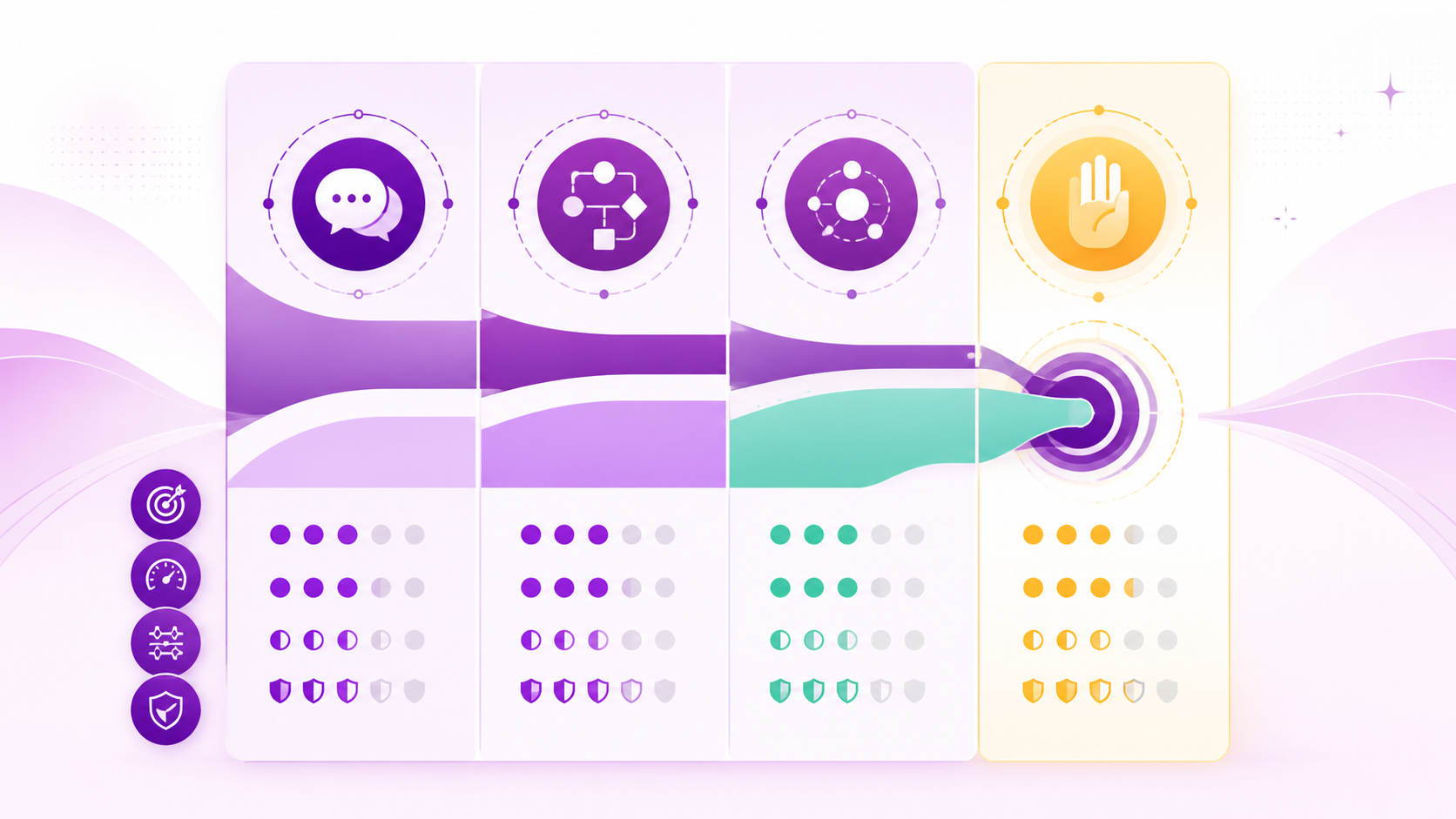
Beauty and Spa Booking Playbook: Automate Logistics, Keep Care Human

A booking tool can check a room and send logistics. It must not decide whether a service is suitable for a person or interpret an unexpected reaction.
Start with one request and fill the card below. Automation handles only verified logistics; a qualified person owns suitability, care, reactions, complaints, and material rebooking decisions.
Start with the beauty and spa booking card
Customer's service request in their words:
Service and logistics needed:
Sensitive question or prior reaction, if stated:
Decision (book / clarify / practitioner review / stop):
Person responsible for the next action:
Stop and handoff conditions:
First action: copy the customer's words into the card. If they mention suitability, a reaction, or a complaint, pause booking and obtain acceptance from the qualified practitioner or service manager.
Completion standard
- Start state: a permitted service request enters an assigned intake queue.
- End state: the request exits ineligible, becomes one verified appointment with accepted owners, or is reconciled after change/completion; approved care and rebooking states are recorded separately.
- Evidence: service catalog/version, intake limits, practitioner/room slot, booking ID, consent/permission, change log, handoff receipt, completion and issue status.
- Time horizon: from intake through the service-specific care and rebooking review window.
Roles and prerequisites
| Role | Owns | Approves | Receives handoff |
|---|---|---|---|
| Front-desk/intake owner | Logistics and customer communication | Booking exception | New request |
| Qualified practitioner | Suitability boundary and care content | Service/care decision | Sensitive question |
| Scheduling owner | Practitioner, room/equipment availability | Conflict recovery | Selected slot |
| Service manager | Complaints, reactions, retention review | Rebooking expansion | Issue escalation |
Before launch, define services eligible for automated booking, prohibited advice, required practitioner review, preparation and approved care content, practitioner/room/equipment sources, privacy-minimum reminder fields, change/rollback, emergency/issue route, backup owners, baseline, and thresholds.
In a small team, one person may combine front desk and routine scheduling. The qualified practitioner must still own suitability and care decisions, and the service manager or named backup must accept complaints and unexpected reactions.
Phase 1: establish the service boundary
- Owner: practitioner and service manager.
- Inputs: service catalog, local business rules, practitioner policy, approved content.
- Actions: classify bookable, clarification-required, practitioner-review, and unsupported services; list prohibited advice.
- Output: versioned eligibility and escalation matrix.
- Exit gate: every service has an intake owner and safe route.
- Escalation/rollback: remove a service from automated intake when policy/content changes or suitability cannot be bounded.
Phase 2: qualify logistics without giving suitability advice
- Owner: intake owner.
- Inputs: customer request, identity/permission, service matrix, minimum logistics.
- Actions: confirm service, location, preferences, practitioner needs, and required preparation; route sensitive/medical questions unchanged.
- Output: eligible booking request or accepted practitioner handoff.
- Exit gate: logistics are complete and any suitability question has a qualified owner.
- Escalation/rollback: do not infer condition or recommend treatment; stop slot offers until the handoff is accepted.
Phase 3: create one verified appointment
- Owner: scheduling owner.
- Inputs: eligible request, live practitioner/room/equipment availability, timezone, idempotency key.
- Actions: offer current choices, recheck selection, write one booking, return exact facts and change/help routes.
- Output: one booking ID/version or a visible failure.
- Exit gate: all capacity sources agree and confirmation is delivered.
- Escalation/rollback: suppress confirmation on partial write; reconcile duplicates/conflicts and route to front desk.
Zalo OA documents a vendor service-booking utility in Vietnam. It illustrates intake, confirmation, management, and reminders, not an Easy AI integration or attendance result. Review the source.
Phase 4: maintain care and issue precedence
- Owner: practitioner for approved care; service manager for issues.
- Inputs: booking version, completed service, approved care version, complaints/reactions, change and delivery events.
- Actions: invalidate old reminders, send minimum approved content, and suppress commercial/rebooking actions during unresolved issues.
- Output: current communication state and accepted issue route.
- Exit gate: no obsolete message remains; every sensitive issue has an owner.
- Escalation/rollback: withdraw outdated care content, alert the responsible practitioner/manager, and preserve the original message/event.
Phase 5: reconcile and consider rebooking
- Owner: service manager with practitioner rules.
- Inputs: verified completion, customer request, practitioner-approved interval where applicable, issues, permissions.
- Actions: close appointment outcome, determine eligible rebooking/no-action, capture correction, and review quality.
- Output: reconciled outcome and approved next state.
- Exit gate: no issue conflict, no unsupported “need” claim, and any handoff is accepted.
- Escalation/rollback: cancel rebooking actions on a new complaint, change, or permission withdrawal.
Fictional completed run
A fictional salon receives a request for a color service from customer Vy, who mentions a prior unexpected reaction. Intake owner Hana preserves the wording and pauses booking; practitioner Leo accepts the handoff and advises an in-person consultation under the salon's policy without giving a diagnosis. Scheduling owner books consultation C-317 after verifying Leo, room, and ICT slot. After the consultation is marked complete, only the approved non-clinical preparation note is sent. No rebooking action is created because no service was performed and the customer did not request one.
Customer's service request in their words: Vy requests a color service and says they had a prior unexpected reaction
Service and logistics needed: In-person consultation with Leo, an available room, and a verified ICT time
Sensitive question or prior reaction, if stated: Prior unexpected reaction; wording preserved without interpretation
Decision (book / clarify / practitioner review / stop): Practitioner review before any service booking
Person responsible for the next action: Hana obtains acceptance; Leo decides the consultation route; scheduling creates consultation C-317
Stop and handoff conditions: No diagnosis, service recommendation, or rebooking; stop automated messages if a complaint or new reaction appears
Handoff, QA, and measurement
| Trigger | Owner and timing | Context and fallback |
|---|---|---|
| Suitability or sensitive question | Qualified practitioner, before booking | Keep original wording, service, and history supplied by the customer; use consultation or a manual route |
| Unexpected reaction or complaint | Service manager, under the team's immediate-response policy | Keep service, practitioner, time, and customer wording; stop messages and follow approved emergency guidance |
| Capacity or partial-write conflict | Scheduling owner, before confirmation | Keep booking key and practitioner/room states; hold for front-desk review |
QA checks: current service matrix; no medical/suitability advice; practitioner/room/equipment verified; one booking; minimal reminder content; old versions cancelled; issues suppress commerce; outcome reconciled.
| Metric | Definition | How the team uses it |
|---|---|---|
| Valid booking rate | Bookings meeting service, practitioner, capacity, identity, and confirmation rules / booking attempts | Scheduling owner reviews weekly against the pre-pilot audit and a launch threshold set in advance |
| Accepted escalation rate | Sensitive or issue handoffs accepted in target / sensitive or issue handoffs | Service manager reviews weekly against the pilot and a pre-set pause threshold |
| Rebooking integrity | Rebooking actions with verified completion, permission, no issue, and approved basis / rebooking actions | Service manager reviews weekly against the pilot and a threshold set before expansion |
Failure signals include unsupported suitability language, practitioner/room conflict, sensitive detail in reminders, stale care content, rebooking during an issue, and unaccepted escalation. Pause the affected service and repair policy, content, or ownership.
What to do after completion
Use the appointment operations playbook for the shared booking contract, the appointment reminder template for one record, and customer retention for metric boundaries.
Evidence and limitations
No medical or suitability advice, attendance, retention, practitioner availability, integration, or Easy AI capability is claimed.