




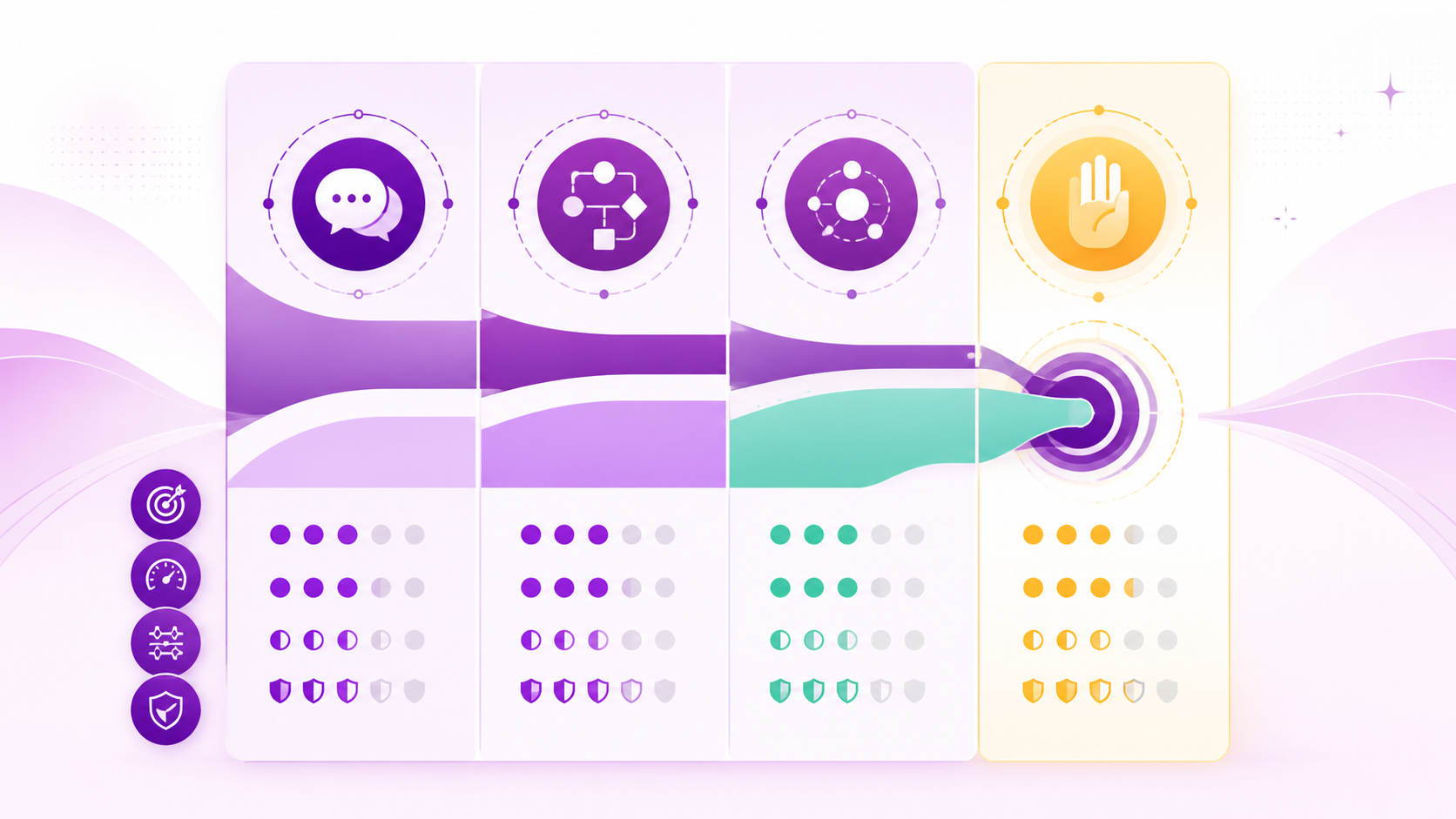
AI-Assisted Objection Handling Playbook: Answer, Escalate, or Stop

An objection is not a line to defeat. It may be an evidence request, constraint, misunderstanding, negotiation, or decision to stop. Use the five-step response card below to classify it, choose a response, check evidence, reply, and either hand off or close—never pressure disguised as assistance.
Completion standard
- Start state: an assigned owner has the buyer's exact concern and interaction permission.
- End state: the concern is answered from current evidence, accepted by a specialist, or closed at the buyer's request.
- Evidence: original wording, classification, source/version, approval or handoff receipt, and final state.
- Time horizon: respond within the approved service target; never trade accuracy for speed.
Roles and prerequisites
| Role | Owns | Approves | Receives handoff |
|---|---|---|---|
| Seller | Clarification and buyer response | Non-material response | Buyer correction |
| Evidence owner | Source currency | Approved wording | Source gap |
| Authorized specialist | Material commitment | Price/security/legal answer | Escalation packet |
Before starting, define response classes, approved sources and expiry, material-commitment allowlist, stop rules, acceptance targets, and rollback for drafted or recorded answers.
In a small team, the seller may also maintain ordinary sources and review routine replies. Price, security, legal, and other material commitments still need the person with current authority. First action: copy the five phase headings and paste the buyer's exact concern under phase 1 without paraphrasing it.
See the card in a completed run
A fictional procurement lead asks whether a quoted service includes weekend coverage. The current scope document is ambiguous, so seller Linh labels the case evidence request, avoids promising coverage, and transfers the original question, quote version, and source gap to operations owner Tom. Tom accepts within the team target and confirms that weekend coverage requires a separate scope. Linh sends the bounded answer and records the buyer's decision to review it.
Phase 1: classify without assuming
- Owner: seller.
- Inputs: buyer wording and context.
- Actions: choose
clarification,evidence request,constraint,negotiation,stop, orunknown; preserve exact language. - Output: provisional class and confidence.
- Exit gate: seller accepts the class or asks one neutral question.
- Escalation/rollback: reset to
unknownwhen context changes; stop immediately when permission ends.
Phase 2: choose the response mode
- Owner: seller; specialist owns material modes.
- Inputs: accepted class, authority rules, buyer intent.
- Actions: select clarify, sourced answer, acknowledge, escalate, or stop.
- Output: response plan with owner.
- Exit gate: the mode fits authority and does not treat “no” as a persuasion target.
- Escalation/rollback: withdraw unapproved negotiation/comparison and create a specialist packet.
Microsoft documents objection detection and escalation for one vendor agent; NIST describes human oversight and override. These support mechanisms, not performance claims. Microsoft, NIST.
Phase 3: retrieve and verify evidence
- Owner: evidence owner.
- Inputs: response plan and source registry.
- Actions: verify scope, version, expiry, applicability, and approved wording.
- Output: evidence packet or explicit gap.
- Exit gate: every material sentence is supported and within scope.
- Escalation/rollback: invalidate stale drafts and state the limit when evidence is absent.
Phase 4: respond and confirm
- Owner: seller or authorized specialist.
- Inputs: verified packet and channel context.
- Actions: answer the concern, name limits, offer one choice, and invite correction.
- Output: reviewed response and buyer disposition.
- Exit gate: buyer receives an accurate answer/limit and next state is recorded.
- Escalation/rollback: correct a sent factual error visibly; do not silently overwrite history.
Phase 5: close, hand off, and learn
- Owner: seller; manager owns QA.
- Inputs: disposition, corrections, and handoff events.
- Actions: confirm specialist acceptance or close; sample errors and update sources/rules.
- Output: accepted ownership or final close plus review record.
- Exit gate: no unowned commitment or queued pressure remains.
- Escalation/rollback: manager reassigns timed-out handoffs; automation remains paused until acceptance.
Use this response and handoff card
| Trigger | Severity | Owner | Required context |
|---|---|---|---|
| Price/security/legal commitment | High | Authorized specialist | Exact wording, source/version, gap |
| Factual correction | High | Seller manager | Sent answer and verified correction |
| Handoff timeout | Medium | Sales manager | Packet and attempted owner |
| Trigger | Respond by | If unresolved |
|---|---|---|
| Price/security/legal commitment | Before reply | State limit; no commitment |
| Factual correction | Same service window | Pause related answers |
| Handoff timeout | Team target | Assign backup |
QA checks: preserve buyer wording; allow unknown; current sources; correct authority; visible limits; accepted handoff; stop respected; corrections retained.
| Metric | Definition | Baseline | Decision threshold |
|---|---|---|---|
| Supported-answer rate | Answers fully supported by current approved sources / answers sampled | Pilot sample | Set before expansion |
| Accepted escalation rate | Escalations accepted within target / escalations | Pilot sample | Set before launch |
| Correction rate | Buyer- or reviewer-confirmed factual corrections / responses sampled | Pre-pilot audit | Pause threshold pre-set |
| Metric | Review owner | Cadence |
|---|---|---|
| Supported-answer rate | Evidence owner | Weekly pilot |
| Accepted escalation rate | Sales manager | Weekly |
| Correction rate | Enablement | Monthly |
Failure signals include repeated unknown without routing, stale sources, low handoff acceptance, buyer stop violations, and recurring corrections. Pause the affected class and repair ownership or evidence.
What to do after completion
Define broader escalation with the human-handoff guide, return to sales discovery when the concern reveals an unknown job, or record accepted actions with the post-meeting template.
Evidence and limitations
No win-rate improvement, product capability, legal/security assurance, integration, or Easy AI capability is claimed.