
In the digital era, artificial intelligence (AI) is no longer a distant concept but has become an essential tool, providing significant competitive advantages for businesses. Two commonly mentioned terms are Machine Learning and Deep Learning. Although often used interchangeably, they play distinct roles and serve different purposes in business environments. This article dives into the differences between Deep Learning and Machine Learning and how each contributes to business growth and success.
Machine Learning: The Foundation of Artificial Intelligence
Machine Learning is a broad field within AI that focuses on developing algorithms that allow computers to learn from data without being explicitly programmed. Instead of following predefined instructions, Machine Learning systems are “trained” using large datasets, enabling them to identify patterns, relationships, and make predictions or decisions.
The basic Machine Learning process typically includes:
-
Data collection and preparation: The most critical step. Data must be collected, cleaned, and preprocessed to ensure quality and suitability for training.
-
Algorithm selection: Depending on the problem and data characteristics, different algorithms are used. Common ones include:
-
Linear Regression: Predicts continuous values based on linear relationships
-
Logistic Regression: Predicts probabilities of outcomes (e.g., whether a customer will purchase)
-
Decision Trees: Classifies or predicts outcomes based on decision rules
-
Random Forests: A collection of decision trees that improves accuracy
-
Support Vector Machines (SVM): Finds optimal boundaries to separate data groups
-
K-Means: Clusters data into groups based on similarity
-
Model training: The algorithm learns from data and adjusts internal parameters to optimize predictions.
-
Model evaluation: The trained model is tested on new data to assess accuracy and generalization.
-
Deployment and monitoring: The model is deployed in real-world use and continuously monitored and retrained when needed.
In business, Machine Learning is widely used for:
-
Customer behavior analysis: predicting buying trends, segmentation
-
Fraud detection: identifying suspicious transactions
-
Demand forecasting: optimizing inventory and production
-
Predictive maintenance: reducing downtime
-
Spam filtering: classifying emails automatically
Deep Learning: An Advanced Evolution of Machine Learning
Deep Learning is a subset of Machine Learning, inspired by the structure and function of the human brain, particularly neural networks. Its key difference lies in the use of deep neural networks with multiple hidden layers. These layers allow models to automatically extract complex features from raw data without manual feature engineering.
Common Deep Learning architectures include:
-
Convolutional Neural Networks (CNNs): Highly effective for image and video processing, used in face recognition, image classification, object detection
-
Recurrent Neural Networks (RNNs): Suitable for sequential data such as text, time series, and audio; used in NLP and speech recognition
-
Transformers: A newer architecture that excels in natural language processing tasks such as translation, summarization, and text generation
Deep Learning has unlocked new possibilities for AI, especially in solving complex problems that traditional Machine Learning struggles with, including:
-
Natural Language Processing (NLP): understanding and generating human language (chatbots, sentiment analysis, translation)
-
Computer Vision: enabling machines to interpret images and videos
-
Speech Recognition: converting speech to text
-
Advanced recommendation systems: delivering more accurate personalized suggestions
Deep Learning vs Machine Learning in Business: Differences and Complementarity
Although Deep Learning is a subset of Machine Learning, they serve different roles:
-
Problem complexity: Machine Learning is suited for structured data and moderately complex problems.
Deep Learning is better for complex problems and unstructured data (images, audio, text). -
Data requirements: Machine Learning works well with moderate datasets.
Deep Learning requires massive datasets due to its large number of parameters. -
Computational resources: Machine Learning can run on standard systems.
Deep Learning requires high computational power, often GPUs or cloud infrastructure. -
Explainability: Machine Learning models are easier to interpret (e.g., decision trees).
Deep Learning models are often “black boxes” and harder to explain.
Despite these differences, they complement each other. In many cases, businesses combine both approaches—for example, using Machine Learning for initial analysis and Deep Learning for more complex tasks.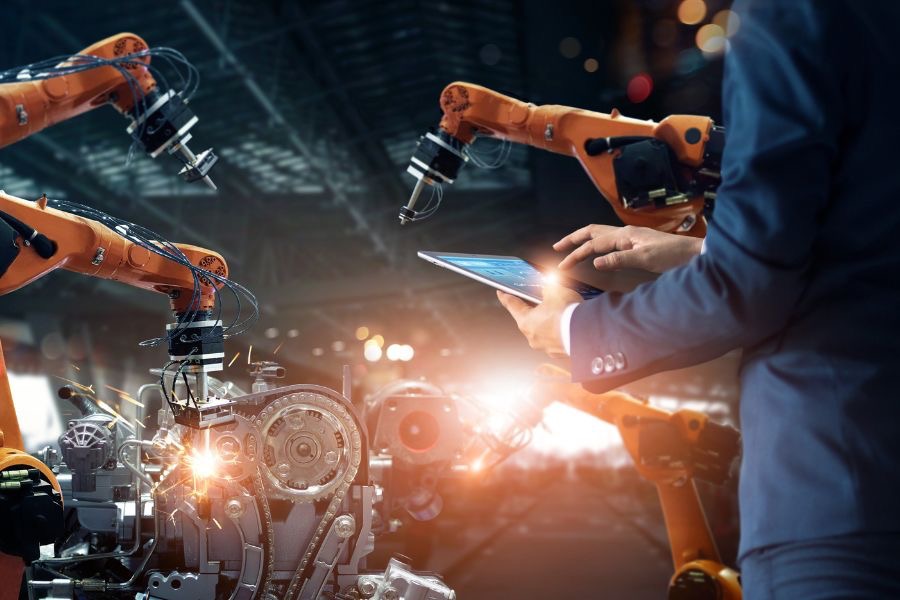
Choosing the Right Technology for Your Business
The choice between Deep Learning and Machine Learning depends on:
-
The type of problem
-
Available data volume and quality
-
Financial and technical resources
-
Business objectives
Many businesses start with Machine Learning for simpler problems and gradually move to Deep Learning as their needs and resources grow. The key is understanding each technology and selecting the right approach for specific use cases.
Easy AI Agents – Pioneering the Integration of Deep Learning and Machine Learning
In summary, both Deep Learning and Machine Learning are critical pillars of AI, enabling breakthrough capabilities for businesses. Machine Learning provides a strong foundation for structured data analysis and rule-based decision-making, while Deep Learning unlocks the ability to process complex, unstructured data.

In this context, Easy AI Agents stands out as a pioneer, combining the strengths of both technologies to deliver comprehensive and optimized AI solutions for businesses. By leveraging Machine Learning for predictive analytics and Deep Learning for complex data processing such as images, language, and audio, Easy AI Agents helps businesses maximize AI potential, build sustainable competitive advantages, and accelerate growth in an increasingly competitive market. Mastering and effectively applying both Deep Learning and Machine Learning, with the support of leading partners like Easy AI Agents, is the key for businesses to succeed in the future.